I never asked artificial intelligence to write an entire song for me.
That did not make sense. If the system wrote the words, invented the melody, chose the structure, and made all the important decisions, where would I be in the result?
I would be listening to a song, but I would not really be writing one.
I decided early that I had to own the words and the ideas in my songs. This was partly a practical concern about authorship and copyright. More importantly, I loved writing them. Taking that away would have removed the reason I became interested in songwriting in the first place.
Songwriting Felt Like Designing Software
I spent more than thirty years developing software. I often built processes and applications for other people, beginning with a problem and gradually turning it into something structured and useful.
Songwriting activated a similar part of my mind.
A song has specifications, even when they are not written down. It has a subject, a point of view, a structure, a pace, and an emotional direction. A verse has a job. A chorus has another job. Words have to fit within phrases. Repetition can make an idea memorable, but too much repetition can make it dull.
None of this made songwriting mechanical to me. Structure gave the emotion somewhere to go.
There was also an important difference. In software, I usually built something for users, clients, or organizations. In songs, I was writing for myself. I could begin with a memory, a feeling, a family experience, or a question I could not easily express another way, and it beats having hours and days of design meetings, making the case, and debating ideas.
The Problem With the Musical Slot Machine
Suno gave me a way to hear my lyrics as songs. That was exciting, especially while I was still learning piano, guitar, and music theory.
But I did not want songwriting to become a slot machine: enter a prompt, pull the lever, and keep generating until a pleasing result appeared.
Sometimes a generated song sounded surprisingly good on the first listen. After hearing more AI-generated music, however, I began recognizing similarities. Certain melodic movements, vocal habits, arrangements, and emotional effects appeared again and again. It seemed so sloppy from the get-go.
A song could sound polished without having a strong identity of its own.
This did not make the tool useless. It changed how I wanted to use it.
Bringing My Own Musical Identity
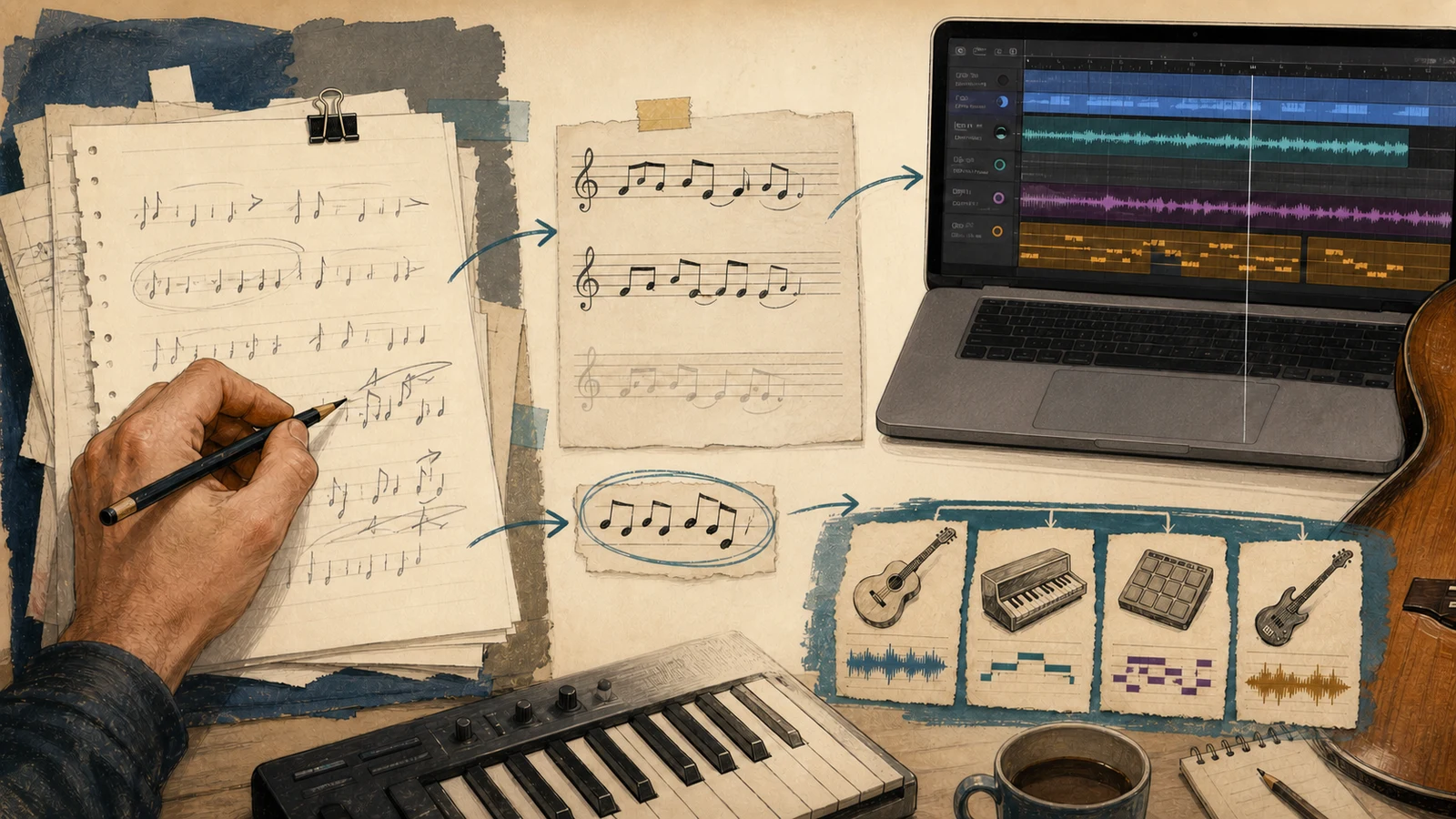
I began supplying a musical motif instead of asking Suno to invent everything. A motif can be small, but it gives a song a recognizable seed. I also used digital audio workstations to edit, organize, and clean up the result.
Over time, I added more of my own material and more deliberate decisions. I experimented with samples of my voice. I studied why one phrase felt natural to sing while another fought against the words. I paid attention to the stress and rhythm already present in the lyrics.
The goal was not to pretend that AI had played no role. The goal was to make sure it served a song that already had a human identity.
Why I Built a Deterministic Melody Tool
As a developer, I naturally began thinking about the process as a system.
Could the natural prosody of a lyric help shape its melody? Could stressed syllables, phrasing, rhythm, and emotional direction contribute to musical decisions? Could the process be repeatable instead of depending entirely on a new roll of the dice?
Those questions led me to develop MelodyCurve, a lyrics-first tool for creating unique, deterministic melodies. Deterministic does not mean that every song sounds the same. It means that the process follows understandable and repeatable rules. The songwriter can customize the result and remain responsible for the musical direction.
I will write more about MelodyCurve separately. Some of its internal methods are part of technology I am protecting, so I will explain what it enables without publishing the recipe.
For now, the important point is simple: I wanted to arrive at a melody through deliberate choices rather than lucky generation.
Copyright Made the Question More Urgent
As I became more serious about songwriting, I began studying copyright. I learned that saying a work is “AI-generated” does not answer the important questions. We have to ask what the person actually contributed.
Did the person write the lyrics? Did the person compose the melody? Did they perform, arrange, select, edit, and creatively modify the work? Or did they provide a short prompt and accept the output?
Those are very different creative processes.
Under current United States guidance, purely AI-generated material is not protected by copyright. Human-written expression can still be protected when a larger work also contains AI-generated material. Human selection, arrangement, and creative modification may also matter, depending on the particular work.
This is one reason I version-control my lyrics, melodic work, motifs, project files, revisions, and other evidence of process. It is also why I resist making simple legal claims about every AI-assisted song. The details matter.
This article describes my creative experience and is not legal advice.
When People Dismiss the Work
As AI music became easier to generate, people began calling much of it “AI slop.” I understand where that reaction comes from. There is a flood of material made with little thought or effort.
What hurt was having careful work placed in the same category automatically.
I might spend weeks writing and revising lyrics, developing a motif, testing musical ideas, editing in a DAW, and listening critically. Someone who saw the word “AI” could assume that none of this happened.
I cannot control every reaction. What I can do is be transparent about my process and continue increasing the amount of meaningful human authorship in every song.
I do not want credit for what the machine contributed. I want the human contribution to be visible, genuine, and substantial.
AI as Part of a Designed Process
My experience in software taught me that a tool is only one component of a larger system. The design of the process determines what the too I’m OKl is allowed to do, what the human must decide, and how the result is evaluated.
That is how I approach AI-assisted music.
The lyrics begin with me. The meaning begins with me. Increasingly, the motifs and melodies begin with me as well. AI can help explore accompaniment, instrumentation, and production possibilities, but it does not get to replace the reason the song exists.
If I were absent, it would no longer be my song.
In the next article, I will look more closely at signature melodies, prosody, and why repeatability can give songwriters more creative control.
Related: Does AI Music Need the Same Normalization Photography and Programming Went Through?
Reference: U.S. Copyright Office Artificial Intelligence Initiative