MIDI and lyrics can describe two very different sides of a song. MIDI can suggest motion, timing, emphasis, and musical shape. Lyrics can carry language, structure, memory, and human meaning. When I bring both into Orrery Glyph, the goal is not to illustrate a song literally. It is to give the artwork more of the song to respond to.
That raises an interesting question: how can musical information and written words add flavor and depth to fine art without turning the picture into a technical chart?
I think the answer begins by treating the song as a creative source, not as a set of instructions that must be displayed. Orrery Glyph receives information from the song, works within a chosen visual theme, and gives me material to examine and shape as an artist. I still decide what has presence, what feels forced, and what deserves to remain.
First, What Is MIDI in Plain English?
MIDI is not the recorded sound of a piano, guitar, singer, or orchestra. It is closer to a set of musical directions.
A MIDI file can describe events such as which notes occur, when they begin, how long they last, and how strongly they are played. Depending on the source, it may also include tracks, instrument choices, tempo information, and other performance details.
A useful comparison is a player-piano roll. The roll does not contain the sound of the piano. It contains information that tells the piano what to play. MIDI is far more flexible, but the basic distinction helps: it describes musical activity rather than storing the finished audio.
For visual art, that distinction is valuable. I do not need to copy the sound. I can consider the movement inside the music.
What Can Musical Movement Contribute to an Image?
Music moves through time, while a still image appears all at once. That difference creates a challenge, but it also creates an opportunity.
A melody may rise, fall, pause, return, or push forward. A passage may feel sparse and exposed, then become crowded and energetic. Some notes may arrive gently. Others may feel like an interruption. A repeated musical idea can create recognition even when the surrounding arrangement changes.
I can ask visual questions that grow from those qualities:
- Should the composition feel calm, restless, balanced, or unsettled?
- Where does the eye move first, and where does it pause?
- Does a repeated visual idea create rhythm or become predictable?
- Should one area feel quiet while another carries more energy?
- Can the image suggest a musical journey without becoming a graph?
The important word is suggest. I do not want a viewer to need technical knowledge of MIDI to appreciate the artwork. The musical source should deepen the visual experience, not become homework.
What Do Lyrics Add That MIDI Cannot?
MIDI can describe musical events, but it does not know that a falling leaf may represent change, that a cloud may hold a family memory, or that one line in a chorus carries the emotional center of a song.
Lyrics bring language into the process. They contain images, subjects, relationships, repeated phrases, sections, and shifts in point of view. They can move between the concrete and the abstract. A lyric may name a bird, a room, or a road. It may also express longing, uncertainty, gratitude, distance, or hope.
Song structure matters too. A verse may introduce a place or memory. A chorus may return to the central thought. A bridge may change the emotional direction. Repetition can mean more than repetition when the same words return after the listener has learned something new.
This gives me another set of visual questions:
- What is the lyric asking the listener to notice?
- Which subjects belong on the surface, and which should remain implied?
- Is the emotional center obvious, hidden, or changing?
- Does a repeated section need a repeated visual presence?
- Would open space express the lyric more honestly than another object?
Why Not Use Lyrics Alone?
Lyrics can be rich enough to inspire a painting, drawing, collage, or system-rendered work on their own. Artists have always responded to poetry and stories.
But a song is not only its words. The same lyric can feel tender, defiant, mournful, playful, or distant depending on the melody, tempo, phrasing, and performance. If I use only the words, I may understand what the song says while missing part of how it moves.
MIDI gives Orrery Glyph access to some of that musical shape without pretending that the file contains the whole human performance. Lyrics supply meaning and poetic structure. Together, they offer a broader creative source.
Why Not Use MIDI Alone?
A visual response to MIDI alone can be beautiful. It can reveal motion, density, contrast, repetition, and contour. It may even create an image with strong emotional character.
Still, musical motion does not automatically explain the human reason behind the song. A rising line might feel hopeful in one context and desperate in another. A quiet passage may express peace, grief, suspense, or simple restraint.
Lyrics help place that movement inside a world. They do not remove ambiguity, and I would not want them to. They give the visual process more context from which to make meaningful choices.
What Happens When MIDI and Lyrics Meet?
I think of MIDI and lyrics as two forms of evidence about the same song.
One describes aspects of musical motion. The other describes aspects of language and meaning. They may support each other, but they may also create productive tension. A sad lyric can sit over music that feels surprisingly light. A gentle phrase can arrive at a musically forceful moment. Those differences can give the artwork depth because they prevent a one-dimensional reading.
Orrery Glyph does not need to place every note and every word on the surface. That would be closer to documentation than fine art. Instead, the combined sources help define a field of possibilities inside a visual theme.
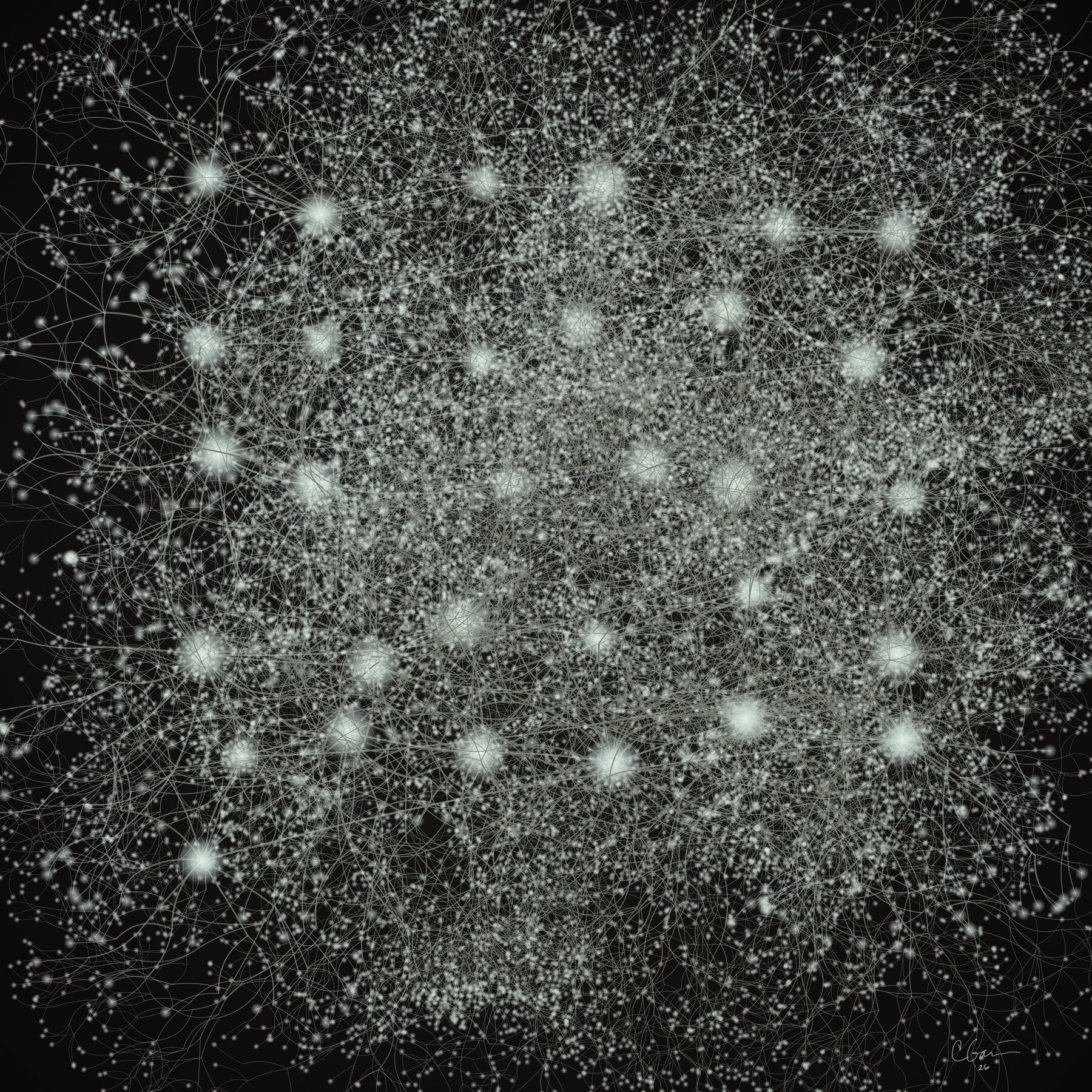
The chosen theme matters. Mycelial Networks creates an organic visual world of connected growth, branching relationships, and luminous paths. That metaphor can be useful when lyrics and musical movement need to feel related rather than merely placed side by side. The released Love in the Cloud visual series shows how a song can enter that world without becoming a literal picture of every note or line.
Bioluminescence sets a different expectation. It suggests a living presence in darkness, where light, pulse, reach, and atmosphere can carry the feeling of musical activity. It may be more fitting when a song calls for inner light, nocturnal space, breath, or living energy. One theme is not automatically better than another. The artistic question is which visual world can hold the song honestly.
Does the System Decide What the Song Means?
No. That is an important boundary.
The system can organize and respond to information that I provide. It can help reveal relationships, create continuity, and render possibilities within a theme. It cannot replace my lived connection to the song or my judgment about the result.
I choose the source material. I choose the theme and the artistic direction. I look at the output. I reject what feels decorative, mechanical, crowded, or emotionally false. I may revise the conditions, work on the result by hand or digitally, or decide that an image should remain a study.
This is why I use the terms computationally rendered and system-rendered. The system renders according to a designed process, but the artwork still depends on human intention, selection, and responsibility.
Is This Just Music Visualization?
Music visualization often helps people see measurable features of sound or performance. That can be useful and beautiful. Orrery Glyph has a different fine-art goal.
I am not trying to make a screen that proves where every note occurred. I am asking whether information from a song can participate in an artwork with composition, atmosphere, tension, restraint, and a life beyond the playback controls.
The finished work should not require the viewer to decode it. A person can simply experience the image. Knowing that the work grew from lyrics and MIDI can later add another layer, much like learning the story behind a painting.
Can the Same Song Lead to More Than One Artwork?
Yes, because a song can support more than one honest reading.
One artwork may respond to the whole song. Another may focus on a verse, chorus, bridge, or short lyrical moment. One may emphasize continuity across several pieces. Another may isolate a single emotional turn.
This does not mean that every possible result belongs in a collection. The ability to produce variation makes selection more important. I still have to decide which works stand alone, which belong together, and where the body of work should end.
The nine Love in the Cloud visual works offer a concrete example. The song supported a family of related images, but the existence of more possible results did not require me to keep all of them. A system can continue producing. I still have to establish the artistic boundary.
What Does a Viewer Need to Know?
Very little is required before looking.
A clear label can explain that the work is based on a song and that lyrics and MIDI contributed to the process. The title, medium, year, edition information, and a short statement of creative intent can provide useful context. If the song is available, a link can let the viewer hear it.
The viewer does not need my private mappings, dictionaries, calculations, or internal implementation details. Those belong to the protected craft of Orrery Glyph. The public story can remain honest without becoming a technical recipe.
I introduced the larger idea in I Come in Peace: How an Alien-Language Experiment Became Orrery Glyph. The important public promise is simple: I can explain the inputs, the selected theme, the kind of output, and my creative intention without exposing the machinery that makes the system distinctive.
What About Copyright and Permission?
For public artwork, the safest starting point is a song I wrote, a song I control, or material I have permission to use. Lyrics are creative writing, and MIDI can represent protectable musical expression. Using a familiar song as source material can raise rights questions even when the final image looks very different.
That is why ownership and permission belong near the beginning of the process, not at the end. A private experiment and a commercial fine-art release are not the same situation.
Does Explaining This Make Orrery Glyph Easy to Copy?
No. This article explains what I am trying to accomplish, not the protected mechanics that make Orrery Glyph behave as it does.
The general idea of responding visually to lyrics and MIDI is understandable. What makes my tool distinctive is how the information is interpreted, how the parts influence one another, how each theme creates its own visual language, and how the system remains consistent enough for me to make artistic decisions.
I have not published the private translation rules, scoring methods, internal structures, or rendering techniques needed to reproduce that behavior. A reader can understand the creative purpose without receiving a recipe for rebuilding the tool.
Orrery Glyph also represents more than software. Its identity comes from the visual themes I have developed, the body of artwork, the history recorded in my work, and the human judgment I apply to every result. Someone can imitate a broad idea. That does not give them the system, the artistic language, or the years of decisions behind it.
The Deeper Goal
I am not trying to turn music into a novelty picture. I am trying to let different forms of human expression meet.
The lyrics carry the words I chose. The MIDI carries part of the musical movement I shaped. The theme creates a visual world with its own expectations. The system helps these sources interact. Then I look, question, select, and take responsibility for what becomes art.
That combination can add flavor because the image is not responding to only one kind of information. It can add depth because motion, language, structure, and artistic judgment can agree, disagree, and enrich one another.
The result is not a picture of the song. It is another way of meeting it.