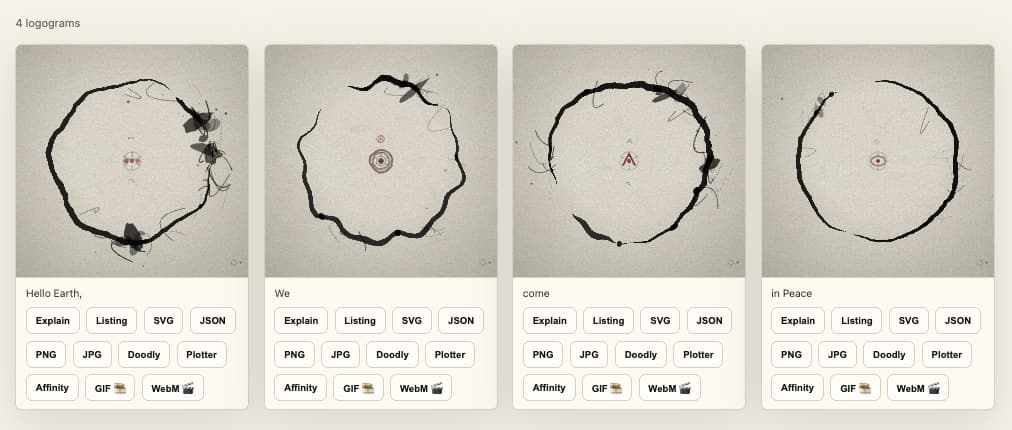
Orrery Glyph began while I was following 3I/ATLAS, an interstellar comet passing through our solar system. According to NASA, it is only the third known object discovered arriving from outside our solar system.
I was fascinated by the idea of a visitor from somewhere beyond our familiar neighborhood. My thoughts soon returned to the movie Arrival and its central question: if another intelligence appeared, how would we communicate?
What stayed with me was not only the story. It was the film’s treatment of linguistics and the circular writing used by the heptapods. The marks felt like language and art at the same time. They did not simply place one word after another on a straight line. They seemed to hold a complete thought inside a single form. The film’s linguistic ideas were developed with consultation from McGill linguist Jessica Coon, who has discussed the real challenge of trying to understand a completely unknown language.
That led me to a playful question of my own: what would an abstract “I come in peace” message look like?
I began imagining an original visual language—not the kind used to order food or give directions, but one that could feel meaningful before anyone knew how to read it. I wanted marks that suggested relationships, emotion, movement, and intention without spelling out every word.
The idea also connected several parts of my life. I spent two years studying architecture before building a long career in software engineering. Later, I began writing songs. I also draw and paint. To me, these fields are not as separate as they may appear. Architecture, software, music, and art all begin with structure, relationships, choices, and a desire to communicate something.
At first, Orrery Glyph was one visual abstraction language. Then the project began asking for more.
The problem with one visual language
A song is not one thing. It has words, but it also has rhythm. It has sections. A verse may remember the past, while a chorus makes a promise and a bridge changes direction. The melody may rise while the words describe loss. A quiet line can carry more emotional weight than a loud one.
My original visual language could express some of that, but it could not express everything. A circular glyph might be right for one song. Another song might feel like a field of stars. Another might need water, movement, figures, architecture, or something closer to a handmade mark.
I did not want to build a collection of unrelated effects. I wanted every visual form to grow from the same underlying interpretation of the song.
That became the turning point.
The hidden layer between a song and its image
I began separating two questions:
- What is happening inside the song?
- How should a particular visual style express it?
The first question belongs to an abstraction layer. The second belongs to a visual theme.
The abstraction layer is now the heart of Orrery Glyph. At a high level, it creates a reusable interpretation from selected parts of a song. Different visual themes can respond to that interpretation in their own ways.
I am deliberately keeping the inner workings private. The exact mappings, scoring, language rules, geometry, and composition methods are part of technology I have developed over time. But the general idea is easy to explain: the song is interpreted once, and many visual languages can respond to it.
This changed Orrery Glyph from one invented language into a broader song-to-art system.
Lyrics and MIDI tell different parts of the story
Lyrics tell me about meaning, relationships, memory, questions, and emotional direction. Song structure tells me how those ideas develop across verses, choruses, bridges, and other sections.
MIDI contributes something different. It can describe musical movement: pitch, timing, velocity, intervals, and density. The same lyric can feel very different when it is sung as a narrow, quiet melody or a wide melody filled with leaps.
When lyrics and MIDI are interpreted together, a visual work can respond to both what the song says and how the music moves.
That does not mean the software “understands” a song as a human being does. I do not make that claim. The system is an instrument I designed. It responds to selected evidence, and I remain responsible for the creative direction, theme, settings, curation, and final presentation.
One song can become a collection
This is where the idea became especially interesting to me as an artist.
One original song can produce a whole-song master image. Its verse, chorus, bridge, hook, and outro can also become coordinated individual pieces. The same interpretation can support a mosaic, a minimal seal, an animated work, or a full music video.
The pieces are not identical, but they belong together. They share a source and a visual history.
My “Love in the Cloud” series is an early example. It uses a constellation-like theme. The whole song and its sections become related fields of fine lines, orbital movement, and luminous points. That look is only one theme inside Orrery Glyph, but it helped me see the commercial and collectible potential of the larger system.
A collector might encounter the complete song artwork, choose a favorite section, or collect several related pieces. A music listener might experience the same material as an animation or video. The song becomes more than something heard once and then gone. It leaves a visual family behind.
Digital work can return to the hand
I am also interested in what happens after the digital image is created.
A generated study can become a guide for drawing, painting, collage, texture, or other physical materials. When I work by hand, I make new decisions about line, pressure, color, omission, scale, and imperfection. The physical work does not have to copy the digital version. It can argue with it, simplify it, or take it somewhere new.
That relationship matters to me. I do not see digital and handmade art as enemies. They can strengthen each other. The digital system can reveal structures I may not have imagined, while the hand can introduce judgment, material feeling, and accidents that software cannot reproduce in the same way.
Where AI fits—and where it does not
AI may assist parts of my broader creative process, including songwriting, exploration, or optional interpretation. But Orrery Glyph should not be confused with typing a prompt into a black-box image generator and accepting the first result.
The system grew from visual rules, software architecture, artistic choices, and repeated testing. Its core value is not that a machine can make an attractive picture. Its value is that different artworks can remain connected to the same song through a designed system.
That is also why I care about repeatability and provenance. If a piece belongs to a song and a series, I want to preserve enough information to identify that relationship without exposing private lyrics or guarded technology.
The experiment is still growing
Orrery Glyph started as an alien abstraction language. That origin is still visible in its name and in its first theme. But the project now has much more scope.
It can turn original songs into visual art, coordinated collections, and music videos. It can combine lyrical meaning with musical movement. It can remain digital or become a starting point for handmade work.
I am retired now, but I do not feel finished. I am building tools around music and fine art, learning what deserves to become a product, and discovering how technology can support a creative life without replacing the person at its center.
The first message was “I come in peace.” The message now is larger:
A song can live in more than one form.
Follow Orrery Glyph Into the Current Studio Work
See the system applied in the bioluminescent organism study, then follow the artistic decisions in Before the Painting and When the Parts Work but the Whole Does Not.