This music responsive generative art study began with a larger question: could fine-art representation become music’s next important creative layer?
This short film offers one concrete answer. The subject is the artwork and its relationship to the song. Orrery Glyph is one of the tools I used to make it.
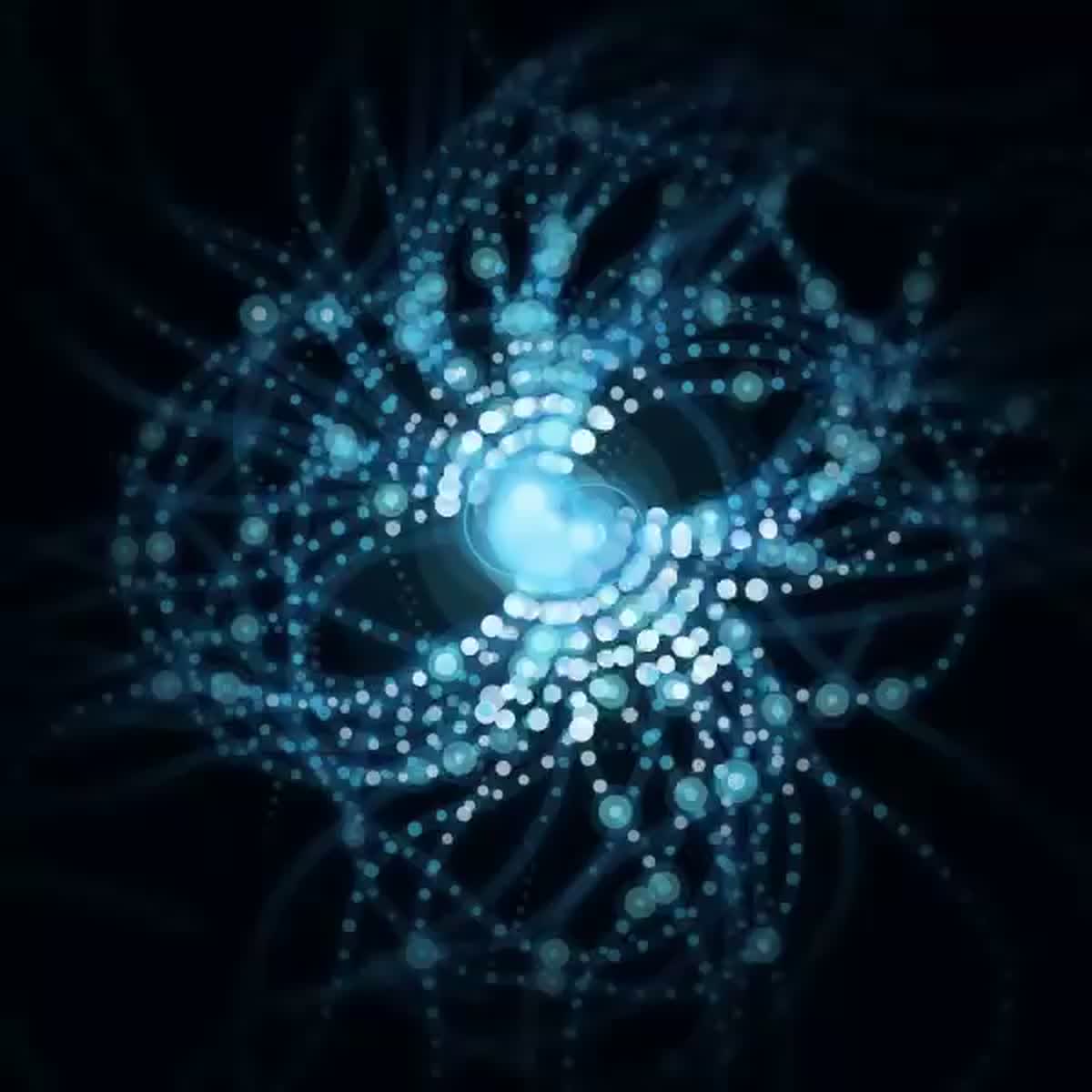
For A Little Leaf of Fall, Orrery Glyph created a luminous, organism-like visual form and animated it with the music. Filaments flare. Particles drift. Small satellites move through the field. The center seems to breathe.
The work does not show a leaf falling through a literal landscape.
It creates something closer to a bioluminescent organism awakened by the song.
How Music Responsive Generative Art Fits the Studio Practice
I do not treat Orrery Glyph as a separate creative identity or as the point of the work. It is part of my studio practice, alongside brushes, pigment, drawing tools, cameras, musical instruments, and digital painting tools.
Some of my work is physically handmade. Some is digitally handmade. Some is computationally or system-rendered from choices, rules, and source material I prepare. I expect to show work from all three approaches. The method may change, but the responsibility for the finished work does not.
A collector should be able to understand how a work was made without being asked to admire the machinery behind it. The useful question is not whether software was involved. It is whether the decisions, execution, selection, and final form produced an artwork worth living with.
Shortened Orrery Glyph demonstration for A Little Leaf of Fall.
The Artwork Came First
Many music visualizers place a decorative animation behind an existing track.
This experiment began from a different idea: the music should participate in the visual behavior.
For this work, I designed Orrery Glyph to use musical information as painting material. The system reads a timeline containing signals such as:
- beat phase;
- energy;
- pitch;
- velocity;
- note density;
- interval;
- attack and release;
- song section; and
- absolute playback time.
The Bioluminescence theme interprets those signals through its own visual language. It treats them as organism breath, filament flare, satellite motion, and particle drift.
The underlying tools handle duration and synchronization. I designed the Bioluminescence visual language and decided how the organism would behave within those boundaries.
What It Means for the Organism to Dance
The organism is not performing a human dance routine.
Its movement is closer to biological response:
- the central body expands and settles;
- luminous structures intensify and recede;
- dotted filaments carry energy outward;
- surrounding particles drift and gather;
- smaller bodies orbit or pass through the field; and
- changes in the music alter the visual pressure and pace.
The result feels alive because several types of motion respond together without moving identically.
The image remains recognizable throughout the shortened demonstration. The music does not replace it with a new random scene every few seconds. It animates one stable visual organism.
Why Bioluminescence Fits the Song
A Little Leaf of Fall could have produced an obvious image of a leaf.
The Bioluminescence treatment moves away from that literal solution. A leaf, like a small organism, carries patterns, veins, growth, motion, vulnerability, and a brief physical life. The animated work preserves those associations without drawing a botanical diagram.
The dark field gives the organism a place to appear gradually. Cool blue light suggests something living below the visible surface. The bright center creates presence, while the surrounding filaments make that presence feel connected to a larger environment.
This is an interpretation, not a scientific model of an organism.
Music Adds More Than Volume
A useful music-responsive work should not merely grow brighter whenever the audio gets louder.
Orrery Glyph’s sound model can use different musical properties for different visual decisions:
- pitch contour can affect vertical direction;
- velocity can affect visual intensity;
- interval size can affect the force or width of a gesture;
- note density can affect local visual density;
- direction can shift the field’s center of gravity;
- beat phase can coordinate recurring movement;
- attack and release can shape flare and settling; and
- song sections can change the larger behavior.
This allows the music to influence form, motion, and timing rather than acting as a single volume meter.
The same song information and system settings can also be treated deterministically. That matters if a fixed visual work, animation, or edition needs a reliable identity.
Human Direction Still Matters
The phrase “the system created it” can hide too much.
Human decisions remain present in:
- choosing the song;
- deciding whether the work should be literal or abstract;
- selecting the Bioluminescence theme;
- preparing the permitted source material and musical information;
- choosing settings and boundaries;
- reviewing movement;
- rejecting weak or misleading results;
- selecting the final visual state;
- choosing the shortened sequence;
- presenting the work; and
- deciding whether it is strong enough to enter the catalog.
Orrery Glyph is part of the medium. It does not remove authorship, judgment, or responsibility.
Several of my creative decisions were also technical decisions. I had to decide:
- which musical signals were meaningful enough to use;
- which signals should affect breath, flare, orbit, and drift;
- how strongly the artwork should respond without becoming visually restless;
- how to preserve one recognizable organism instead of generating unrelated scenes;
- how much variation to permit and where to impose limits;
- how to keep timing repeatable for a fixed film or edition;
- how to render light, particles, and movement clearly at the intended display size; and
- how to prepare the final file for reliable viewing without changing the character of the work.
These are comparable to choosing a surface, mixing a color, selecting a brush, controlling drying time, or deciding where a physical painting is finished. They are implementation choices, but they also shape the visible result.
From Static Artwork to Living Representation
The earlier fine-art representation article proposed several possible models: visual song cycles, commissioned second voices, tour traces, living scores, and collector listening rooms.
This demonstration sits between a music-responsive artwork and a living score.
It can exist in several forms:
- a fixed still image;
- a synchronized video;
- a projection used during a performance;
- an installation in a listening room;
- a selected physical print;
- or a documented edition pairing a fixed object with access to the animation.
Each form would need a clear collector description.
A person buying a print is not automatically buying the video, software, copyright, song rights, or the ability to generate new variations. A video edition would need its own file, display, transfer, preservation, and edition terms.
A Model for Accomplished Musicians
This example supports the larger proposal for musicians.
An accomplished artist could select one significant song and work with a visual system or visual collaborator to create one resolved, music-responsive organism. The goal would not be to produce an endless stream of visual content.
The first experiment could include:
- one song with continuing meaning;
- one visual thesis;
- one stable visual organism or environment;
- a defined relationship between musical signals and motion;
- one short film;
- one fixed collector object;
- clear credits and rights;
- a provenance record; and
- a careful listening or exhibition presentation.
If the work deserves to exist without the release campaign, it may become the beginning of a serious visual practice.
What Could Come Next
The same approach opens several creative directions:
A Family of Organisms
Several songs in one cycle could generate related organisms. They would share a visual grammar while responding differently to each song’s structure and energy.
A Live Performance Organism
A stable form could respond to a live MIDI performance while retaining controlled boundaries. The final state could be saved as the performance’s visual record.
A Multilingual Pair
Two language versions of a song could share a body plan while rhythm, phrasing, and melodic emphasis create different movement.
A Collector Diptych
A fixed archival print could be paired with a private viewing page containing the synchronized animation, explanation, provenance, and care information.
A Quiet Installation
The organism could inhabit a gallery or listening room where the music is available by choice rather than played continuously.
Key Questions and Example Answers
Did the music generate a random creature?
Example answer: No. Orrery Glyph prepared one stable Bioluminescence scene. Musical signals then shaped breath, flare, orbit, drift, and timing within that scene.
Is it a literal leaf?
Example answer: No. It is an abstract, organism-like interpretation related to the song, not a botanical illustration.
Is this an audio visualizer?
Example answer: It is music-responsive, but it uses a theme-specific visual language and several musical signals rather than only changing a generic image with volume.
What could a collector acquire?
Example answer: The offer must define the object precisely. It could be a fixed print, a video edition, a paired print-and-viewing package, or another documented form. Rights and future variations must be stated separately.
How does this support fine-art representation for musicians?
Example answer: It demonstrates that a song can support a stable, independent visual entity whose movement is shaped by music and whose object, authorship, provenance, and presentation can be represented seriously.
Related Reading
- Can Fine Art Be the Next Big Thing in Music?
- `Physical Handmade, Digitally Handmade, and System-Rendered Art: A Collector Guide`
- Provenance and Certificates for Music-Focused Artwork
- Orrery Glyph: From Alien Language to Song-to-Art System
Disclosure
This article describes Carl Garcia’s Orrery Glyph experiment using A Little Leaf of Fall and the supplied shortened demonstration video. The bioluminescent organism is an abstract artistic interpretation, not a scientific simulation of a living species.
Continue the Seasonal Drift Studio Record
For the larger studio process, read Before the Painting and When the Parts Work but the Whole Does Not. The origin of the visual system is documented in I Come in Peace.