
My Stanford digital transformation capstone was about a technology hiring company. In the project, I called it TechGig, but that was not the company’s real name.
The project was a proposal, not an implemented production system. This article describes the business reasoning and proposed use cases without disclosing the real company, proprietary calculations, underlying methodology, or source materials.
The central business need was straightforward to describe and difficult to solve:
Improve the precision of matches between technology professionals and the companies trying to hire them.
This was not simply a search problem. A technically qualified person can still be a poor match when the role, working arrangement, career goals, employer culture, or expectations do not line up.
One disparity in the project data made that especially clear. Employer interest in onsite work was approximately 54 percent, while candidate interest was about 12 percent. Better keyword matching would not make that disagreement disappear. The platform needed to understand what both sides actually wanted.
That is why the capstone became more than a proposal to add AI to a hiring platform. It became a structured proposal connecting a business need to data, experiments, technology choices, organizational change, risk, and proposed measures.
The Process Started With One Business Need
Digital transformation projects can easily turn into technology catalogs: cloud, AI, machine learning, automation, APIs, low-code, IoT, and AR/VR.
The approach was more disciplined. It required every technology to justify itself against a business need.
For TechGig, I kept returning to one priority: matching precision.
Improving it could increase user satisfaction, engagement, and retention. It could help employers find better candidates, help professionals find work that fit their goals, and differentiate the platform in a crowded hiring market. It could also support new revenue through premium services.
That one need became the filter for the rest of the project.
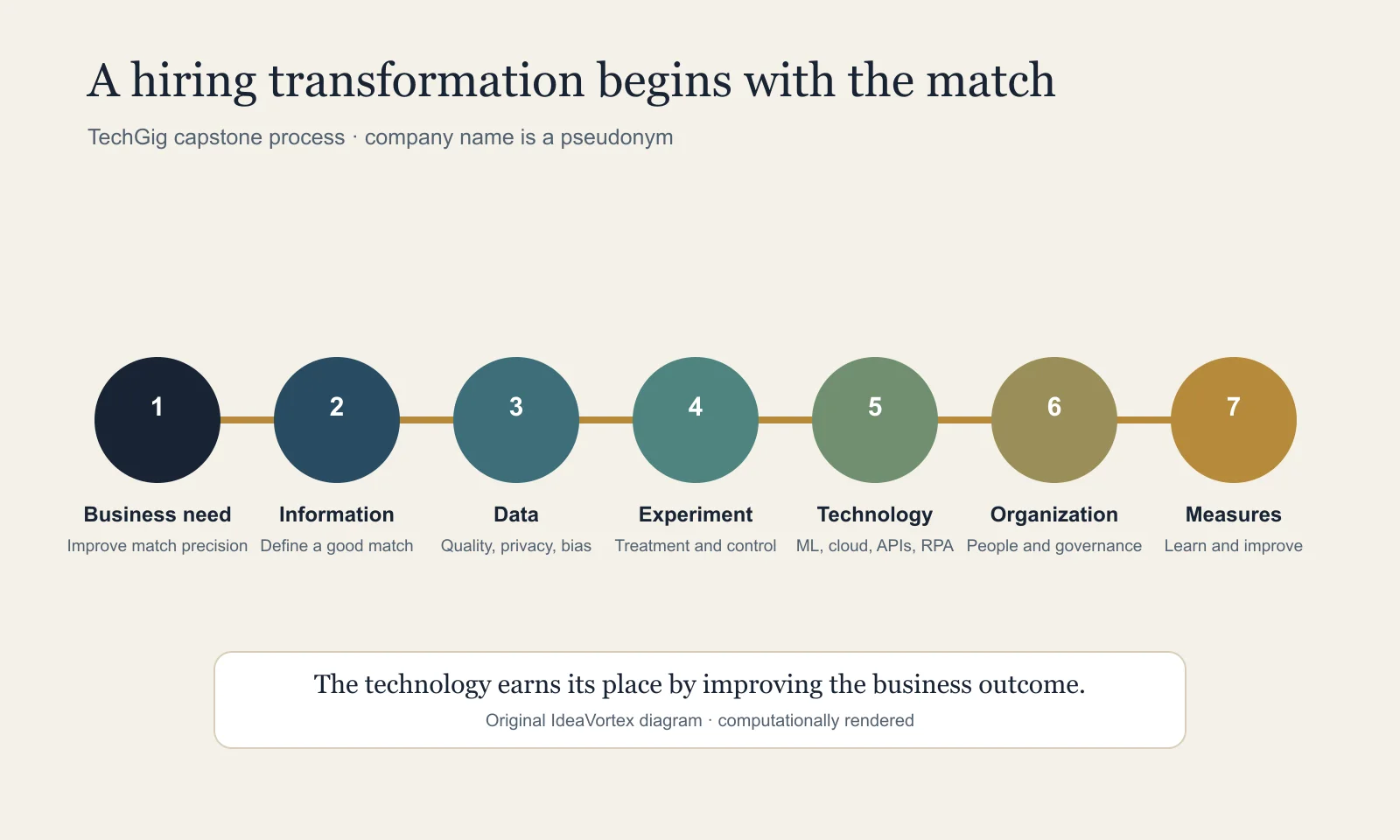
Define What a Better Match Means
A hiring platform cannot improve matching until it defines what “better” means. The capstone identified information that went beyond a conventional résumé:
- role responsibilities, required skills, and expected outcomes
- employer values, mission, and working culture
- candidate preferences, career goals, and personal values
- industry and sector context
- interest in onsite, remote, permanent, or gig-based work
- platform behavior and engagement
- match outcomes and user feedback
- and broader labor-market and skill-demand trends.
Possible sources included internal profiles and interaction data, along with external professional, portfolio, employer-review, and market sources.
The point was not to collect everything. Each source had to be considered for business alignment, quality, cost, privacy, security, integration difficulty, and the possibility of bias.
Turn the Assumption Into an Experiment
The project did not assume that AI and machine learning would improve matching. It turned that belief into a testable hypothesis:
Integrating AI and machine-learning tools into the platform will improve job and talent matching, resulting in higher user satisfaction and engagement.
The proposed experiment would separate users into a randomized treatment group with enhanced matching capabilities and a control group using the existing experience.
The measures included:
- match success rate
- user satisfaction
- engagement and retention
- time to match
- growth in the user base
- and revenue or premium-service adoption.
Descriptive analysis would compare results before and after the change, examine typical values and variation, identify outliers, and combine the quantitative results with qualitative feedback.
This mattered because a model can look accurate in isolation while failing to improve the experience of candidates or employers.
Choose Machine Learning by the Problem, Not the Fashion
The capstone considered multiple machine-learning approaches.
Supervised learning could use historical outcomes to predict the likelihood of a successful match. I considered logistic regression for its simplicity and interpretability, but a random forest could better handle nonlinear relationships, mixed data types, and imbalanced hiring data.
Unsupervised learning, including K-means clustering, could help group candidates and roles by skills, experience, job type, and behavior. Its risks included choosing the wrong number of clusters and oversimplifying people into segments.
Reinforcement learning could model matching as a sequence of decisions and rewards. But hiring does not always behave like a clean Markov process, and the data, computational cost, design complexity, and explainability requirements made it a much more difficult choice.
The conclusion was not that the most advanced technique would win. Robustness, accuracy, interpretability, feasibility, privacy, cost, and bias all had to be balanced.
Build the Platform Around the Learning Cycle
Cloud services could provide the scalable data and computing foundation for analytics and model development. High availability would protect user trust, while continuous deployment could support rapid, carefully measured improvements.
APIs could integrate external data and specialized capabilities. Low-code tools could help nontechnical teams participate in application development and experimentation, provided the organization managed security, performance, and vendor-lock-in risks.
RPA could automate repetitive, rule-based work across existing systems. The purpose was not simply to remove human tasks. It was to move routine work away from employees so they could focus on judgment, relationships, and exceptions.
Other technologies did not receive the same priority. IoT and AR/VR could have future uses in remote-work readiness, training, or collaboration, but they did not directly solve the immediate matching problem. A serious transformation plan must be willing to say “not now.”
Transformation Included the Organization
The technical design was only part of the capstone.
Implementation would require executive sponsorship, collaboration among technology, human-resources, product, and data specialists, and transparent communication with the people whose work would change. Pilot programs could test the proposal and expose weaknesses before a wider rollout.
The organization would also need:
- clear data ownership and governance
- privacy and security controls
- training and continuous support
- feedback loops for candidates, employers, and employees
- monitoring for bias and model drift
- and a culture willing to learn from evidence.
That is the difference between installing a tool and changing an organization’s capability.
Key Questions and Example Answers
These public-facing questions show how a hiring-platform team could begin evaluating a similar proposal without exposing the methodology or sources behind my original capstone.
What business outcome are we trying to improve?
Example answer: Improve the quality of matches between technology professionals and hiring organizations, including skills, role expectations, working arrangements, career goals, and organizational fit.
What would count as a successful match?
Example answer: A match should produce more than an application or click. The team would define success using agreed outcomes such as progression through the hiring process, satisfaction on both sides, retention, and time to a suitable match.
What information would the proposal require?
Example answer: Role requirements, candidate capabilities and preferences, employer working conditions and culture, historical outcomes, user feedback, and relevant market context. Each source would require review for quality, permission, privacy, bias, cost, and fitness for the intended decision.
What should remain under human judgment?
Example answer: People should remain responsible for hiring decisions, candidate consent, exception handling, fairness review, disputed information, and the definition of acceptable tradeoffs. A model may support a decision; it should not silently redefine a person’s opportunity.
How could the proposal be tested safely?
Example answer: Begin with a limited, randomized pilot that compares an enhanced matching experience with the existing process. Preserve a fallback, monitor different user groups, and stop or adjust the pilot when evidence shows harm or unreliable behavior.
What measures would matter?
Example answer: Proposed measures could include match success, satisfaction, engagement, retention, time to match, model robustness, subgroup performance, complaints, manual overrides, and the operational cost of maintaining the system. These are evaluation measures, not observed results from the capstone.
What is the most important risk?
Example answer: A technically accurate-looking model could reproduce bias, use inappropriate proxy data, or optimize platform engagement instead of genuinely suitable employment outcomes.
What should be postponed?
Example answer: Complex reinforcement-learning or highly automated matching should wait until the organization has reliable definitions, governed data, fairness controls, a clear experiment, and evidence that simpler approaches are insufficient.
Why These Projects Are So Valuable
Looking at the capstone now, I see something more valuable than a school assignment.
A well-designed capstone is a compact transformation laboratory. It forces an idea to travel the full distance from business need to information, data, technology, experiment, organization, risk, return, and execution.
The public-facing pattern is reusable even when the proposed technologies change, without disclosing the proprietary or course-specific methodology behind the original project.
That makes carefully prepared projects useful to founders, technology leaders, consultants, and organizations trying to evaluate an initiative before spending heavily on it. The value is not a list of fashionable tools. The value is the reasoning that connects the tools to a real outcome.
I removed a proprietary calculator from my project, and TechGig is a pseudonym. I also would not redistribute Stanford’s templates or course text. But I can create an original, redacted case-study edition that preserves the useful thinking:
- the business-need statement
- the data and decision framework
- the experiment design
- the technology tradeoff matrix
- the implementation roadmap
- and the success measures.
That would be worth offering as a download to readers who want a practical example of what a disciplined digital transformation project looks like.
The most important condition is the one the capstone process taught me from the beginning:
The project must be designed around the business need—not around the technology someone wants to sell.