
This article examines a completed digital transformation sample project built around a fictional legacy automotive manufacturer called US Motors. It is a worked example from the course materials, not my Stanford capstone and not a description of a former client.
The scenario is hypothetical. The roadmap was not implemented, and the article does not report observed business results. It uses a high-level decision structure derived from established digital transformation practice without reproducing the underlying course methodology, templates, calculations, or source materials.
In the fictional scenario, the company has operated for more than a century. Over time, different business functions have adopted their own technologies. Many systems are outsourced, disconnected, or selected to meet the objectives of one department. Business units have separate data, analytics, technical priorities, and information technology budgets.
The starting problem is not a lack of technology.
It is too much technology without enough connection.
The hypothetical example asks a practical question: How might a long-established company break down its data silos without trying to replace everything at once?
Digital Transformation Was Not a Shopping List
The easy version of a transformation plan would have been to recommend cloud services, machine learning, automation, APIs, low-code tools, and a modern data platform.
Those technologies all appeared in the course material. But a list of modern tools is not a strategy.
The company’s deeper hypothetical problem is organizational and architectural. Each department could make a locally reasonable decision and still make the overall system harder to understand. Data could be useful inside one function while remaining inaccessible, incompatible, or invisible to another.
The proposed strategy is simple to state:
Use digital technology to break data silos, integrate cross-functional data, and use that data to support growth and innovation.
The purpose of the example is to turn that sentence into a sequence an organization could evaluate before deciding whether to proceed.
The Roadmap Began With People
The first proposed initiative is not a cloud migration. It is the development of digital culture and literacy.
If the roadmap were pursued, the organization would need to:
- provide training that developed technical capability and a digital mindset
- create communities where employees could share what they were learning
- encourage integrated, data-driven reporting
- secure executive advocacy for data-related initiatives
- and hire technical specialists where important skills were missing.
The proposed capabilities include data science, analytics, architecture, software engineering, and technical management. A technically correct design can still fail when people do not understand why it exists, how their work will change, or whether they will be supported through that change.
The roadmap would aim to expand the organization’s capacity to make good technical decisions—not merely deliver a new system.
A Future-Proof Data Architecture
The next proposed step is to define a data architecture aligned with the company’s strategy and business needs.
“Future-proof” did not mean predicting every technology the company might use. It meant creating a blueprint for managing data assets that could accommodate new sources, systems, and analytical methods without producing another generation of isolated solutions.
Before implementation, that architecture would need to answer questions such as:
- What data exists?
- Who owns it?
- Which systems create or change it?
- How is it defined?
- Who should be allowed to use it?
- How can it move safely between systems?
- What new data might future technologies produce?
Without those answers, moving data to the cloud could simply create cloud-based silos.
Integrate Before Replacing
One of the example’s most important recommendations is to investigate integration of legacy systems before assuming they all must be replaced.
APIs and selected low-code or no-code integration tools could connect data from existing systems without immediately interrupting established business procedures. That approach could preserve valuable historical information, provide cross-functional access sooner, and reveal which systems truly could not fit into the wider data landscape.
This is not an argument for keeping every legacy system forever. It is an argument for learning before making an irreversible decision.
Integration could make the current environment more visible. If the company first understood the dependencies, data quality, and operational value of each system, it could then make evidence-based decisions about which systems created unacceptable limitations.
Why the Example Focused on Cloud Data Storage
For a hypothetical transformation analysis, the example focuses on the possibility of collecting and aggregating siloed data in cloud storage.
Cloud storage could provide:
- scalable capacity
- more flexible access to shared data
- a foundation for unified data governance
- compatibility with modern analytics
- and a path toward machine learning, IoT, microservices, and DevOps workflows.
But “move it to the cloud” was not an execution plan.
Before any migration, the company would need to understand what each legacy system stored, which data should move, how formats would be converted, and how the transfer would be validated. A provider would also need evaluation for security, reliability, financial stability, service responsiveness, compatibility, and technical limitations.
The cloud would be an enabling layer. It would not remove the responsibility to understand the data.
Return Was More Than Cost Savings
The hypothetical financial analysis considers possible savings in personnel relative to on-premises deployments, energy use, equipment purchases, and maintenance. These are evaluation categories, not realized savings.
It also identifies possible investments:
- software and license fees
- the time and cost of switching platforms
- training and skill acquisition
- and the temporary loss of productivity while people learned new tools and
processes.
The potential intangible returns would be just as important.
A shared cloud foundation might support data analytics, machine learning, unified access, security, and governance. It could improve collaboration between functions and make later innovation easier. Those potential benefits might not fit neatly into a first-year savings calculation, but they would be part of the reason to evaluate the initiative.
The Risks Were Architectural and Human
The analysis also identifies threats and liabilities that would require validation.
Migration could disrupt legacy systems and existing business processes. If the first cloud initiative failed, it could increase organizational resistance to every cloud-related proposal that followed.
In the fictional scenario, the existing structure is another liability. Departments have their own technical groups, tools, and priorities. That independence creates useful local knowledge, but it could also resist a holistic data architecture.
The proposed answer is not to ignore those teams. Their knowledge would be an asset. If the proposal advanced, execution would require:
- involving legacy-system experts
- keeping users and leadership informed
- explaining the purpose and implications of migration
- training current staff
- planning for newly hired specialists
- running pilot projects before broad migration
- and defining measurable indicators of progress and impact.
A pilot would turn migration into a learning process. The organization could test assumptions, discover hidden dependencies, and adjust the plan before exposing every business function to the same risk.
The Seven-Part Sequence
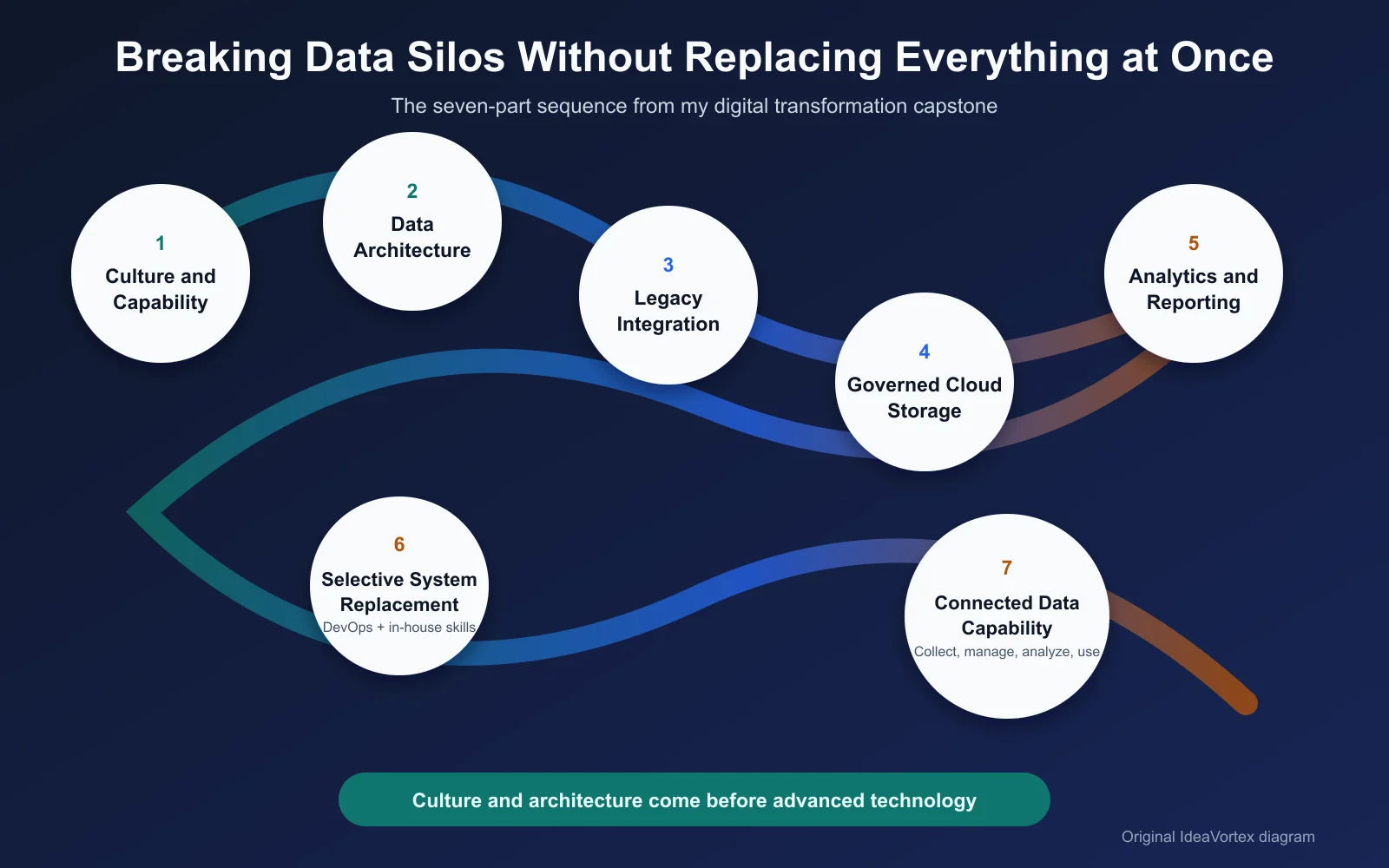
The hypothetical roadmap proposes seven connected initiatives:
- Develop digital culture, literacy, and technical capability.
- Define a robust and adaptable data architecture.
- Integrate data from legacy systems through APIs and appropriate integration
- Aggregate siloed data in governed cloud storage.
- Add cloud analytics and real-time reporting.
- Replace legacy systems that could not participate in the modern
- Create a seamless long-term system for collecting, managing, analyzing, and
tools.
architecture, supported by in-house development, DevOps, and selective low-code or no-code solutions.
using data.
The proposed order is deliberate: culture and architecture before broad migration, integration before indiscriminate replacement, and shared data before advanced analytics.
What the Example Still Teaches
No organization implemented this roadmap, and no results were measured. Its usefulness lies in showing how a hypothetical proposal can be reasoned through before implementation. AI has made that discipline even more important.
An organization cannot repair fragmented ownership, incompatible definitions, poor data quality, or departmental distrust merely by placing an AI interface over disconnected systems. AI can make information easier to query, but it can also make an incoherent data environment look more coherent than it really is.
The unglamorous work still matters:
- understand the business need
- map the data
- define ownership and governance
- connect systems deliberately
- involve the people who know them
- test the migration
- and measure whether the organization is actually improving.
Digital transformation is not the moment a company adopts a new technology. It is the longer process of becoming able to use technology, data, and human knowledge as one connected system.
That is the value of a well-designed hypothetical transformation project: it connects a business need to data, technology, people, risk, and proposed measures without presenting speculation as evidence.