Seasonal Drift: “Fall Was Beautiful, Soaking Up the Sun” is the first study in a new exploration. It is not a promised catalog work, and the current gallery is not being presented as a finished botanical plate. The artistic need comes before the available method. Technical completion does not equal artistic completion.
The study begins with a small gesture from the song A Little Leaf of Fall: patient affection, closeness and distance, the approach and retreat of tenderness, and something modest that remains in memory after the larger moment has passed.
The Question Behind the Work
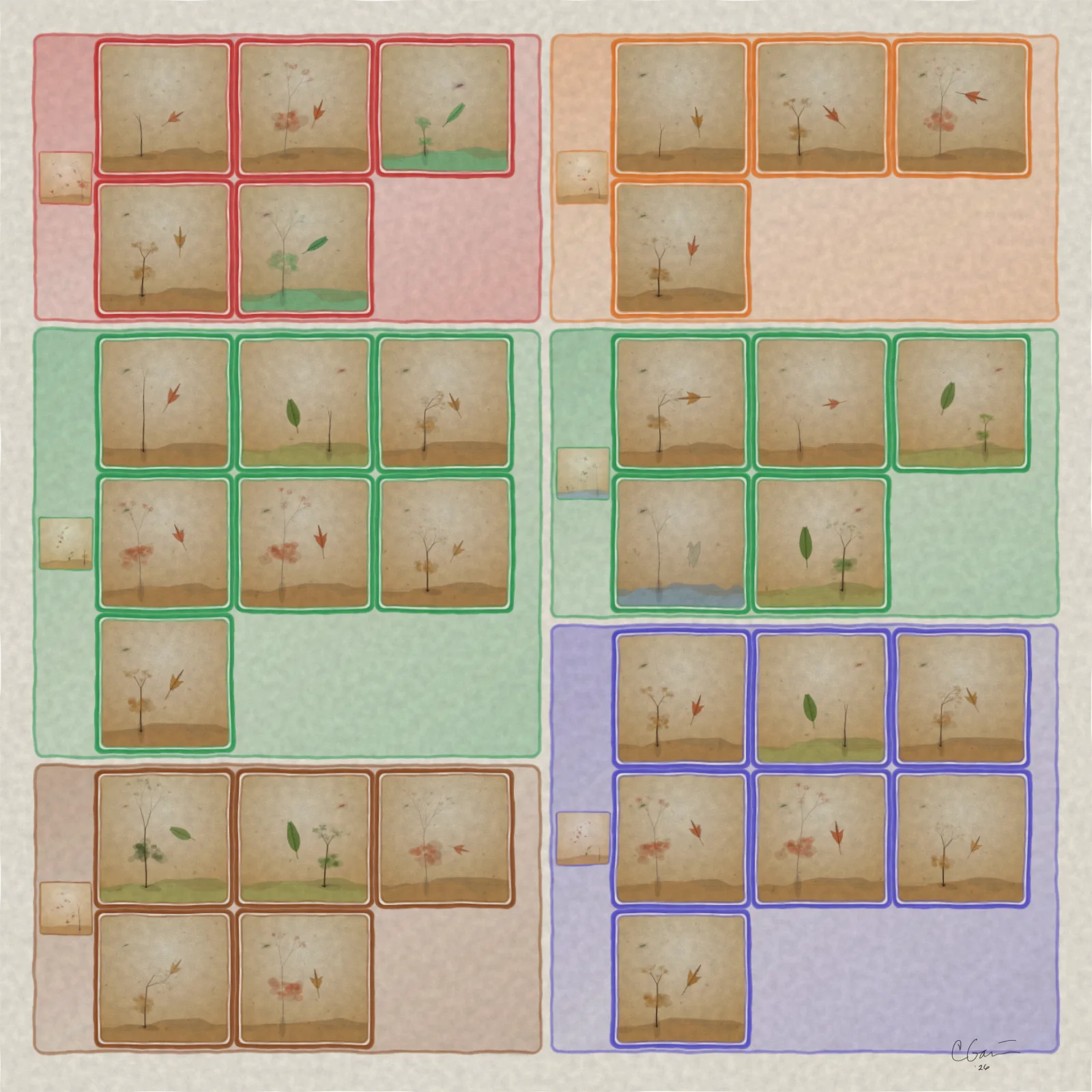
The current Orrery Glyph gallery is useful because it shows the song’s sections and individual line studies clearly. It gives me authentic material to examine. But clarity is not the same as resolution. A collection of successful parts may still fail to become one emotionally necessary artwork.
The central question is not whether the system can draw more leaves, add more detail, or complete another export. It is whether the visual language can carry the song’s patience without merely illustrating its lyric.
What the First Study Must Test
Botanical depth without ordinary illustration
The leaves may need veins, translucency, decay, variation, and overlapping shadow. Those qualities could give them weight, age, and vulnerability. They could also turn the work into a conventional botanical illustration. The test is whether natural detail deepens the emotional structure or simply makes the objects more recognizable.
The hummingbird as presence, distance, or omission
A hummingbird can easily explain tenderness, approach, and retreat. That makes it dangerous. It may work best when small, partial, distant, or absent. If the bird tells the viewer what the song means before the rest of the artwork can act, it should be removed.
Season without predictable seasonal color
Memory should not depend on a familiar march from spring green to autumn orange. A season can be carried through density, surface, light, brittleness, translucency, erosion, spacing, and temperature. Color remains available, but it should not perform the entire idea by itself.
A descending path that earns its movement
The current studies suggest descent. A downward path may feel patient, inevitable, and emotionally necessary. It may also feel like a systematic arrangement imposed because the song contains a falling leaf. The path must create an experience of approach and retreat, not merely organize sections from top to bottom.
Still plate, triptych, or quiet loop
The first resolved form is still undecided. A botanical plate could concentrate attention and make revision visible. A seasonal triptych could hold distance and recurrence. A quiet loop could let tenderness approach and withdraw over time. Motion is not automatically more complete than stillness; the form should be selected only after it proves necessary.
Independence from song and explanation
The artwork should be tested in silence and without this essay beside it. The song is its source, but the visual work must establish its own presence. If it survives only because the viewer has read the lyric or heard an explanation, it is not yet visually resolved.
What Must Remain
The work does not have to retain a literal leaf, a hummingbird, or any other named object. It does have to retain four emotional conditions:
- patient affection;
- closeness and distance;
- the approach and retreat of tenderness; and
- a small gesture that remains in memory.
Any object may be removed if it explains the lyric without strengthening the artwork. Omission is not a failure of fidelity. It may be the decision that allows the work to become independent.
How the Study Will Be Recorded
I want the record to preserve real decisions, including directions that are rejected. Each meaningful revision should note the medium or rendering method, dimensions, palette, materials or settings, what changed, and why an element was kept or removed.
The record should distinguish technical findings from artistic judgments. “The export rendered correctly” is a useful technical statement. It does not answer whether the marks are too muted, whether the paper texture dominates the forms, or whether the composition carries memory.
Each study should end with one deliberate decision:
- Select — the direction is strong enough to carry forward.
- Revise — the underlying direction matters, but a specific problem remains.
- Reject — the direction explains or decorates more than it deepens.
- Return later — the idea may matter, but it is not the right answer for this stage.
Current Decision
Revise. The linear gallery is accepted as an authentic diagnostic study and rejected as the finished work. It preserves the song structure, exposes useful motifs, and gives the next revision something concrete to answer. It does not yet gather those parts into one patient visual body.
The next study should reduce explanation rather than add spectacle. I will test a quieter botanical field with greater variation in translucency, decay, and overlapping shadow. The hummingbird will begin as a distant or partial event, with absence treated as an equally serious option. Seasonal change will be carried first through surface, density, and light rather than predictable color.
The descending structure will remain only if it creates emotional necessity when viewed without the song. The work will be tested first as a still. A triptych or quiet loop should follow only if the still reveals a need that time or separation can genuinely answer.
Why This Remains a Study
A formal catalog entry would imply a level of selection and completion that has not yet been earned. For now, Seasonal Drift belongs in the studio record: named, documented, visually testable, and open to rejection.
The goal is not to prove that Orrery Glyph can finish an image. The goal is to discover whether this visual language can hold tenderness without explaining it away.
Related Studio Notes
- Before the Painting: How I Decide Which Visual Language Fits a Song
- When the Parts Work but the Whole Does Not
- The Journey of Looking: How an Artwork Discovers What It Needs
Studio status: revise. The current linear gallery is a working study, not a finished botanical plate or catalog work.