I do not always know what a work needs when I start it. I may know the emotional source, the available materials, and the first visual direction. That is enough to start. It is not enough to finish.
The rest comes from looking.
Urban sketcher Ian Fennelly describes his practice as a “journey of looking”. In his teaching, the journey moves from large shapes toward smaller details. More important to me is the principle behind it: sustained attention changes what the artist understands. The more carefully I look, the more clearly I can decide what belongs.
That idea applies to a handmade drawing or painting. I have found that it also applies to the computationally rendered art I am developing for my songs. Code can repeat a rule exactly. It cannot spare me from judging the result.
Looking is part of making
At the start of a work, I am usually looking for possibilities. Later, I am looking for relationships. Does one form support another? Is the eye being led somewhere useful? Does a detail deepen the emotional idea, or merely explain it?
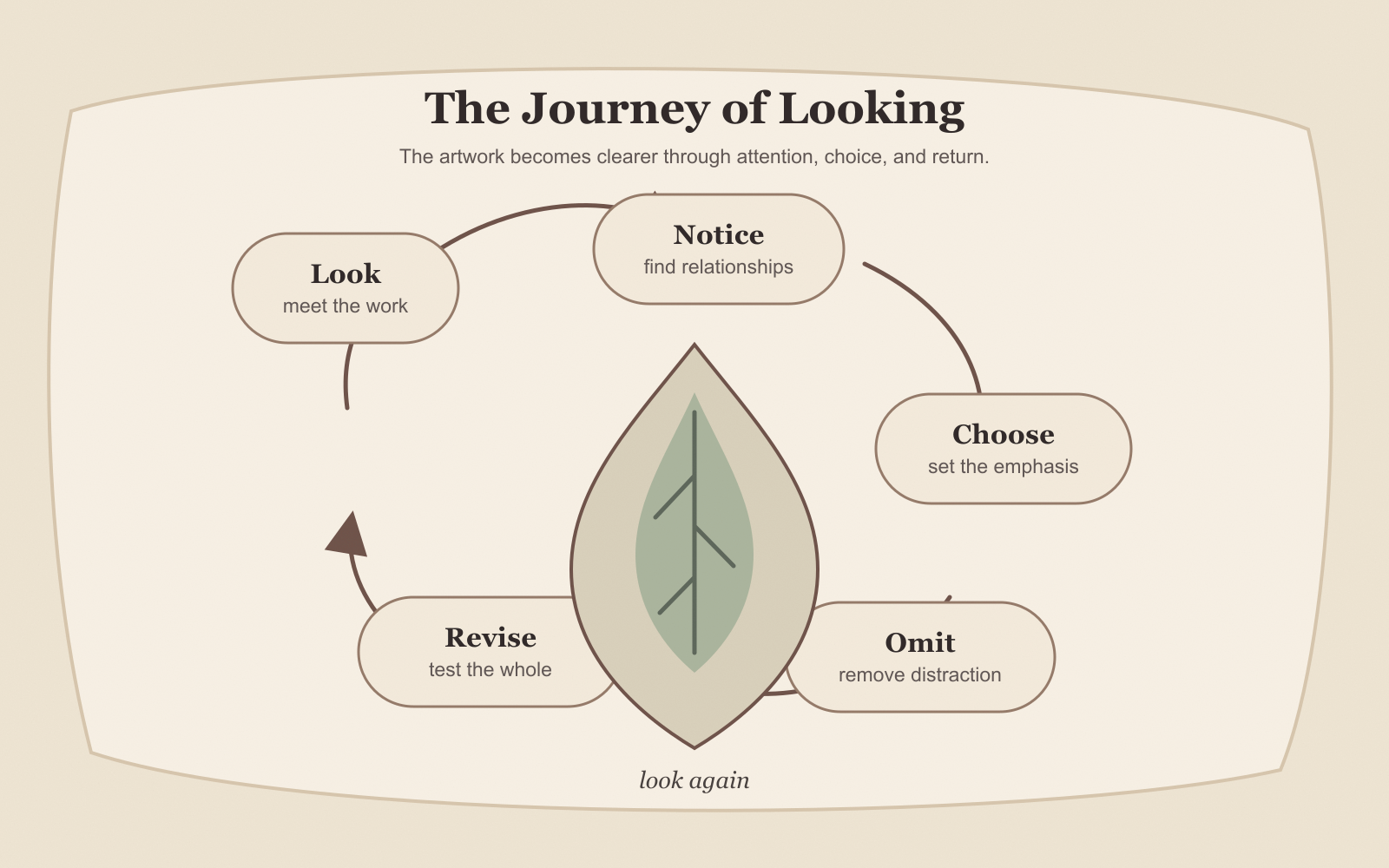
The answers emerge in stages:
- Look at the source.
- Notice what carries the emotional weight.
- Choose what the artwork should emphasize.
- Omit what weakens that emphasis.
- Revise the work.
- Look again.
This is not indecision. It is how the work becomes specific.
The process also explains why a technically correct result may still be artistically weak. A system may follow every rule I gave it and produce a complete image. I still have to decide whether that image says enough, says too much, or says the wrong thing.
What Seasonal Drift made me notice
My current Seasonal Drift study began with the song “A Little Leaf of Fall.” I recorded the early visual choices in Before the Painting: How I Decide Which Visual Language Fits a Song. The first direction was a vertical botanical plate: descending leaf-like forms, translucent overlaps, selective veins, irregular edges, and changes in opacity rather than a predictable parade of seasonal colors.
The song also contains a hummingbird. At first, that raised a familiar compositional question. Should the bird be fully visible, reduced to a peripheral trace, or absent?
I could not answer that question by treating each lyric line as an isolated illustration. The artwork needed a hierarchy that could continue from one section to the next and still make sense when the entire song was viewed as one work.
Looking across the lyric gave me a practical answer. The leaf appeared more often, so I treated it as the primary subject. The hummingbird became a secondary subject. That simple decision improved the storytelling. It did not settle every visual choice, but it gave the work a center of gravity.
This was not a universal law about leaves and hummingbirds. It was a decision that fit this song.
From a theme to a surface
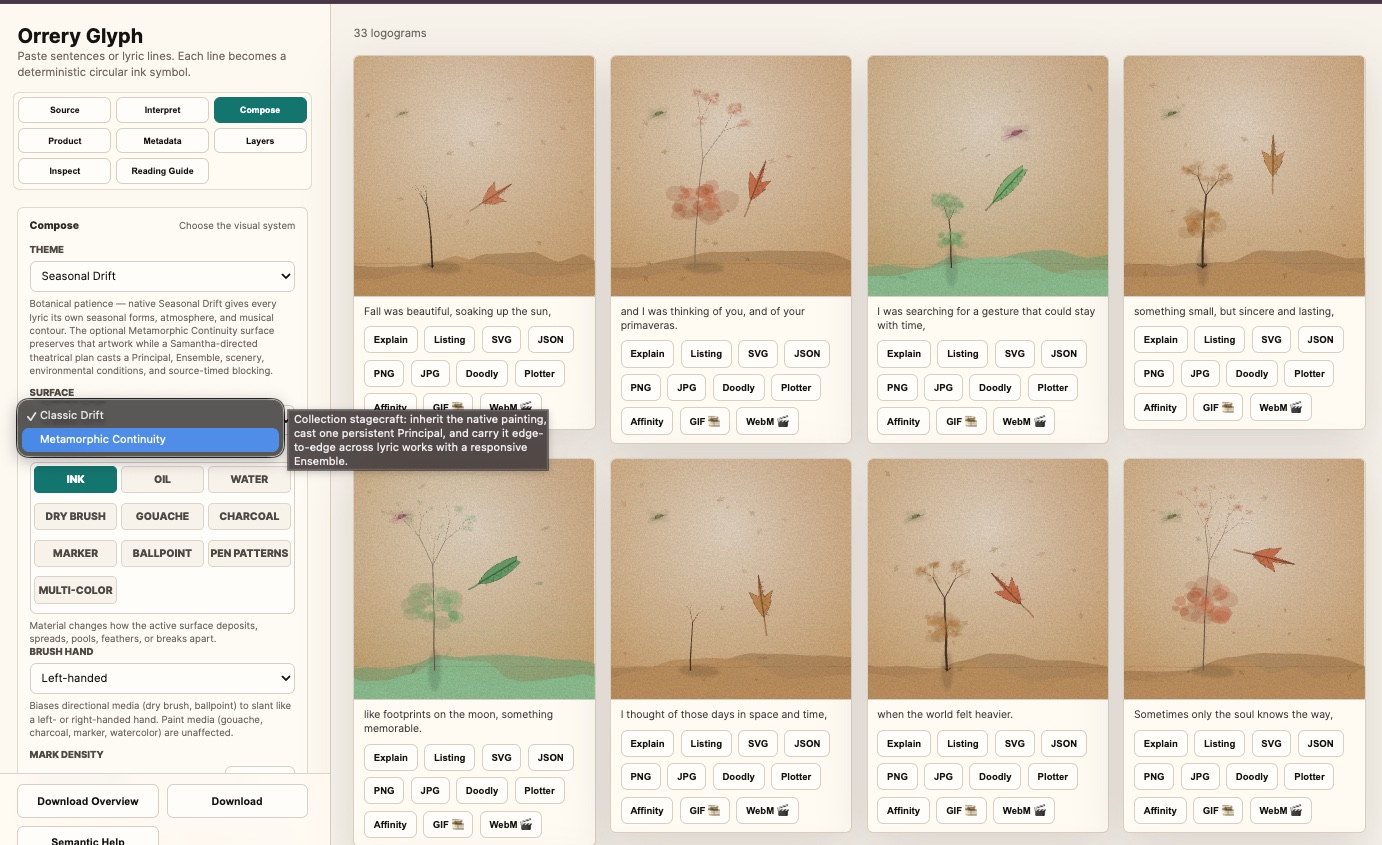
To carry that decision through Orrery Glyph, I created a new surface called Metamorphic Continuity. A surface inherits useful behavior from its parent theme while adding rules of its own.
Metamorphic Continuity: An unbroken process of transformation where underlying forms, materials, or philosophical states constantly shift while maintaining a persistent, connected existence. In Orrery Glyph, the artwork can change across lyric scenes without losing its identity, relationships, or memory.
In this case, the parent preserved the abstract semantics I had already developed. The new surface added continuity between a primary subject and a secondary subject. It let visual elements persist, change role, or move from one lyric section into another.
The idea was partly inspired by a pair of paintings my daughter made. In the first, a female silhouette blows toward a flower, and small figures descend by parachute. In the next painting, those figures continue their journey and become easier to see. Each panel stands on its own, but the movement between them carries the story.
I wanted a related kind of continuity for Seasonal Drift: not a literal copy of that imagery, but a way for one section to leave consequences in the next.
Building that behavior was a programming task. The art is being written algorithmically overall, and the implementation details are proprietary. What matters here is the artistic decision the programming serves. The code exists because the work needed continuity, not because continuity happened to be convenient to code.
The line, the section, and the whole song
One of the hardest parts has been changing the scale at which I look.
A visual response can work for a single lyric line. Several line-level responses can work together as a section. Yet the full gallery can still fail as one artwork. Repetition may become mechanical. Secondary forms may compete for attention. A convincing moment may have no useful role in the whole.
That is why I review Seasonal Drift at three levels:
- By line: Does the image respond meaningfully to this part of the lyric?
- By section: Do the images establish development, rhythm, and continuity?
- As a whole: Can the complete song hold together as one visual work?
The whole view is not a summary assembled after the fact. It is another artistic test. Sometimes it sends me back to change a line that looked perfectly good on its own. I discuss that failure mode more fully in When the Parts Work but the Whole Does Not.
This is where looking becomes omission. I may remove a recognizable object even when the system identified it correctly. I may reduce a hummingbird to movement, spacing, or an afterimage. Abstraction does not require an object for every noun in the source. A pure-text source can support object-free abstraction, and Orrery Glyph already does. A song adds a difficult balancing act because its recurring subjects can help carry memory while also making the image too literal.
Deterministic does not mean predetermined
Orrery Glyph is deterministic. Given the same source, settings, and version of the rules, it can reproduce the same result. That gives me provenance and lets me compare revisions honestly.
It does not mean I knew the final artwork in advance.
The deterministic system produces evidence I can inspect. I decide which behavior to keep, which rule to revise, and which detail has become irrelevant. Then I run the work again and compare it at the line, section, and whole-song levels.
This is generative art in the established computational sense: a rule-based system produces the form. It is not an AI-generated slot filled by a nondeterministic prompt. The distinction matters, but it does not make the work automatic. My role is visible in the system I designed, the hierarchy I chose, the versions I rejected, and the omissions that allow the result to breathe.
The same thing happens when I draw in ink. A line records both attention and commitment. When I add paint, I discover that one area needs restraint and another needs weight. The tools differ, but the journey of looking remains.
The unresolved question
The current subject rule worked for “A Little Leaf of Fall”: frequency helped establish the leaf as primary and the hummingbird as secondary.
What happens with the next song?
The most frequent subject may not always be the most important one. A single image can be the emotional hinge of an entire lyric. Pronouns and metaphors can hide a subject from a simple count. A future theme may need a different rule.
If the rules change, an existing song must still remain deterministic. That means the rule set and its version need to be part of the work’s record. I do not yet know the best general solution. I would rather leave that question open than disguise it with a premature answer.
This uncertainty is not a flaw in the studio record. It is the next useful problem. That is also why I keep a creative decision record instead of presenting the latest output as if it had arrived fully formed.
What I am keeping
For now, I am keeping:
- the leaf as the primary subject for this song;
- the hummingbird as a secondary presence;
- Metamorphic Continuity as a distinct surface;
- inherited abstract semantics from the parent theme;
- review at the line, section, and whole-song levels;
- deterministic generation and versioned rules;
- omission as an explicit artistic decision.
I am not claiming that frequency alone can identify the primary subject of every song. I am also not committing to a fully visible hummingbird or a fixed seasonal palette. Those decisions remain conditional on what the complete work needs.
My decision is revise.
Seasonal Drift has found a stronger way to tell its story, but it has not reached its final form. The next step is not to add every detail the lyric permits. It is to look again and discover which details the artwork can no longer do without.