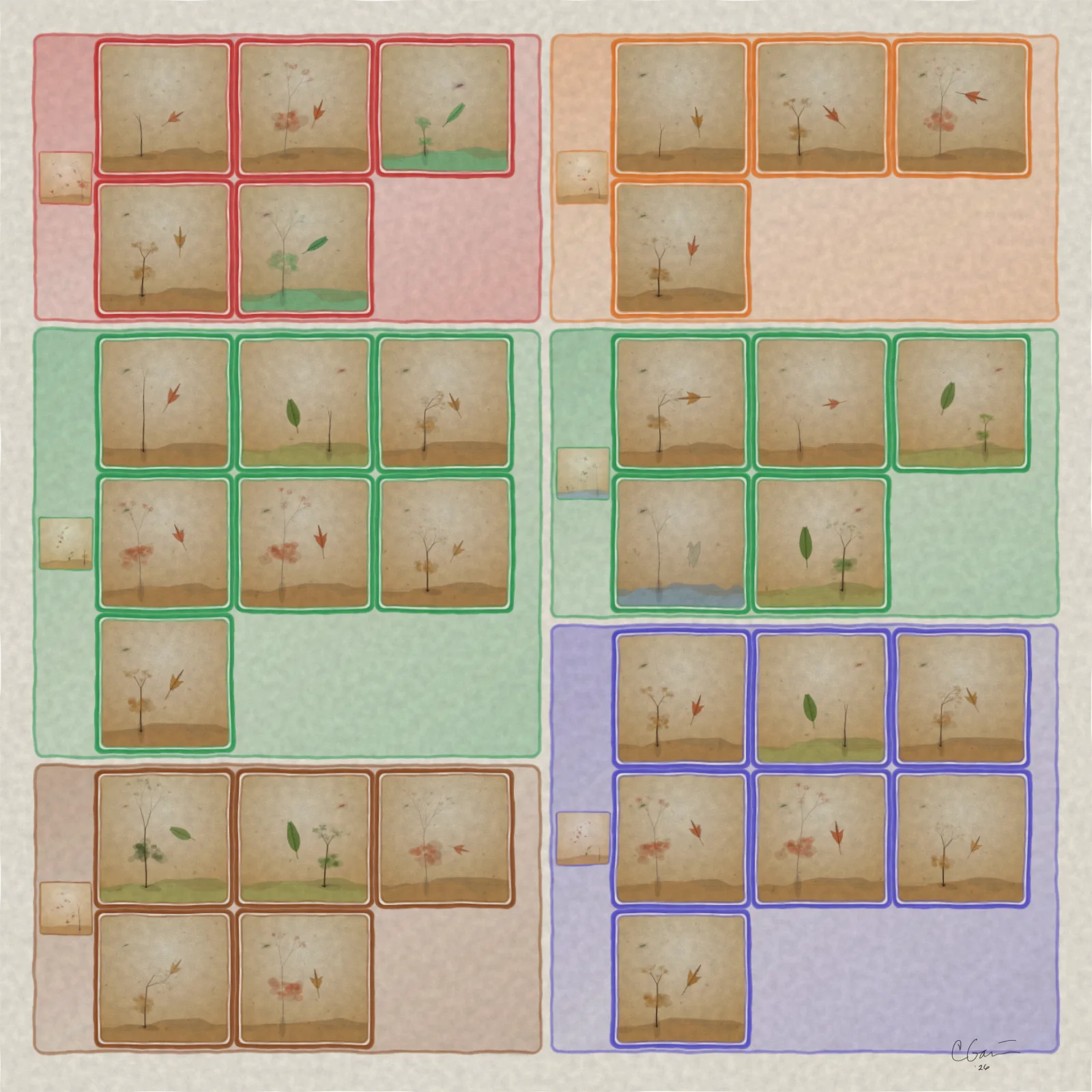
Seasonal Drift began with a question that sounds technical but is really artistic: should a system translate a song into one complete image, or should it create conditions from which several independent works can emerge?
While working with A Little Leaf of Fall, I reached a point where the whole-song composition began to feel less like a resolved artwork and more like accumulated explanation. Every line added another demand. The leaf descended, returned, crossed other forms, carried memory, suggested a hummingbird, and moved through changing seasons. Combined on one surface, those gestures risked becoming crowded and scrubbed together.
The answer may not be a better whole-song arrangement. It may be to stop asking one image to contain the entire song.
Letting the leaf move between works
I am now considering the song as a sequence of section works. The falling leaf can move across lyric lines and through verses, choruses, and the bridge without every moment remaining visible at once. One section might show its arrival. Another might preserve only an edge, a shadow, or the memory of where it passed. A later work might contain the space it has left behind.
The continuity would exist between the artworks rather than through the density of a single composition.
This also changes what could become available to a collector. A section can stand as a complete work with its own breathing room. Several sections can be assembled into a sequence, but the whole song does not have to become one overloaded picture. The song survives in the movement from one surface to the next.
Where the idea first became visible
Part of this way of thinking came from watching my daughter create two paintings that behave as a single passage. In the first, a human silhouette blows pollen into the air. From that drifting cloud, her beautiful little people begin to emerge. In the second painting, they continue their journey. Nothing literally moves, yet the interval between the two canvases supplies motion: the eye carries the figures out of one image and into the next.
That was the revelation for me. Continuity does not require one crowded surface, and a static painting does not have to be static in the imagination. A wall could hold a sequence of collector works in which a gesture begins in one piece, crosses the space between frames, and resolves—or deliberately refuses to resolve—in another. Each painting could remain complete while also belonging to a larger movement.
When repetition stopped being movement
That insight led to what I called the Metamorphic Continuity surface for Seasonal Drift. In the early studies, the leaf changes its relationship to the tree, the ground, and the surrounding forms. It seems capable of arriving, crossing, departing, and returning. The eye can follow it through a developing passage.
Metamorphic Continuity: An unbroken process of transformation where underlying forms, materials, or philosophical states constantly shift while maintaining a persistent, connected existence. In Orrery Glyph, the artwork can change across lyric scenes without losing its identity, relationships, or memory.
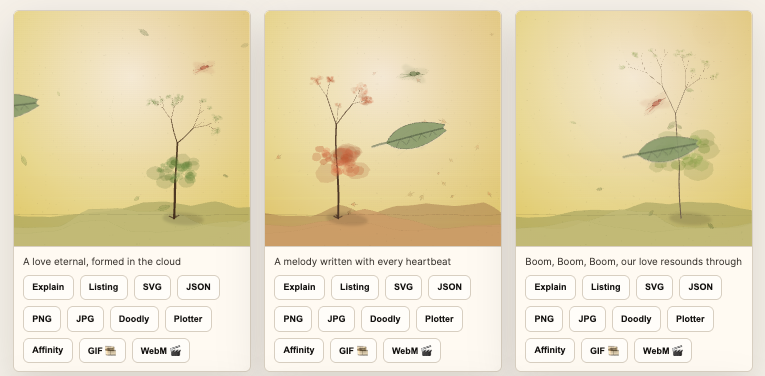
In the later sequence, variation remains in the atmosphere, color, and secondary marks, but the primary subject repeatedly settles into a similar compositional role. The panels differ, yet the leaf no longer seems to travel in a prescribed direction. The system is producing change without producing a convincing journey.
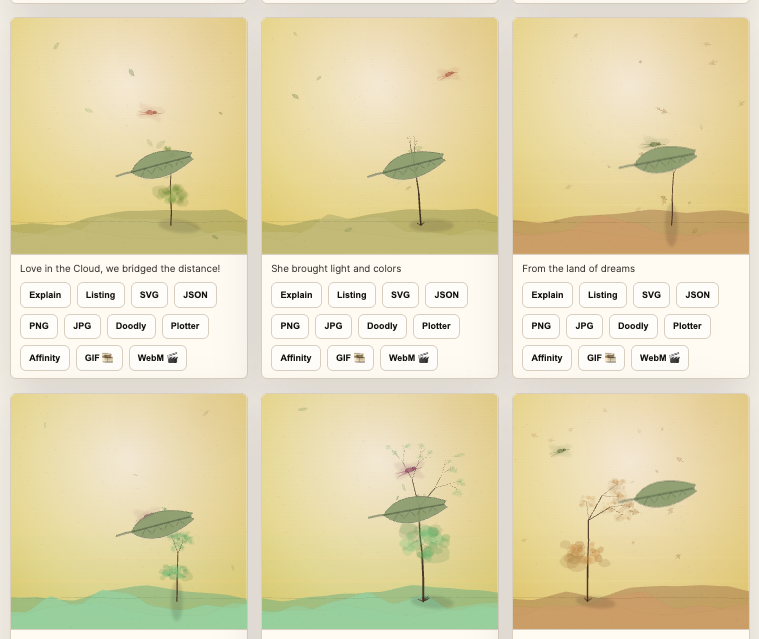
This is where a door or gate becomes useful—not as a visible symbol that must appear in the artwork, but as a continuity condition between one lyric line and the next. After the first three lines, the system could decide whether the subject is held, passed onward, or released. The exit from one section would establish a possible entrance into another, while the artist would still decide whether that path deserves to remain visible.
The thought recalls work I once did on a gates feature in the original Java-based Cocoa environment: a transition had an intentional point of departure and an intentional landing. For Seasonal Drift, I would use that principle less as screen navigation than as a compositional score. A bitmap-like field of occupied and empty regions could let me predetermine where a gesture may leave, where it may return, and what it must cross along the way.
Several possibilities follow. A leaf can be held, remaining near an anchor until the lyric gives it reason to move. It can be passed, leaving one section at a chosen edge and entering the next with altered scale, material, or emotional weight. Or it can be released, disappearing so that only a shadow, gap, stain, or changed atmosphere carries its memory. These are not automatic answers. They are ways of creating enough continuity for looking to make the final decision.
Am I making the art, designing the tool, or both?
There is another question beneath all of this: have I migrated my creativity into the technical form? The act of designing routes, gates, rules, and transitions is genuinely creative. But creative satisfaction inside the tool is not proof that the collector’s work has been made. A system can become so absorbing that it quietly replaces the paintings it was meant to support.
This is partly an economic decision because time is the scarce material. An hour used to make a rule reusable is an hour not spent drawing, painting, revising, or placing a finished work before a collector. Yet the calculation is not simply code versus canvas. A useful tool can preserve discoveries, generate strong starting conditions, and make a family of works possible. The question is whether that leverage returns time and artistic possibility—or continually asks for more.
Have I moved my creativity into the tool?
Partly, and that is not automatically a loss. Designing a compositional grammar can itself be an artistic act. The danger begins when the most important decisions are experienced only while programming and never become visible, material, or emotionally legible in the finished work.
Is the tool serving the artwork, or has the artwork become a demonstration of the tool?
A collector should not need to admire the mechanism in order to feel the work. If an image is interesting mainly after its rules are explained, the system may be ahead of the art. The strongest result should stand without the code, the song, or an explanatory paragraph.
What deserves to be reusable?
The reusable part may be the condition rather than the mark: where a gesture enters, what it crosses, what it leaves behind, and whether it is held, passed, or released. The final edge, stain, pressure, or brushstroke can remain singular. This lets the system remember a discovery without manufacturing replicas of its resolution.
Does scalability strengthen or weaken the collector’s work?
Digital generation can produce many studies, but abundance is not the same as value. Its best use may be to explore possibilities and preserve continuity across a series. The hand-finished or entirely hand-made work can then carry scarcity, material presence, revision, and the evidence of an individual decision. Scale can belong to the search while rarity belongs to the resolution.
When should I stop coding and begin painting?
I should stop when the system has produced a condition worth answering by hand. If the next technical improvement mainly postpones contact with the material, it is probably not the next artistic step. A useful gate is simple: can I now make a stronger drawing or painting because of what the tool revealed? If yes, leave the screen.
How will I know whether the hybrid practice is working?
Not by the number of features completed, but by the number and quality of resolved works, meaningful studies, and informed rejections. The tool should shorten the distance between looking and making. If it lengthens that distance, its scope needs to contract.
Working in both camps should feel like power—and it really is. I can invent the instrument as well as play it. I can move between rule and intuition, repetition and singularity, digital possibility and material consequence. That range gives me forms of agency that either practice alone might not provide.
But power can introduce its own stagnation. Every new capability creates another option to test, another feature to refine, and another reason to postpone commitment. The tool can keep a work permanently possible when art eventually requires one possibility to be chosen. Stagnation is therefore not evidence that the technology lacks value; it may be evidence that its abundance needs a boundary.
My present answer is therefore both, but not in equal measure at every moment. I can design the tool as studio infrastructure while protecting sustained periods in which no feature is allowed to compete with the work. The collector’s fine art remains the main goal. Code earns its place when it opens a path, preserves a relationship, or reveals a choice that the hand can take further.
If you also live in both camps—as an artist who builds tools, a designer who works by hand, or a technologist trying to protect an art practice—I would like to hear how you navigate this tension. When does the tool give you power? When does possibility become stagnation? What helps you stop designing the conditions and commit to the work?
Looking before choosing abstraction or representation
This raised a larger question for me: should themes such as Seasonal Drift become mostly abstract, or should they retain recognizable objects?
I do not think abstraction and representation should be permanent settings. They should be consequences of looking. A leaf may remain botanical when its veins, translucency, decay, and overlapping shadow strengthen the work. It may become partial when a torn edge carries more feeling than a complete specimen. It may disappear when its absence is more active than its presence.
Looking is not passive observation here. It is the work of deciding what the artwork needs, what it can release, and what has begun to explain too much.
The bandwidth of working by hand
I favor genuinely hand-made workflows. Drawing and painting give me a kind of bandwidth that is difficult to reproduce digitally. Perception, memory, touch, hesitation, pressure, erasure, and revision can occur almost at once. I do not have to translate every judgment into a named parameter before I can respond to it.
The apparent weakness of handwork is that its decisions may seem unreusable. A physical gesture cannot simply be called again like a software function. But the gesture and the decision are not the same thing. The mark may be unique while the reason for it can still be remembered:
I removed the complete leaf because the torn edge carried memory more effectively.
That decision can inform another work without turning the original gesture into a stamp.
Rules as a score, not a finished artwork
I have not given up on rules. I am reconsidering what they should do.
A useful system does not need to decide that tenderness is a yellow leaf in the lower-left corner. It might instead establish a compositional event:
Tenderness enters from the upper-right, crosses one occupied region, and lands partially outside the lower field.
The rule describes movement, contact, and consequence. It leaves the form unresolved. The result could become a leaf, a shadow, an erased passage, a wash of pigment, or nothing visible at all.
In that sense, code can function as a score. It can establish boundaries, passages, exclusions, and possible landings. It can preserve a relationship across multiple section works. It can help the falling leaf exit one lyric line and reappear in another without prescribing the final mark.
The artist still has to look.
Code the conditions, paint the decision
The most promising path for Seasonal Drift may therefore be hybrid, but not in the usual sense of decorating a generated image by hand. The coded structure would remain provisional. It could produce a field, a route, or a set of constraints. The physical work would decide whether those conditions deserve to become art.
Some studies may remain digital abstractions. Some may become printed scores that are resolved with graphite, ink, watercolor, collage, abrasion, or paint. Others may begin and end entirely by hand, with their decisions documented afterward.
The system should preserve the reason for a choice without pretending to replace the choice.
A working principle for the first Seasonal Drift study
For now, I am carrying forward a simple principle:
Each section receives one passage of the fall, one remembered gesture, and enough empty space for departure.
This gives the leaf somewhere to go. It gives each section the possibility of becoming an independent artwork. It also lets the complete song remain larger than any single surface.
Technical completion will not determine when these works are finished. Looking will.