A fine art collection does not begin the moment I produce several attractive images. It begins when the works develop a shared purpose, stand on their own, and belong together for reasons deeper than appearance.
I am facing that question as I develop the Orrery Glyph visual theme Seasonal Drift, inspired by my song A Little Leaf of Fall. I have experiments, studies, recurring subjects, and a system that can help me explore them. I don’t want to call every successful result a finished artwork or every group of results a fine art collection.
The difference matters to me as an artist. It should also matter to anyone trying to understand, collect, or build a body of computationally or system-rendered art.
An Experiment Gives Me Permission to Look
An experiment does not have to know where it is going. Its job is to help me notice possibilities.
I may test how a leaf descends, how one transparent form overlaps another, or how a hummingbird can remain present without taking over the picture. I may discover that a visual rule works beautifully in one image and becomes mechanical when repeated. I may find that a technically correct result has no emotional center.
None of those outcomes is wasted. Even rejection teaches me something about the work.
I wrote about this process in The Journey of Looking. Looking is not a passive step after making. It is part of making. I look, notice, choose, omit, revise, and look again.
An experiment gives that cycle room to happen. A collection asks me to take responsibility for what survives it.
What a Minimalist Surface Means
Seasonal Drift is the theme. It supplies the world, cast, palette, and visual vocabulary. Its minimalist surface is an optional artistic and stagecraft treatment that specializes that existing artwork without replacing the theme’s identity. It directs how the world is staged, treated, and performed. Here, the restrained treatment sets the expectation for the work from the beginning.
Minimalism here does not mean that nothing is happening. It does not mean that the system simply removes detail or produces an empty background. It means that each visible element has to earn its place.
A leaf may carry more weight than a crowd of decorative shapes. Open space may express distance, memory, or quiet movement. A faint trace of a hummingbird may be stronger than a complete illustration. Repetition may create rhythm, but too much repetition can flatten the work.
This restraint helps me judge the results. When the visual language is intentionally spare, an unnecessary element cannot hide easily. A weak relationship becomes visible. A forced explanation becomes obvious. The surface asks me to choose.
That is different from asking a system to make something generally beautiful. I am defining conditions for a particular artistic world, then deciding whether each result belongs in it.
A Fine Art Collection Needs More Than a Shared Style
It is easy to mistake consistency for coherence. Several works may share the same colors, textures, or shapes and still say very little together.
A filter can create similarity. A collection needs a point of view.
For me, that point of view begins with a question. What am I trying to understand through these works? In Seasonal Drift, the source includes descent, seasonal change, tenderness, memory, and movement. The artwork does not need to illustrate every lyric. It does need to remain honest to the human experience that led me to begin.
The works should feel related because they are looking at the same world from different positions. They should not feel related only because the same software made them.
The First Test: Can Each Work Stand Alone?
A work in a fine art collection should have its own reason to exist.
If an image makes sense only after I explain the lyric that produced it, it may still be a useful study. It may not yet be an independent artwork.
I want someone to encounter the image without the song playing and still find composition, tension, movement, and emotional weight. The song can deepen the experience. It should not have to rescue it.
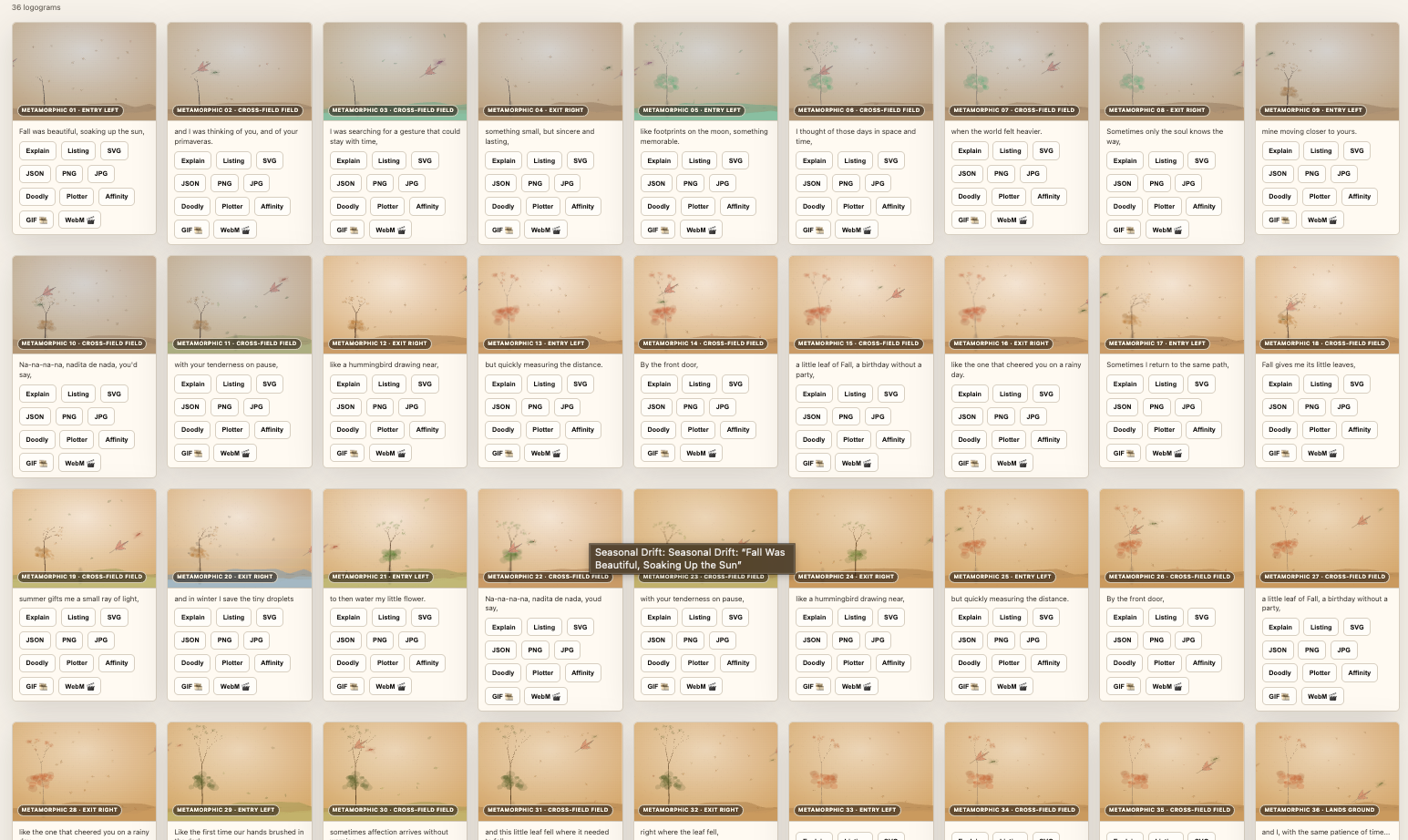
This is one reason I began separating lyric sections instead of forcing an entire song into one crowded surface. I described an early stage of that search in Seasonal Drift: “Fall Was Beautiful, Soaking Up the Sun”.
The Second Test: Do the Works Change Without Losing Their World?
A collection needs continuity, but continuity is not sameness.
If every work repeats the same arrangement, the collection may feel like a set of variants. If every work changes completely, the viewer may not believe the pieces belong together.
I am looking for a more useful balance. A subject can enter, fade, return, or leave a trace. One work can contain the consequence of an earlier work without copying it. Space, direction, opacity, scale, and rhythm can carry relationships between pieces.
This is the problem behind Metamorphic Continuity: an unbroken process of transformation where underlying forms, materials, or philosophical states constantly shift while maintaining a persistent, connected existence. In Orrery Glyph, it is a surface that specializes Seasonal Drift theme with staged behavior and continuity across lyric scenes, allowing the artwork to change without losing its identity, relationships, or memory. I wrote about that development in Seasonal Drift: Generative Fine Art that Keeps Moving. The system supports continuity, but I still decide whether that continuity feels necessary or merely clever.
The Third Test: Am I Selecting or Merely Accumulating?
A system can produce more possibilities than I should keep.
That abundance can create a false feeling of progress. Ten acceptable images are not automatically stronger than three resolved ones. More output can make the real decisions harder to see.
Selection is not an administrative task at the end. It is an artistic act.
I ask whether a work adds something the collection does not already have. I ask whether it deepens the visual language or only demonstrates another capability. I ask whether I would defend its presence if the name of the tool disappeared.
I also need the freedom to remove a work that I once liked. A collection becomes clearer when I stop protecting every successful experiment.
The Fourth Test: Is the System Serving the Art?
I spent more than three decades designing and building software systems. That background naturally affects how I make art. I think about abstraction, relationships, boundaries, variation, and continuity.
Still, a sophisticated system is not the same as a strong artwork.
A feature may be impressive and visually unnecessary. A rule may be elegant in code and awkward on the surface. A repeatable process may produce a result that I do not want to show.
The system earns its place when it helps me reach artistic decisions I could not reach as clearly, quickly, or consistently without it. It does not earn its place by being complicated.
This is why I prefer the term system-rendered or computationally rendered for this work. The system participates in rendering. I remain responsible for the intention, structure, selection, revision, and final presentation.
The Fifth Test: Can I Define the Physical Work?
A collection may begin on a screen, but I eventually have to decide what the collector encounters.
Is the work a fixed digital piece, a moving work, an archival print, or a combination? What size gives the composition enough room? What happens to pale transitions and dark forms on paper? Does the surface support the quiet visual language, or does it overpower it?
Those decisions are not packaging added after the art. They affect how the work exists.
If I offer a limited edition, I also need a clear edition size, inventory record, certificate, production master, and truthful description of the medium. A fine art collection needs enough definition that another person can understand what is being offered and how it should be preserved.
The Sixth Test: Does the Collection Have a Boundary?
A collection cannot remain open simply because the system can continue producing.
I need to decide what belongs to this body of work, what belongs to a later development, and what should remain in the studio as research.
The boundary may come from a visual question, a group of song sections, a particular surface, a period of development, or a carefully selected number of works. Whatever form it takes, the boundary should be understandable.
Without a boundary, I have a stream of output. With a meaningful boundary, I may have a collection.
My Working Checklist for a Fine Art Collection
- Does each selected work stand on its own?
- Do the works share a point of view, not only a style?
- Does the minimalist visual language remain intentional?
- Is there enough variation to keep the collection alive?
- Does continuity connect the works without forcing them to match?
- Have I rejected works that merely repeat what is already present?
- Is the system serving an artistic need?
- Can I describe the physical or digital work clearly?
- Can I explain why the collection begins and ends where it does?
- Am I ready to place my name behind the group, not only behind individual experiments?
Where Seasonal Drift Is Now
Seasonal Drift is helping me answer these questions through actual work rather than theory alone.
The minimalist surface has established a clear expectation. The leaf remains central. Other subjects can appear, but they have to support the visual hierarchy. Continuity can move between lyric sections, but it cannot become a technical demonstration. Each image has to survive my looking.
I am not using the word collection as a shortcut. I want to earn it.
When I am ready, I will share more of the fine-art work growing from A Little Leaf of Fall. For now, the honest place to stand is between experiment and collection, looking carefully at what the work is becoming.
That middle space is not a delay. It is where I learn what deserves to remain.