A note before we begin: I call the software in this essay “Project Lark.” That is a made-up name for the generative visual-art tool in this example. I want to discuss the idea without making this post sound like a legal claim or a product announcement.
Fair use and popular songs lead to a practical question: can I give a well-known song to Project Lark, turn parts of it into visual art, and show or sell the result?
The short answer is: maybe, in some situations. But “the picture looks different from the song” is not enough by itself.
This is an artist’s discussion, not legal advice. A real commercial project may need a copyright lawyer or permission from the people who control the song.
Why use a known song at all?
Because people already have a relationship with it.
If I show someone art made from one of my own songs, they may enjoy the image, but they do not know the starting point. With a familiar song, they can compare the artwork with their own memory. They may notice that one song becomes a slow descending form while another gathers into a crowded center.
That gives Project Lark a better chance to show what visual translation actually means. The audience is not learning the song and the artwork at the same time.
Would that help people connect with the art?
I think it could.
A known song brings emotion, memory, and cultural context with it. That can make the visual work easier to enter. It could also introduce generative art to people who would not normally seek it out.
But there is a catch. If the artwork gets most of its value from the song’s fame, then I have to ask whether I am making a new work or leaning on someone else’s success. Familiarity is useful, but it does not prove fair use.
What would Project Lark actually use?
That question matters more than it first appears.
A tool might use:
- the full lyrics;
- a few words or themes;
- the song’s sections and timing;
- MIDI or chord information;
- the sound recording;
- an official video link;
- or notes entered by the artist.
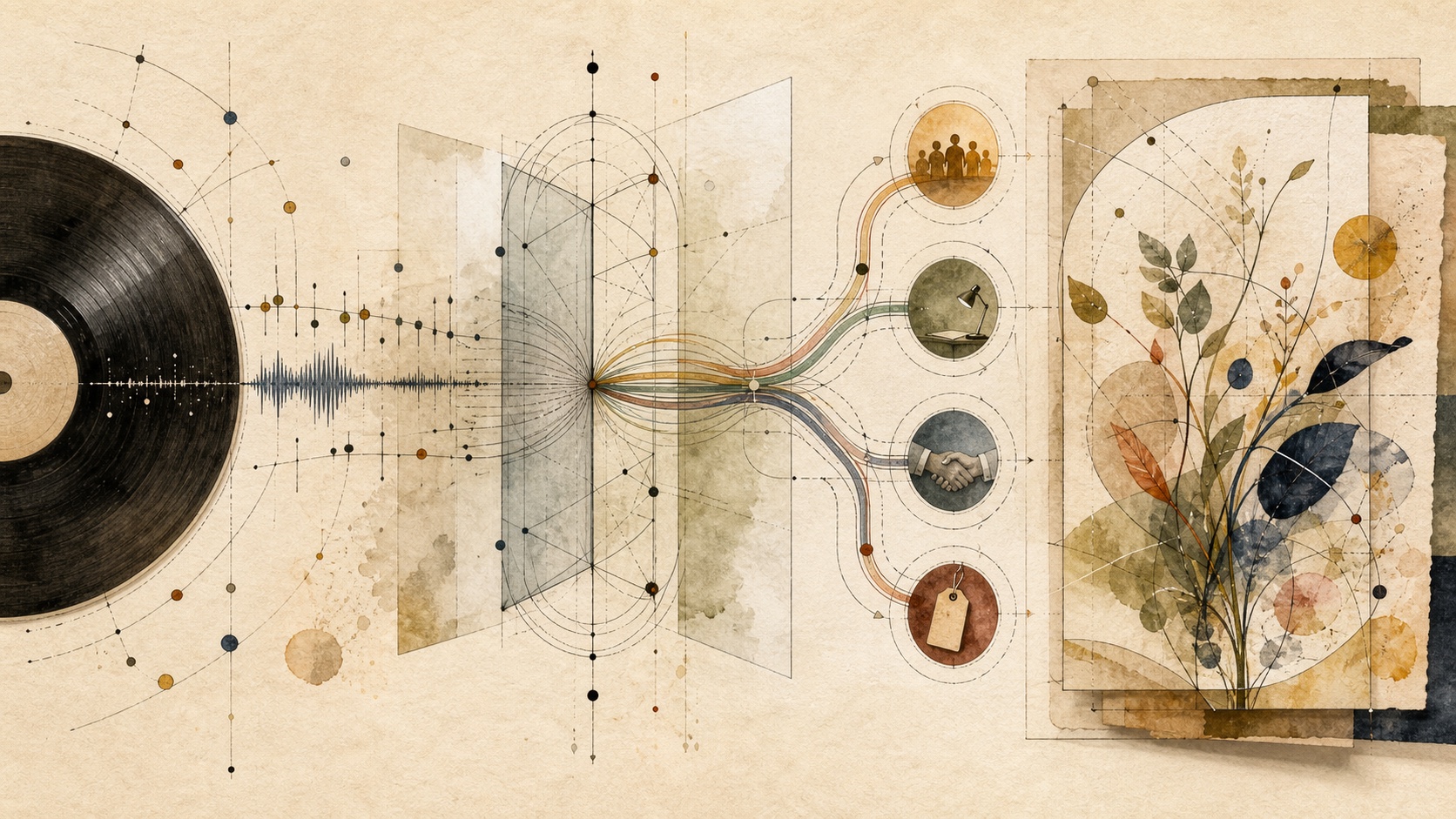
Those are not the same thing. A song may involve separate rights in the composition, lyrics, recording, and video. Linking to an official recording is also different from copying and hosting the audio.
This is one reason provenance matters. The work record should say what went into the system. It should not vaguely say “song data” when full lyrics or a recording were used.
So, is it fair use?
There is no automatic yes or no.
U.S. law uses four fair-use factors. In plain language, they ask:
- Why was the source used? Was the new work commenting, studying, or doing something meaningfully different?
- What kind of source was used? Songs are highly creative works.
- How much was used? A short but memorable part can still matter.
- Could the new use harm an existing or reasonable licensing market?
The full wording is in Section 107 of the U.S. Copyright Act.
Does changing music into an image make it transformative?
It may help the argument, but a change of medium is not a magic pass.
I would ask more direct questions:
- What is the artwork saying or doing that the song does not?
- Are any lyrics still visible?
- Does the piece depend on the song title for its meaning?
- Could the visual idea stand on its own?
- Am I studying the song, or simply making merchandise around its fame?
A serious visual interpretation is different from placing a famous lyric on a decorative product. The exact facts matter.
What changes when the work is sold?
The risk becomes more practical.
A private experiment, a critical blog post, a gallery display, and a limited edition are different uses. Selling a work does not automatically defeat fair use, but it raises questions about licensing, marketing, and collector expectations.
A collector should never be led to believe that a song-based artwork is officially authorized when it is not.
Could licensing be the better answer?
Sometimes, yes.
Licensing is not only a restriction. A good collaboration with a songwriter, publisher, or recording artist could give the work a clearer story, a wider audience, and stronger collector confidence. It could also allow the real song title or recording to be part of the presentation.
A workable practice might include several lanes:
- Original songs: the clearest path for the main IdeaVortex catalog.
- Licensed familiar songs: useful for collaborations and commercial editions.
- Public-domain compositions: remembering that a modern recording may still be protected.
- Critical studies: limited to what the discussion actually needs.
- Private experiments: useful research that never enters the public catalog.
Where does AI fit into this?
AI does not erase the source question.
The artist may make meaningful choices through selection, arrangement, redrawing, repainting, and revision. Those choices matter to authorship. But they do not automatically make the use of a copyrighted song lawful.
The reverse is also true. Permission to use a song does not prove that every machine-generated image has enough human authorship for the artist’s intended copyright claim. The U.S. Copyright Office’s AI work treats those as related but separate issues.
What should I document?
I would keep this simple:
- the source and how it was obtained;
- what information entered the tool;
- what was removed or changed;
- accepted and rejected versions;
- whether lyrics, audio, names, or branding appear;
- whether the work is private, published, or sold;
- permissions or licenses, if any;
- and the final decision: publish, license, revise, keep private, or reject.
Good notes do not create fair use. They do make the process more honest and easier to review.
What is my answer for now?
I do not want to ban familiar songs from experimentation. They may be one of the best ways to show what this kind of visual translation can do.
I also do not want “fair use” to become the business model.
The more promising path begins with music we can use openly and confidently. Original songs can lead to original visual art, with room for the artist, songwriter, and collector to understand how the work came to be.
That is why I am continuing to build the IdeaVortex original-song catalog. The aim is not to illustrate every lyric. It is to make artwork that can hold attention on its own while carrying something true from the music.
The final test is still artistic: does the image hold attention without the song title, the lyric, or a long explanation? When the answer is yes, there may be something worth collecting.
Related reading: IdeaVortex: Where Original Songs Become Visual Art and Digital Art Collecting in 2026.