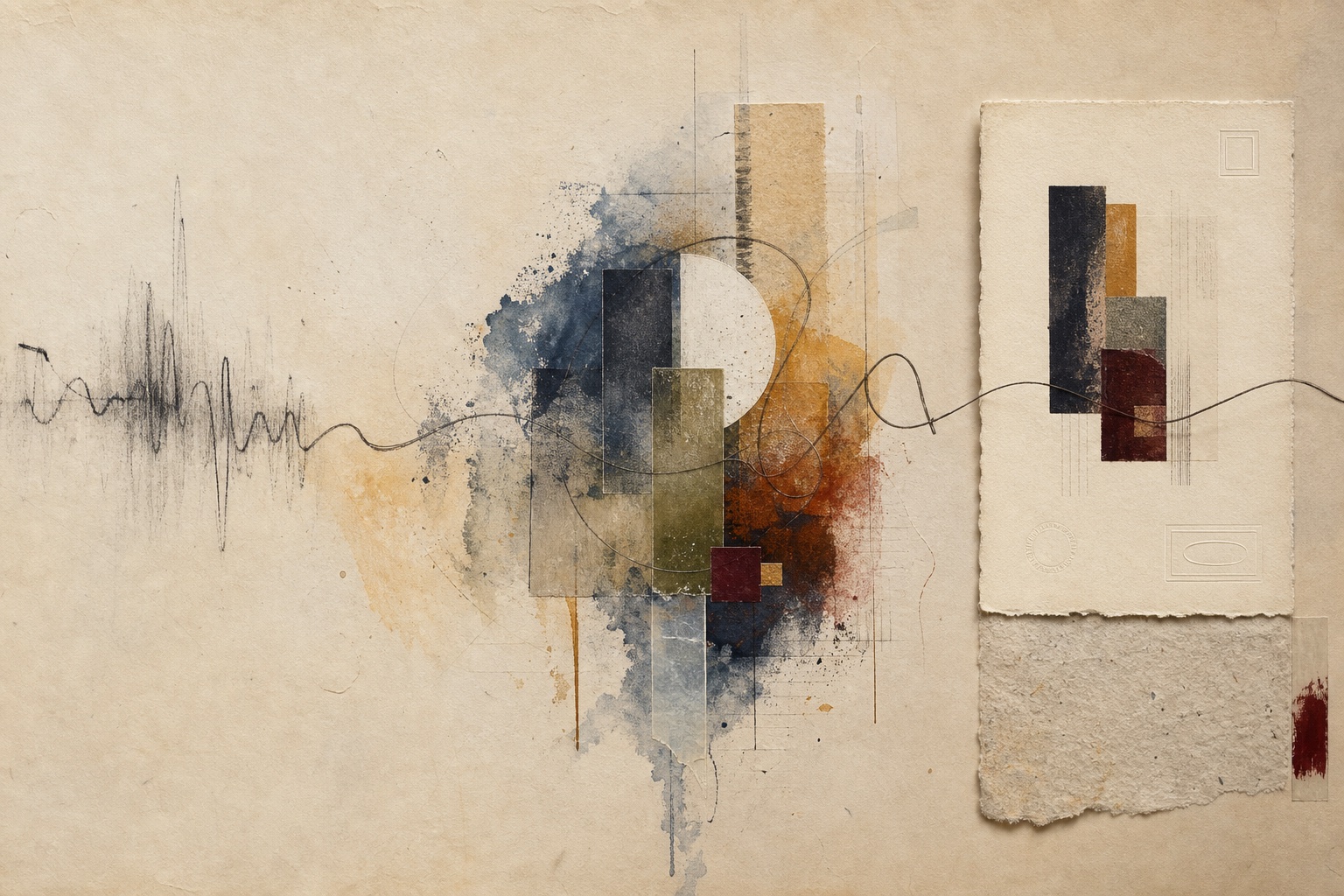
IdeaVortex began with ideas. It now explores how original songs become visual art without reducing the result to illustration. Its more specific creative center is original music, independent visual works, and the human experiences that connect them.
I write songs about love, memory, family, endurance, faith, identity, movement, loss, and renewal. Some of those songs invite a second response in color, gesture, structure, material, and light.
The resulting artwork is not meant to illustrate every lyric. It is an independent visual interpretation of a human tension carried by the song. The music may begin the inquiry, but the artwork must develop its own visual necessity.
IdeaVortex is a music-and-art journal, working studio record, and developing collector guide exploring how original songs become independent visual works.
Three Ways Into the Catalog
Experience the Work
Begin with the art or the music.
Visitors can explore through songs, visual works, human themes, language, medium, and developing song cycles. A person may arrive through a painting, a lyric, a listening page, a process study, or a story.
There is no required order. Looking first and listening later should produce a different but equally legitimate encounter.
Understand the Work
Each completed catalog entry can explain:
- the human experience beneath the song;
- the tension selected for visual interpretation;
- why a particular medium or process was used;
- how the work relates to a song, section, or song cycle;
- whether the work is physically handmade, digitally handmade, hybrid, computationally rendered, or developed through a combination of those practices; and
- enough process and provenance to understand the work without explaining away its mystery.
The artwork must still stand alone. Hearing the song should deepen the experience rather than rescue an unresolved image. Technical completion does not equal artistic completion.
Collect the Work
Collector-facing pages describe—or, for works still under development, will describe—the actual object or edition:
- title, date, medium, dimensions, palette, and materials;
- unique work, study, proof, limited edition, or open edition;
- edition size and signature method where applicable;
- provenance and certificate information;
- display and care guidance;
- availability; and
- the work’s place in the larger catalog.
Ownership of an artwork does not automatically transfer music, copyright, reproduction, or synchronization rights. Those terms should be stated clearly.
A Visual Songbook
The long-term project can be understood as a visual songbook.
It is not a book in which every song receives a decorative image. Some songs may support one major work. Others may become a sequence of section works. Some may produce only studies, and some may never enter the visual catalog.
The catalog develops through small song cycles—groups of works connected by a human concern rather than forced into one visual style.
Possible cycles include:
- Fragile Light: caregiving, mortality, endurance, and hope;
- Marks We Leave: memory, scars, drawing, writing, and human trace;
- Miles and Journeys: movement, ambition, migration, and inner arrival;
- Love Across Time: partnership, distance, memory, and return;
- Faith and the Unseen: belief, doubt, grace, and quiet attention;
- Family Forms: parenthood, partnership, and intergenerational identity;
- Small Courage: overlooked effort, perseverance, and dignity; and
- Nature Remembers: fog, wind, stars, birds, leaves, sea, and landscape.
These cycles give collectors and listeners a way to recognize relationships among works while allowing abstraction, representation, code, drawing, painting, and hybrid methods to remain visually independent.
How Original Songs Become Visual Art: From First Pilot to Working Practice
Love in the Cloud became a nine-work visual sequence organized around sections of the song. It demonstrated that a song could support more than cover art and that several static images could carry movement from one lyric passage into another.
That structure was one creative solution, not a rule for the catalog.
Seasonal Drift raised a different problem. When the whole-song composition became crowded, the better direction was not necessarily a more capable arrangement. It was to reconsider the unit of the work. A falling gesture could move between line or section studies without requiring every moment to remain on one surface.
The studio journal then made another distinction visible: variation is not automatically movement. A system can change colors, marks, and surrounding forms while the primary subject remains compositionally stalled. That observation led to ideas about continuity, entry and exit conditions, and the artist’s responsibility to decide when a coded possibility deserves to become a physical work.
The lesson is not that one method replaced another. The practice widened. Brushes, digital brushes, code, printed studies, collage, and hand revision can each participate when the artistic need calls for them.
What Exists Now—and What Is Still Developing
IdeaVortex now includes published songs, visual sequences, individual studies, process essays, collector-oriented guides, and a growing record of accepted and rejected directions. It has begun to show not only finished results but how the work changes through looking.
The catalog is still developing. Not every study is a formal catalog work. Not every named song cycle has been completed. Availability, editions, certificates, care notes, and object records will be introduced only when the corresponding work is ready.
This distinction matters. The journal can remain exploratory without presenting every experiment as a product. A study may be selected, revised, rejected, or held for later. Authentic revision is part of the record rather than evidence of failure.
AI and generative systems may assist development, interpretation, testing, or documentation, but they do not determine artistic completion. As discussed in The Work Is Never Linear, a tool earns its place when it returns the artist to the work with a clearer eye.
Why the Catalog Matters
Creative work can become scattered among notebooks, drives, websites, stores, streaming services, and social platforms. Its relationships become difficult to see. Its history can disappear.
Behind the public journal, IdeaVortex is building a reliable record connecting:
- songs, translations, and alternate versions;
- recordings and release information;
- related visual works and studies;
- creative media and source files;
- authorship, credits, and rights;
- object and edition details;
- provenance, publication, and exhibition history;
- accepted, revised, and rejected directions;
- availability and collector records; and
- preservation outside any single platform.
This operating discipline is a form of digital transformation. It exists to support the work, not to replace the human decisions that create it. Good technical abstractions can carry learning from one theme into another while preserving their independent visual languages.
The Library of Congress personal digital archiving resources offer practical context for organizing, describing, and preserving creative files beyond any single device or platform.
What Collectors Can Expect
IdeaVortex favors clarity over artificial urgency.
Collectors should be able to determine:
- what the work is;
- how it was made;
- why it belongs to the catalog;
- whether it is unique or part of an edition;
- what accompanies it;
- how it should be displayed and cared for; and
- whether related works may be created later.
Collector-focused articles discuss provenance, editions, process, presentation, care, visual song cycles, and the relationship between owning an object and owning intellectual-property rights.
The site does not treat art primarily as a speculative financial instrument. The emphasis is connoisseurship: sustained attention, informed appreciation, and a continuing relationship with a developing body of work.
Continue Through the Working Journal
- How a Song Becomes an Independent Abstract Visual Work introduces the creative translation from song to autonomous image.
- Before the Painting examines how the visual language and medium are chosen.
- What Collectors Should Know About Music-Focused Artwork explains the object, edition, rights, and provenance questions.
- The Journey of Looking follows the review and revision of a developing artwork.
- Code the Conditions, Paint the Decision considers the balance between tool-building and collector’s fine art.
An Open Invitation
You may enter through music or art.
Listen first, or look first. Follow a human theme. Compare works across languages. Read about a medium. Return as a song cycle develops.
The purpose of IdeaVortex is not to tell a collector what to feel.
It is to make the work, its relationships, and its history visible enough for a personal response to begin.
Catalog navigation
The Music & Art Catalog is the durable index for songs, visual works, studies, process records, and collector information.