A song rarely stays in one place.
It may begin in a lyrics file, move into MelodyCurve, continue through MIDI or MusicXML, enter a digital audio workstation, become a vocal recording and a mix, inspire physical or digital artwork, and finally reach a distributor, website, store, or collector.
Each system can preserve its own output while losing the reason that output exists.
A creative decision record for a song is a practical way to preserve that reasoning without trying to automate artistic judgment.
A File Preserves a Result, Not Necessarily a Decision
A lyrics document can preserve the current words. It may not explain why one line replaced another.
A MIDI file can preserve notes and timing. It may not preserve why a phrase rises, which syllable needed emphasis, or why a difficult interval was kept.
A production session can preserve tracks, effects, and edits. It may not explain which choices define the song and which were temporary experiments.
An image can preserve an artwork. It may not identify which song version, section, memory, or visual decision it responds to.
A distribution form can preserve release metadata. It may not contain the creative lineage that makes the release understandable later.
This is how context disappears. The files remain, but their relationships and reasons become dependent on memory.
Creative Continuity Is the Transformation
The transformation is not putting every file into one large folder.
It is creating continuity across the stages of the work:
- the lyric that shaped the melody;
- the melody that survived revision;
- the arrangement built around it;
- the performance and production decisions;
- the artwork that interprets the song;
- the credits and approvals attached to the release; and
- the public or collector record that identifies the finished work.
The songwriter does not need to document every passing thought. The record should preserve the decisions needed to understand, continue, verify, or publish the work.
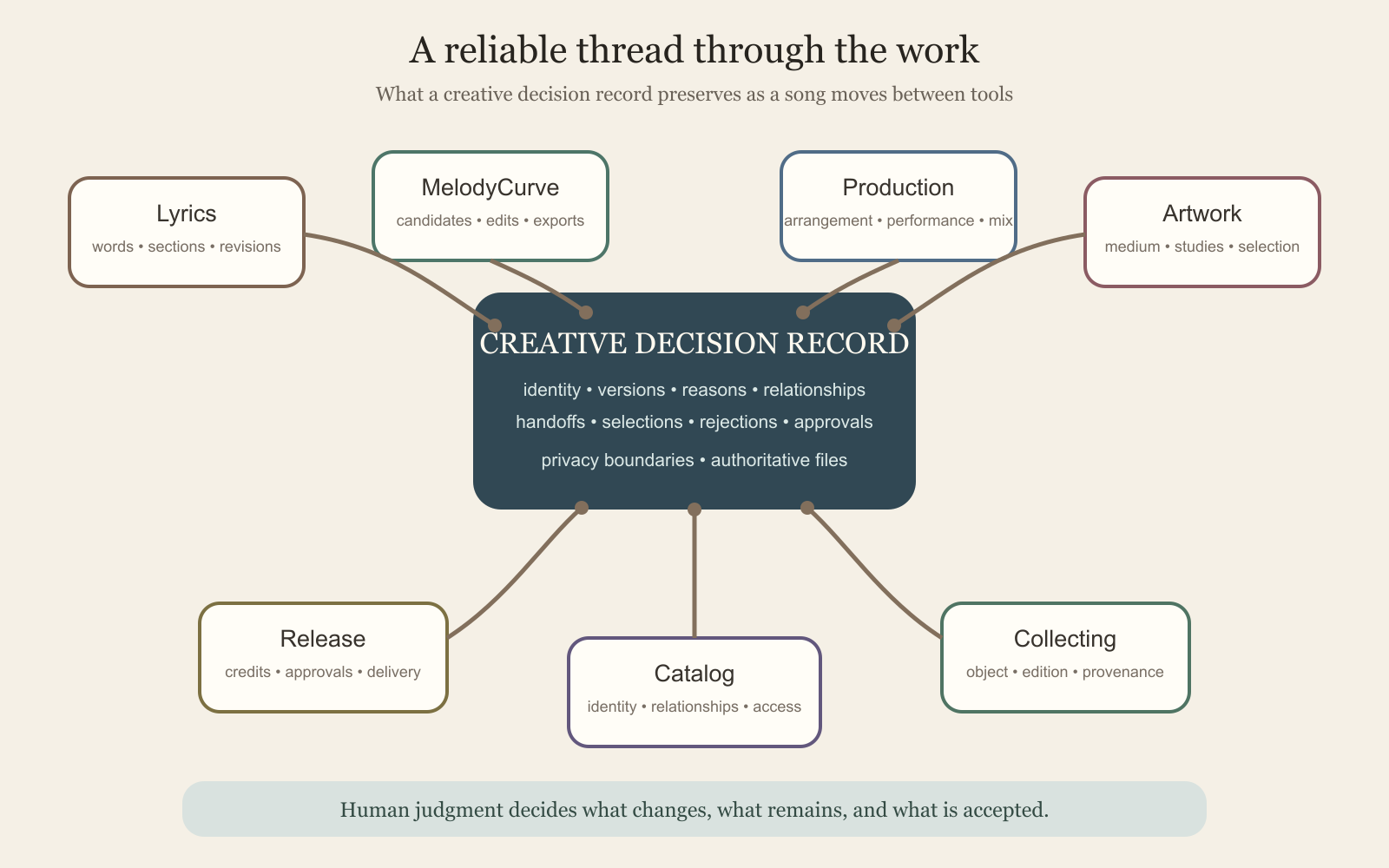
A creative decision record connects the stages of a song without pretending that one application contains the entire creative practice.
Begin With One Canonical Song Identity
The song needs a stable identity before its files begin to multiply.
At minimum, record:
- canonical title;
- internal catalog identifier;
- songwriter and contributor names;
- language;
- current composition status;
- related translations or adaptations;
- and the location of authoritative working files.
The identifier should not depend on a filename, web address, distributor, or current title. Those can change.
This does not mean every early idea needs a formal public record. It means that once a song becomes an active work, its versions should have a reliable parent.
Preserve Version Relationships, Not Just Version Numbers
song-final-v7-really-final.wav gives very little useful information.
A version record should answer:
- What changed?
- Why did it change?
- Who made or approved the change?
- Which earlier version did it replace or branch from?
- Is it a lyric, composition, arrangement, performance, mix, master, or translation version?
- Is it still active, preserved for reference, rejected, or released?
These relationships matter because versions do not always form one straight line.
A Spanish adaptation may remain current alongside the English song. An acoustic arrangement may not replace the full production. A radio edit may derive from a master without becoming the authoritative composition. A visual work may relate to an early recording while still responding to the canonical song.
The record should describe those truths instead of forcing every file into a single sequence.
What MelodyCurve Can Preserve
In a lyrics-first workflow, MelodyCurve can keep several musical decisions closer to the words that produced them.
The working record can include:
- lyrics and section markers;
- syllable and phrase relationships;
- selected musical settings;
- chord progression;
- generated melody candidates;
- the candidate the songwriter selected;
- direct pitch or timing edits;
- version history;
- and exported MIDI, MusicXML, audio, or lyrics files.
The useful transformation is not merely that a melody was generated. It is that the writer can inspect, compare, edit, and carry the selected work into another stage.
The decision record should also say what was rejected when that rejection matters. “Candidate three was technically smooth but weakened the question in the chorus” is more useful than retaining five unlabeled files.
What a Production Handoff Should Carry
When the song moves into a digital audio workstation, the production team or future songwriter needs more than a MIDI attachment.
A concise handoff can identify:
- canonical song and composition version;
- approved lyric version;
- reference tempo, meter, key, and structure;
- melodic elements that should remain recognizable;
- intentional tensions or irregularities;
- arrangement areas that remain open;
- reference exports;
- contributor responsibilities;
- and the next decision that needs to be made.
This is not a demand that production follow a rigid specification. It distinguishes the identity of the song from the parts still available for experimentation.
If production changes a defining element, the record can explain why the new version was accepted.
The Artwork Needs Its Own Decision Record
Music-focused artwork should not be reduced to an attachment on the song record.
The artwork is an independent work with its own identity, medium, revisions, and status. Its record can link back to:
- the related song and version;
- the complete song, section, lyric, memory, or human theme it responds to;
- accepted and rejected visual directions;
- whether it is physical handmade, digitally handmade, hybrid, or computationally or system-rendered;
- materials, settings, dimensions, and source files;
- edition or unique-object status;
- and approved public uses.
This is especially important when a tool such as Orrery Glyph can produce by-line, by-section, and WHOLE-song studies. An individually successful section does not automatically establish a finished artwork. The artist’s final selection or rejection belongs in the record.
Release Data and Creative History Serve Different Purposes
Release metadata answers operational questions:
- Who should be credited?
- Which recording is delivered?
- What identifiers and dates apply?
- Which artwork is approved?
- Which rights and territories are covered?
The creative decision record answers different questions:
- How did this become the selected version?
- Which elements define its identity?
- What remains connected to earlier versions?
- Why does this artwork belong with this song?
- Which decisions were made by people, and where were they recorded?
The two records should connect, but they should not be confused.
A distributor does not need private studio deliberations. A future collaborator should not have to reconstruct the creative history from a distribution form.
Do Not Turn the Record Into Surveillance
A useful decision record is selective.
It should not capture every keystroke, private conversation, abandoned lyric, health detail, interpersonal conflict, or speculative thought merely because software can store it.
Record information when it helps:
- continue the work;
- distinguish versions;
- respect contributors;
- verify an approved decision;
- publish accurately;
- preserve provenance;
- or understand the relationship among works.
Private material should remain private. Proprietary methods do not need to be disclosed to prove that a process existed. Sensitive drafts can be referenced without being exposed.
Good governance includes knowing what not to collect.
A Minimum Creative Decision Record
A small independent practice can begin with a modest structure.
Song identity
- stable identifier;
- title and language;
- writers and contributors;
- current status;
- authoritative file locations.
Version event
- version identifier and type;
- parent or related version;
- date;
- person responsible;
- concise change;
- reason when material;
- accepted, rejected, superseded, or released status.
Creative anchors
- approved lyrics;
- defining melodic or structural elements;
- intentional tensions;
- open questions;
- selected references.
Handoffs and outputs
- destination tool or collaborator;
- source version;
- exported files;
- instructions and boundaries;
- returned version;
- acceptance decision.
Related works
- recordings and releases;
- translations and arrangements;
- physical or digital artwork;
- system-rendered studies;
- editions, certificates, and catalog pages.
This can begin as a carefully designed table or document. It does not require a large platform.
Questions to Ask at Every Handoff
What is moving?
Name the song, version, files, and stage clearly.
What must remain recognizable?
Identify the lyrical, melodic, structural, performative, or visual elements that carry the work’s identity.
What is still open?
State where experimentation is welcome.
What context would be difficult to reconstruct later?
Preserve that context now, while the decision is still understood.
What should remain private?
Separate necessary lineage from personal or proprietary material.
Who accepts the returned work?
A handoff is not complete merely because another file appears.
A Real Studio Example
The Seasonal Drift studio record shows why these relationships matter. Before the Painting records the visual-language decision and the creation of the Metamorphic Continuity Surface. When the Parts Work but the Whole Does Not follows the same evidence from lyric-line and section studies to the separate human judgment of the complete artwork.
Metamorphic Continuity: An unbroken process of transformation where underlying forms, materials, or philosophical states constantly shift while maintaining a persistent, connected existence. In Orrery Glyph, the artwork can change across lyric scenes without losing its identity, relationships, or memory.
Together, the articles show the decision record in use rather than presenting it only as a proposed structure.
The Record Supports Memory; It Does Not Replace It
Music is made through attention, taste, performance, revision, collaboration, and lived experience.
A creative decision record does not contain all of that. It should not try.
Its role is narrower and more useful: preserve enough continuity that the song does not become disconnected from its own development every time it enters a new tool.
The transformation is not a perfect archive of creativity.
It is a reliable thread through the work.
The next studio entry
The Journey of Looking shows the creative decision record in practice as Seasonal Drift moves through observation, omission, and revision.