An artwork provenance certificate cannot make weak documentation reliable. It can, however, give a collector a readable connection to a trustworthy catalog record.
For music-focused artwork, provenance begins with the catalog record and continues through the object, edition, transfer, care, publication, and future ownership history.
The certificate is one readable expression of that record.
What an Artwork Provenance Certificate Should Establish
Provenance helps establish:
- what the work is;
- who created it;
- when and how it was made;
- which song, version, or song cycle it relates to;
- whether it is unique or part of an edition;
- how it has been published, exhibited, or transferred;
- and whether the current object matches the authoritative catalog record.
Provenance does not guarantee authenticity by itself, future demand, price appreciation, or liquidity.
Begin With a Stable Identifier
Every artwork needs a stable catalog identifier that does not depend on its title, website address, product handle, or current owner.
The identifier should connect:
- the authoritative artwork record;
- source and master files;
- high-quality reference images;
- edition and inventory records;
- certificate;
- store listing;
- publication and exhibition history;
- and transfer records.
Titles can change. Websites can move. The identifier should remain stable.
Describe the Work Precisely
The record should contain:
- artist;
- title;
- date or date range;
- medium;
- dimensions;
- materials and substrate;
- signature method and location;
- unique, edition, proof, study, or variation status;
- edition number and total edition size;
- related song and version;
- song-cycle relationship;
- condition;
- and distinguishing physical or digital characteristics.
For a print, identify the image size, paper size, substrate, ink or pigment process, and whether framing is included.
Record the Music Relationship
Music-focused artwork needs a clear contextual relationship without implying a transfer of music rights.
Record:
- song title and catalog identifier;
- relevant language or recording version;
- whether the work responds to the complete song, a section, or a human theme;
- whether it belongs to a series;
- composer, lyricist, performer, and other credits where relevant; and
- the rights statement governing lyrics, recordings, reproduction, and synchronization.
The certificate may summarize this relationship. The internal record can carry more detail.
Define the Edition Before the First Sale
An edition statement should specify:
- total edition size;
- number and type of artist proofs;
- available sizes and whether each size is a separate edition;
- substrate and production method;
- numbering and signature method;
- whether the edition is closed;
- replacement policy for damaged works;
- and whether related but visibly different variations may be made.
Do not change an edition silently after collectors have acquired works.
What a Certificate Should Include
A certificate of authenticity can include:
- artwork catalog identifier;
- artist;
- title and date;
- thumbnail or reference image;
- medium, materials, and dimensions;
- object or edition status;
- edition number and size;
- signature;
- issue date;
- related song or cycle;
- concise provenance statement;
- included and excluded rights;
- care-reference location;
- and a way to verify the record with IdeaVortex.
The certificate should identify the artwork clearly without exposing private collector information.
Protect Collector Privacy
The internal ownership record may include personal information needed for fulfillment, provenance, communication, or lawful business records.
Public provenance should not disclose a collector’s name, address, payment information, or private acquisition details without permission.
A public record can state “private collection” while the authoritative private record retains the necessary transfer history.
Plan for Transfers
A collector may later sell, give, or bequeath the work.
Provide a process for:
- reporting a transfer;
- verifying the object and certificate;
- recording the new owner privately;
- updating the public provenance only with permission;
- replacing a lost certificate without creating a second valid identity; and
- distinguishing ownership transfer from copyright or licensing.
This is especially important for works intended to remain understandable over many years.
Digital and System-Rendered Records
Digitally handmade and system-rendered works may require:
- authoritative master-file identification;
- file checksums;
- software or system name and version;
- rendering or print specifications;
- declared variation rules;
- dependency and migration notes;
- backup locations; and
- a record of every authorized physical realization.
The collector-facing certificate may summarize these facts. The archive should retain them.
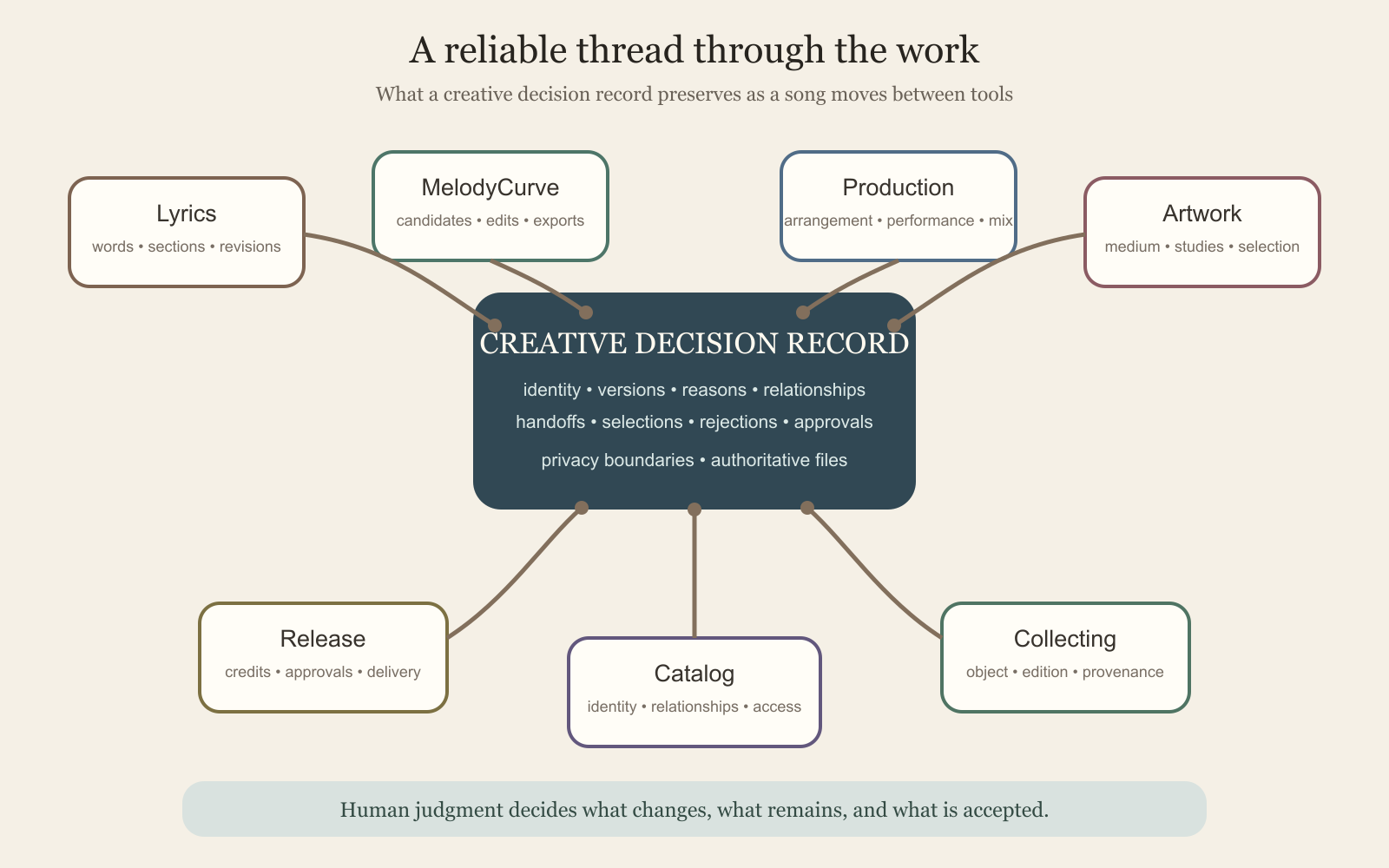
A Practical IdeaVortex Record
The first implementation can use four connected records:
- Creative record: song relationship, human center, visual score, medium, and source files.
- Object record: dimensions, materials, signature, condition, images, and care.
- Edition record: edition rules, proofs, production, numbering, inventory, and authorized realizations.
- Transfer record: certificate issue, acquisition, shipment, ownership, and later transfers.
WordPress and Shopify can display or transact with portions of this information. Neither should be the only authoritative archive.
Key Questions and Example Answers
Is a certificate the same as provenance?
Example answer: No. The certificate summarizes and attests to facts from the larger provenance record.
Does a certificate guarantee future value?
Example answer: No. It helps identify and document the work. It cannot guarantee demand or price.
Should the collector’s name appear publicly?
Example answer: Only with permission. Public provenance can state “private collection” while the private transfer record remains complete.
What happens if a certificate is lost?
Example answer: IdeaVortex should verify the object and ownership, cancel or record the prior certificate status, and issue a traceable replacement rather than creating an unrelated new identity.
Use This Record in Context
Pair this guide with the media distinctions collectors should preserve, the broader collector guide, and the real Love in the Cloud nine-work series.