Collectors often encounter physical, digital and system-rendered art under the single word “digital,” even though these works can be made and preserved very differently.
For collectors, that can obscure how a work was made, what object is being offered, and what should be preserved.
IdeaVortex uses three primary descriptions—physical handmade, digitally handmade, and computationally or system-rendered—plus hybrid work when a piece meaningfully crosses those boundaries.
These are not rankings. They describe different relationships among the artist, tools, process, and object.
Comparing Physical, Digital and System-Rendered Art
The distinctions below describe how the artist, tools, process, and final object relate. They are not rankings of artistic value.
Physical Handmade Art
Physical handmade art is created through direct work with physical materials.
Examples may include drawing, painting, collage, printmaking, sculpture, or mixed media. The surface can preserve pressure, texture, correction, layering, wear, and other evidence of material contact.
A collector should ask:
- What are the materials and substrate?
- Is the work unique?
- Has it been fixed, varnished, mounted, or framed?
- Are there vulnerable surfaces or materials?
- What light, humidity, handling, and storage conditions are recommended?
- Are studies or related versions known?
High-quality photography documents the work. It does not replace the physical object.
Digitally Handmade Art
Digitally handmade art is composed and revised directly by the artist through digital tools.
The artist may draw, paint, layer, erase, mask, transform, or assemble the work by hand within software. Digital tools affect the process, but the work is not primarily produced by an autonomous or rule-driven generative system.
A collector should ask:
- What is considered the authoritative digital master?
- Is the acquisition a file, a physical realization, or both?
- Is the physical realization unique, limited, or open edition?
- What dimensions, substrate, ink, and printer specifications apply?
- How are files identified, preserved, and backed up?
- May the artist produce the work in another size or format later?
The edition statement should define the collectible object rather than relying on the fact that a source file exists.
Computationally or System-Rendered Art
Computationally or system-rendered art uses declared rules, systems, algorithms, data relationships, repeated processes, or controlled variation as part of the medium.
The artist may design the system, select inputs, set boundaries, direct iterations, reject results, revise the process, and choose the final work.
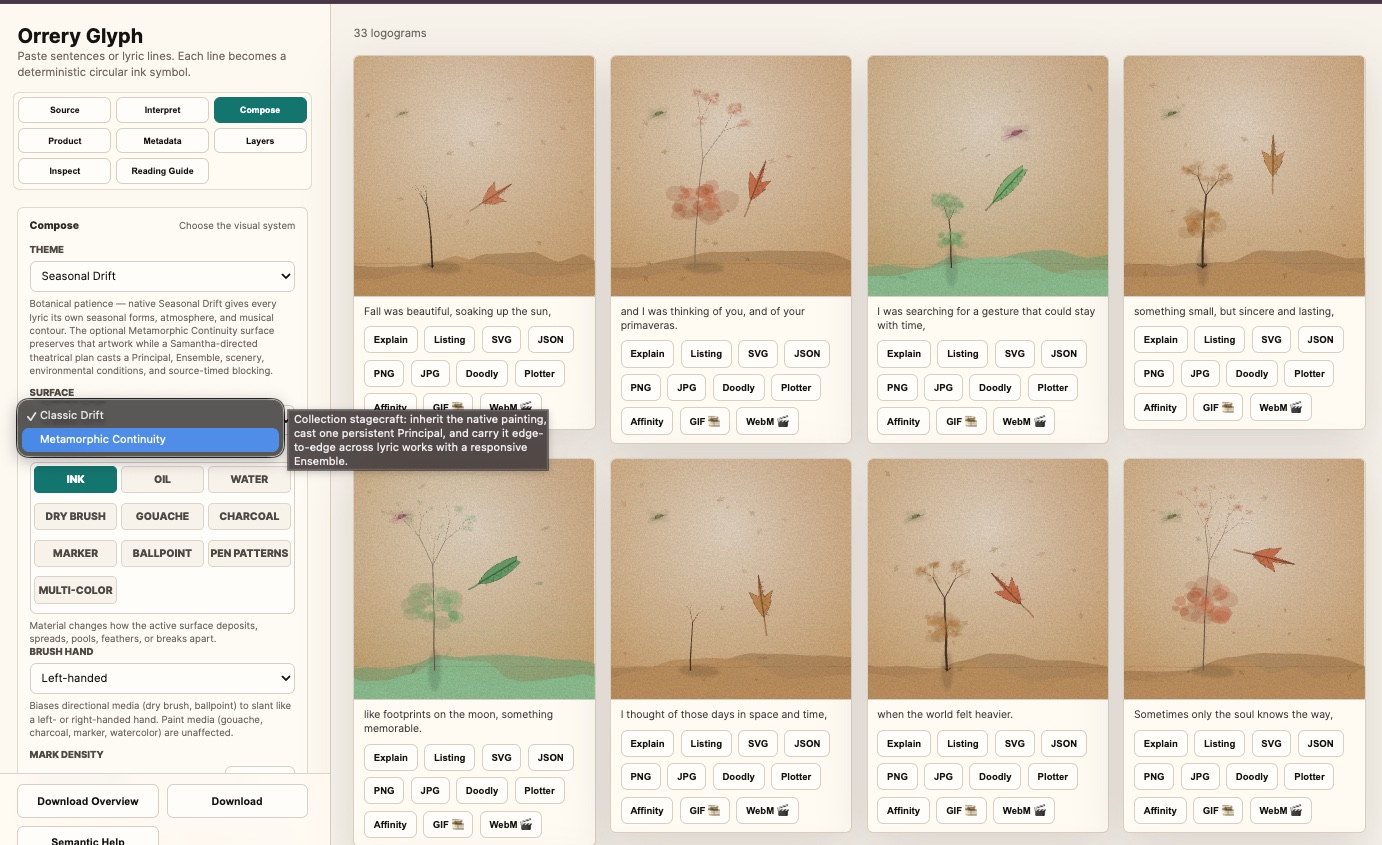
For the Love in the Cloud series, Orrery Glyph is a human-directed system used to create networked visual structures connected to selected song information.
A collector should ask:
- What system or process produced the work?
- Which decisions did the artist control?
- Is the acquired work fixed or capable of changing?
- Is it one selected result, a declared variation, or a live system?
- Can the system produce related future works?
- What defines the edition?
- What files, instructions, dependencies, or physical realization accompany the work?
“System-rendered” should not be treated as a synonym for a casual prompt or a generic AI image.
Hybrid Work
A hybrid work may combine direct physical action, digitally handmade composition, system-rendered structures, scanning, printing, transfer, or further physical intervention.
The description should identify the meaningful stages.
For example, a system-rendered structure printed and then substantially redrawn, painted, cut, or collaged by hand may be a hybrid physical work. A physical sketch scanned only for cleanup and archival printing may remain best described according to the artist’s actual process and final object.
The label should clarify rather than inflate.
Medium and Object Are Separate Questions
Medium describes how the work came into being.
Object status describes what the collector acquires.
A system-rendered work may be offered as:
- one unique physical realization;
- a limited archival-pigment edition;
- an open edition;
- a fixed digital file with defined transfer terms;
- or a live software-based work.
A physical handmade image may also produce authorized editions while the original remains unique.
Collectors need both descriptions.
What Provenance Should Record
Regardless of medium, provenance should include:
- stable catalog identifier;
- artist, title, and date;
- truthful medium description;
- dimensions and materials;
- object and edition status;
- signature and certificate information;
- source or master-file record where relevant;
- creation and revision information appropriate to the process;
- publication and exhibition history;
- condition;
- and ownership history when appropriate.
System and digital works may also require software versions, dependencies, checksums, rendering specifications, or migration plans.
Avoiding Misleading Language
Descriptions should avoid:
- calling every digitally produced image AI-generated;
- calling a printed digital work a handmade original without qualification;
- implying that an edition is unique;
- hiding that a system can create related variations;
- using “one of one” while retaining an undefined right to make identical physical objects;
- treating a physical print as though it includes copyright; and
- using technical language to make an ordinary production step sound rare.
Clarity supports trust.
Key Questions and Example Answers
Is physical handmade art more authentic?
Example answer: Not automatically. Authenticity depends on accurate authorship, process, object description, and provenance. Different media carry different qualities.
Is digitally handmade art the same as AI-generated art?
Example answer: No. Digitally handmade art is composed and revised directly by the artist using digital tools. A computational system may have little or no role.
Can a system-rendered work be original?
Example answer: Yes. Originality may reside in the artist’s system, rules, inputs, selections, revisions, and final work. The description should make those roles understandable.
What matters most to a collector?
Example answer: The quality of the work, truthful process description, precise object or edition definition, provenance, condition, rights, and long-term care.
Continue the Collector Guide
Apply these distinctions with the music-focused artwork collector guide and the provenance and certificates guide. A real nine-work example appears in Love in the Cloud.