The Love in the Cloud art series began with a song I wrote for my daughter and her husband. It later became the first full test of a larger IdeaVortex question:
Can a song become a coherent body of visual art without reducing the art to illustration?
The result was a black-and-white series of nine related works:
- Love in the Cloud;
- Verse 1;
- Chorus;
- Verse 2;
- Verse 3;
- Bridge;
- Hook;
- Outro; and
- Gallery.
The project established a useful reference point for the music-and-art catalog. It also showed why every future song should not be forced into the same format.
What the Love in the Cloud Art Series Tests
The Song Supplied a Relationship, Not a Picture
The song concerns love, connection, shared memory, and continuity. Its title also suggests networks and a cloud, but the visual project did not need to draw literal people standing beneath an illustrated cloud.
The stronger visual problem was relational:
- How can many small elements remain distinct while forming one field?
- How can connection feel active rather than diagrammatic?
- How can density and openness coexist?
- How can a black-and-white image carry warmth without relying on color?
- How can each song section have its own visual identity while remaining part of one family?
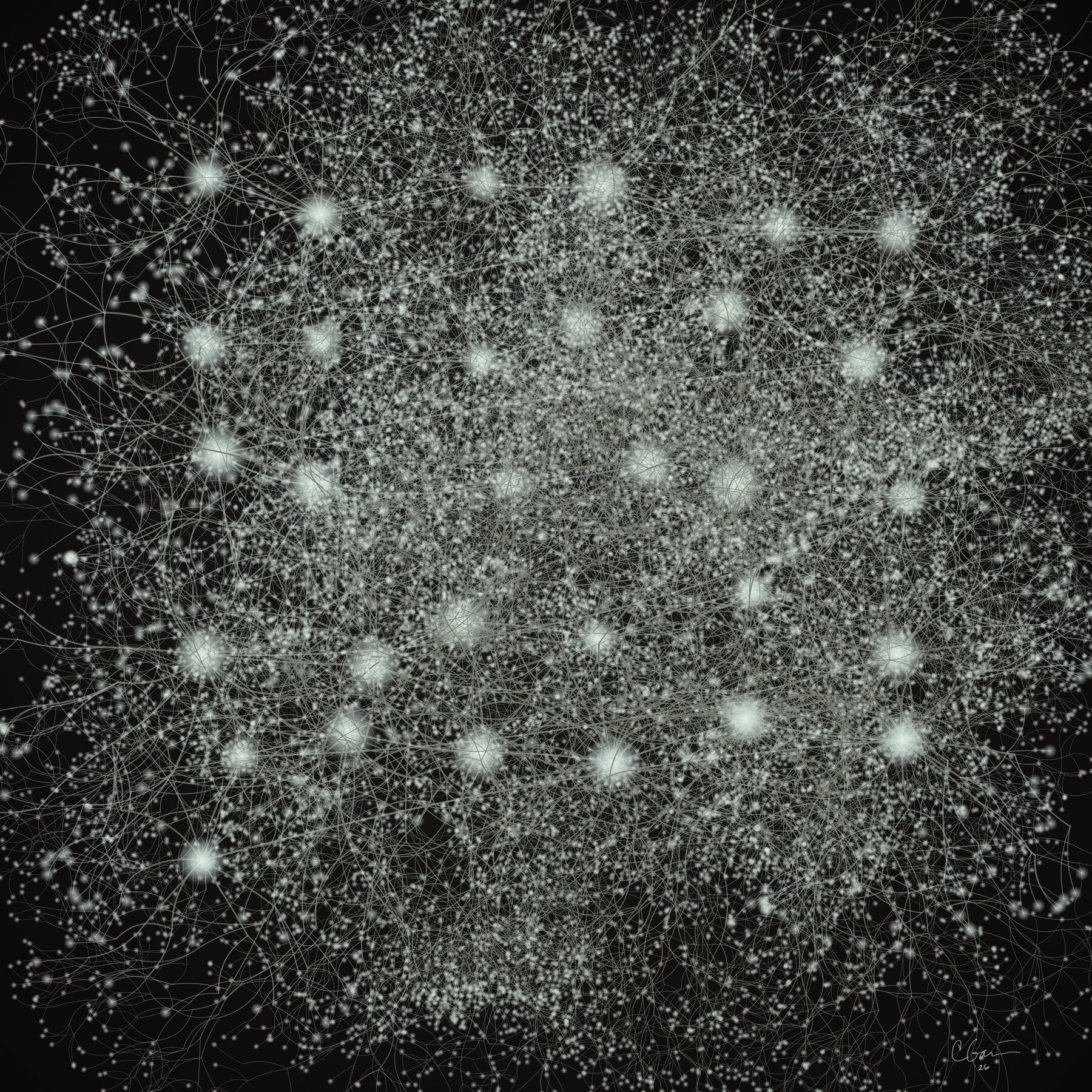
Those questions led toward networks, points of light, paths, clusters, and changing densities.
Why the Work Is System-Rendered
The series is system-rendered through Orrery Glyph, a human-directed process that translates selected song information into themed visual structures.
That description matters.
The works are not physical handmade drawings, even though archival prints become physical objects. They are not simply generic images generated from a title. A human-directed system creates the structures, and artistic decisions shape the inputs, rules, composition, selection, revision, and final presentation.
The system is part of the medium because networks, repetition, variation, and emergence belong to the meaning of this particular project.
Why There Are Nine Works
The song’s structure offered natural points of variation.
Verses, chorus, bridge, hook, and outro do not perform the same musical job. The visual series could therefore explore changes in density, direction, rhythm, concentration, and release without abandoning its shared grammar.
The main work establishes the larger field. Section-based works give individual parts of the song a more focused response. The gallery work helps the series read as a whole.
Nine was appropriate for this project because the internal structure supported it. It should not become a rule that every song must produce nine objects.
What Makes the Series Coherent
The works share:
- a black-and-white field;
- a language of networks and luminous nodes;
- repeated but non-identical structures;
- a tension between individual points and collective form;
- square presentation; and
- one source relationship to the song.
Coherence does not require identical compositions. The changes among works are part of the experience.
Defining the Collector Object
The current collector plan describes each work as:
- a 24 × 24 inch archival-pigment print on paper;
- an edition of ten;
- one artist copy retained;
- nine available to collectors;
- signed and accompanied by a certificate of authenticity; and
- shipped rolled in a tube.
Before publication or sale, those details must remain consistent across the artwork catalog, store, certificate, inventory record, and collector documentation.
The edition refers to the physical print, not to ownership of the song, copyright, reproduction rights, or the underlying Orrery Glyph system.
What the Pilot Taught
One Creative Record Is Necessary
The song, nine artworks, source files, titles, SKUs, print specifications, edition counts, descriptions, certificates, and store entries need reliable relationships.
Disconnected files make it easy to omit a work, duplicate an edition, or publish inconsistent information. The earlier omission of Bridge and Hook from one display was a practical example of this risk.
Medium Language Must Be Precise
Calling the work merely “digital art” would hide the role of the system. Calling it handmade would be inaccurate. “System-rendered through Orrery Glyph using a human-directed process” gives collectors more useful information.
The Artwork Needs Its Own Presence
The song explains why the series exists. The network fields, light, density, rhythm, and composition must still reward looking without the music playing.
The Series Needs More Than Store Listings
A collector should be able to encounter the complete series, understand the relationship among works, hear the song by choice, review the medium and edition, and identify which works remain available.
That calls for a catalog page, not only nine separate product cards.
What Comes Next
Love in the Cloud can become the first complete catalog entry and the first proof point on the IdeaVortex About page.
The next steps are:
- reconcile all nine authoritative artwork records;
- confirm titles, master files, print specifications, and edition language;
- create consistent certificates and provenance records;
- photograph or render the complete series consistently;
- publish a series page with optional listening access;
- connect each individual work to the series;
- show availability without creating false urgency; and
- preserve the records outside WordPress and Shopify.
Key Questions and Example Answers
Did software make the artistic decisions?
Example answer: No. Orrery Glyph is part of the medium. Human decisions direct the source relationship, rules, composition, selection, revision, and final presentation.
Are the works illustrations of song sections?
Example answer: They are abstract visual responses. The song sections provide structure, but the works use networks, light, density, and rhythm rather than literal scenes.
Why is one artist copy retained?
Example answer: The stated edition contains ten prints, with one retained as the artist copy and nine offered to collectors. The certificate and inventory records must describe this consistently.
Will every IdeaVortex song become a nine-work series?
Example answer: No. Love in the Cloud is a reference implementation, not a production template. Each song will receive only the visual treatment its artistic idea supports.
Continue Through the Catalog and Collector Record
Place this nine-work series in its larger context with the music-and-art catalog transformation, the provenance and certificates guide, and the song-cycle collecting guide.
Catalog entry
Explore the IdeaVortex Music & Art Catalog for the song, its nine-work series, process records, and collector information.