Turning a song into visual artwork is not the same as producing a strong image for each lyric.
A lyric line can produce a strong image. A verse can hold together. Several sections can look persuasive beside one another.
The complete artwork can still fail.
I encountered that problem while developing Seasonal Drift for A Little Leaf of Fall. Orrery Glyph could render meaningful line studies and coherent song sections. That success created useful evidence, but it did not settle the larger artistic question: could the complete song become one visually necessary work?
This is where a production workflow and an artistic decision begin to separate.
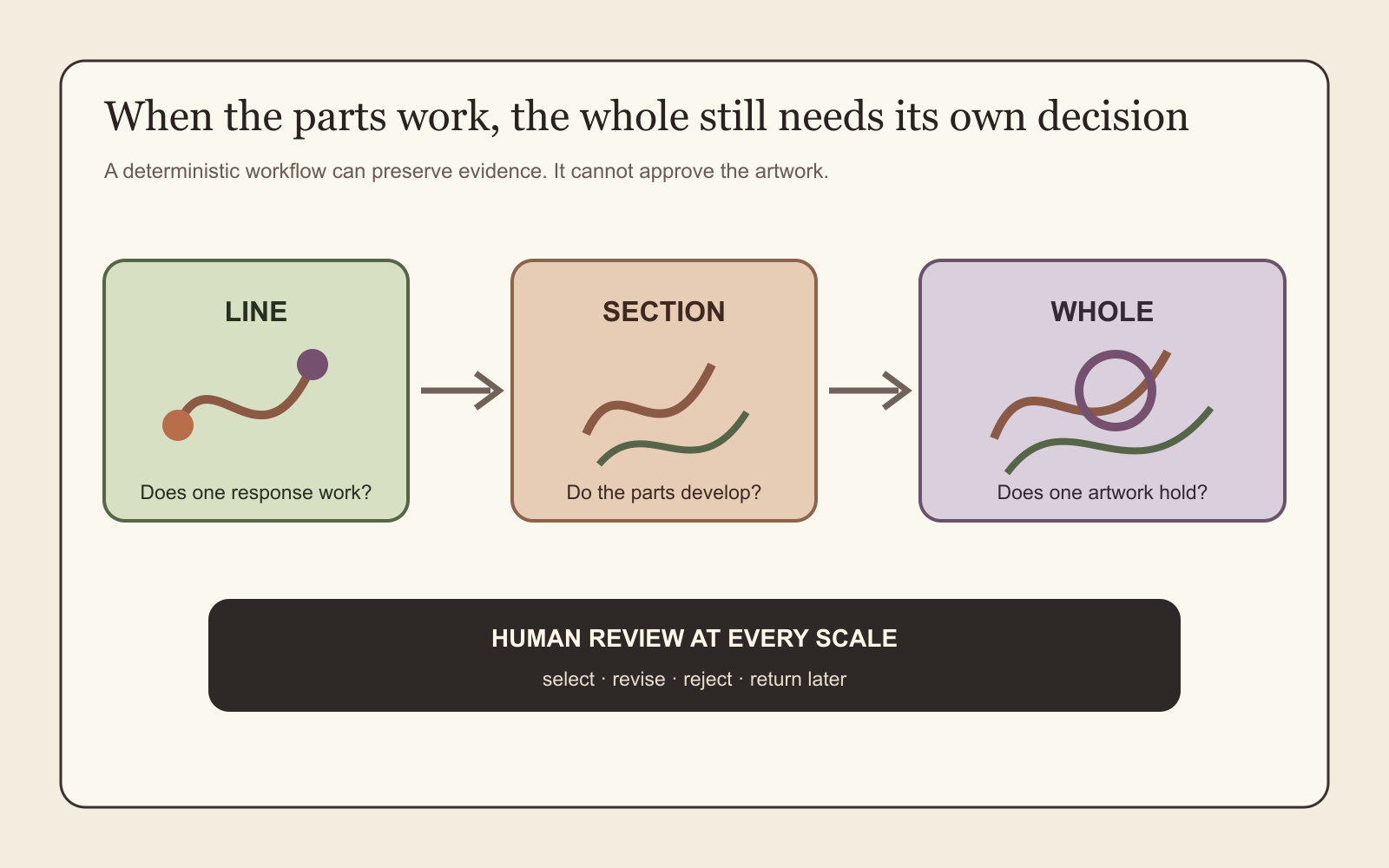
Three Scales, Three Different Tests
I review this work at three scales.
The line
A line study asks whether one lyric fragment can produce a meaningful visual response. It can test an object, gesture, direction, relationship, density, pause, or change.
A successful line study is local. It does not have to carry the song.
The section
A section study asks whether a verse, chorus, bridge, or other musical unit can hold a visual character across several lines.
The section introduces continuity. Repeated forms can become motifs. Changes in spacing, color, pressure, and movement can develop rather than simply appear.
A successful section is more than a collection of good lines, but it still does not have to resolve the complete work.
The whole
The WHOLE view has a different burden. It must establish hierarchy, pacing, balance, recurrence, contrast, and an ending. It must decide what the viewer notices first, what persists, what disappears, and what remains after the last section.
The whole cannot be approved by adding up local successes.
Why Good Parts Can Produce a Weak Whole
Several problems can emerge only when the song is viewed together.
Too many line-level subjects can compete for attention. A leaf, bird, flower, tree, figure, and landscape may each work in isolation while leaving the full composition without a center.
Repeated visual responses can become mechanical. A renderer may treat every lyric with equal emphasis even when the song does not.
Section boundaries can become too obvious. The result may look like a set of panels or presentation slides instead of one artwork.
A strong local image can also become too literal. If every named object is preserved, the full result may illustrate the lyrics rather than interpret the song.
Finally, the parts may agree stylistically but fail emotionally. Consistent color and texture can unify a surface without carrying the song’s movement from closeness to distance, or from tenderness to memory.
Seasonal Drift Made the Problem Visible
As I recorded in Before the Painting, Seasonal Drift began as a strong conceptual match for A Little Leaf of Fall. Its botanical vocabulary, interrupted descent, translucency, and measured movement could respond to the song’s leaves, seasons, patient affection, and approach and retreat.
The first linear gallery helped me inspect each lyric line and compare groups of lines by section. It also exposed the risk of treating every successful study as evidence that the entire visual language had been solved.
Some line works had convincing atmosphere. Some objects carried the lyric clearly. Some sections developed their own color and movement.
The gallery was still diagnostic evidence, not a finished artwork.
This distinction matters. Technical completion asks whether every line rendered and every file exported. Artistic review asks whether those results belong together.
Metamorphic Continuity: A Response, Not an Automatic Solution
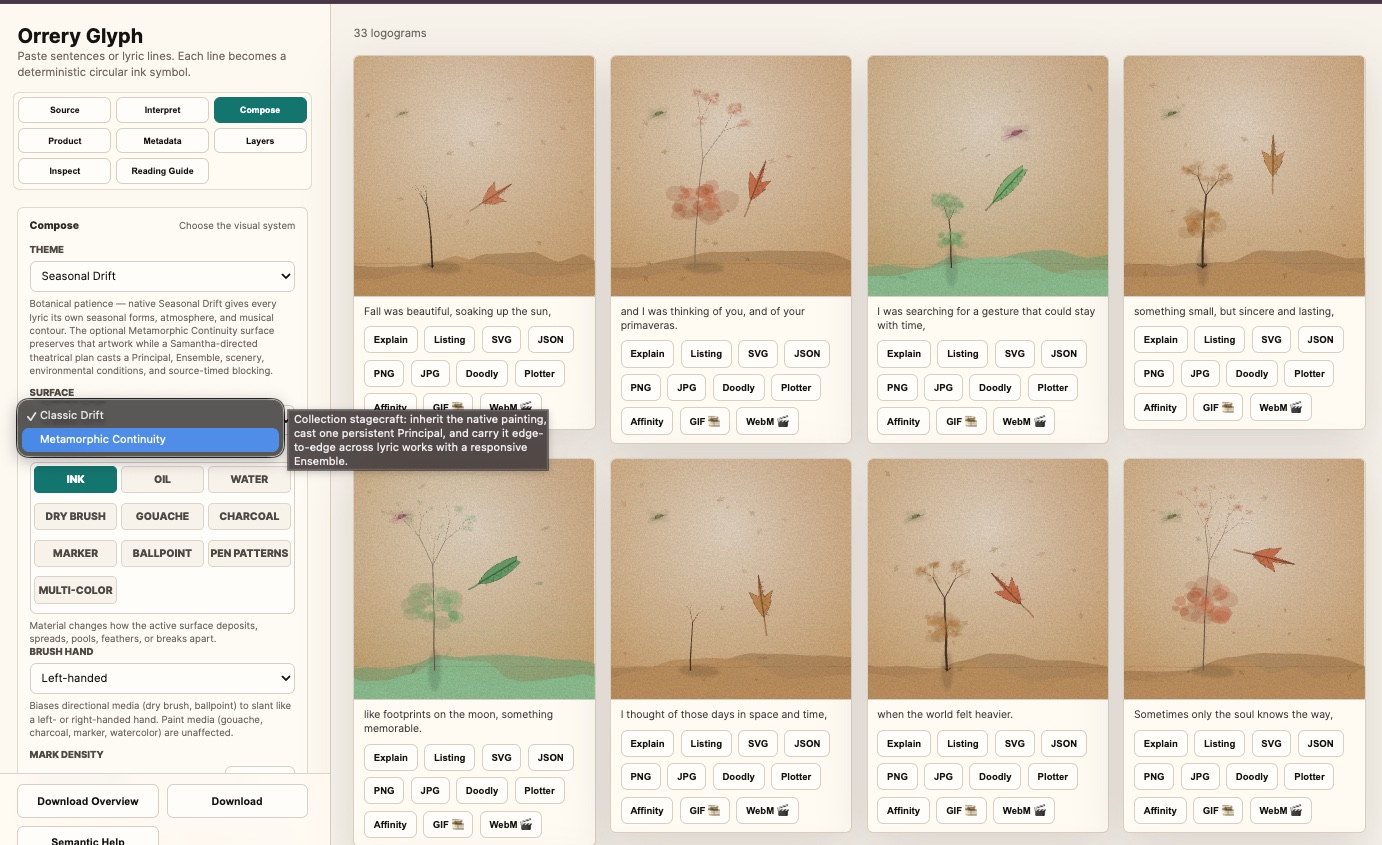
The line-to-whole problem led me to create a new Orrery Glyph Surface named Metamorphic Continuity.
Metamorphic Continuity: An unbroken process of transformation where underlying forms, materials, or philosophical states constantly shift while maintaining a persistent, connected existence. In Orrery Glyph, the artwork can change across lyric scenes without losing its identity, relationships, or memory.
A Surface in this context is not merely texture or simulated material. It inherits behavior from a parent theme and adds another set of visual rules. Metamorphic Continuity retains Seasonal Drift’s botanical atmosphere while allowing a lyric-derived target and subtargets to persist, change, enter, or recede across related visual fields.
The originating idea came from two paintings by my daughter. In the first, a female silhouette blows toward a flower with visible pollen while tiny people begin descending by parachute. In the next painting, those figures continue their journey and become clearer. The two works tell a larger story because an element crosses the boundary between them.
I adapted that continuity principle, not her imagery.
Orrery Glyph deterministically derives the target and subtargets from the lyric structure. I then judge whether their persistence strengthens the artwork. That implementation was a programming task within a larger algorithmic art practice. The derivation algorithm is proprietary, but the observable artistic decision can be documented.
Continuity can help the parts speak to one another. It cannot guarantee that the whole deserves to exist.
Establishing a primary and secondary subject
For A Little Leaf of Fall, the recognizable subjects are the leaf and the hummingbird. I needed a deterministic way to establish which should lead, so I used recurrence in the lyric. The leaf appears most often and became the primary subject. The hummingbird became the secondary subject.
This gave the work a clearer narrative hierarchy. The parent Seasonal Drift theme could continue to preserve abstract semantic relationships, while the Metamorphic Continuity Surface added the more explicit notion of subjects.
The rule also exposes an open design problem. What happens when the next song does not contain a leaf and a hummingbird? Should the subject rules change? If they do, how does this song continue to produce the same deterministic result?
I do not yet know. The likely requirement is to preserve the rule version with the work, but the broader subject model remains unresolved. Readers who follow the studio record may see what my developer-and-artist mind produces next.
I am satisfied with what Orrery Glyph can generate now. Here, generative retains its algorithmic meaning: a programmed system produces repeatable visual results from rules and source material. It does not mean that an AI service generated a finished image from a prompt. I discuss that distinction further in Rethinking AI Music.
Algorithmic Art Still Requires Composition
The art is being written and rendered algorithmically overall.
I define the visual vocabulary, program the deterministic rules, choose the parent theme and surface, set the relationships among lyric units, inspect the outputs, and decide what to retain, revise, or reject.
Repeatability is valuable. If a rule changes, I can compare the result rather than relying on an unrecorded prompt and an unrelated new image.
But deterministic output does not turn local coherence into composition.
The system can carry a target across sections. It cannot decide whether that target has become tiresome. It can preserve a motif. It cannot determine whether the motif deserves the viewer’s attention. It can assemble the WHOLE view. It cannot approve it as art.
A Practical Whole-Work Review
When the parts appear successful, I now ask a separate set of questions about the whole.
Is there a clear visual hierarchy?
Not every lyric line should receive equal weight. The composition needs dominant, supporting, and quiet areas.
Does continuity feel necessary?
A recurring target should develop the story. If it only proves that the system can repeat an object, it should be reduced or removed.
Can the work stand without the lyric?
The song may deepen the artwork, but the complete image should not require the text to excuse its composition.
Are section boundaries helping or dividing the work?
Sections can structure movement, but the final result should not feel like six unrelated cards.
What has been rejected?
A credible studio record includes attractive results that did not belong in the whole. Beauty alone is not sufficient.
What remains unresolved?
Unresolved hierarchy, scale, rhythm, palette, or object relationships should be named before the work is called finished.
The Creative Decision Record Connects the Scales
A creative decision record for a song helps retain the relationship among line, section, and whole studies.
For this work, the record can identify:
- the lyric and song version;
- the Seasonal Drift theme and selected Surface;
- meaningful settings and rule changes;
- targets and subtargets without exposing proprietary derivation logic;
- accepted, rejected, and superseded studies;
- the reason a line or section result was retained;
- the version used to assemble the WHOLE view; and
- the final human decision: select, revise, reject, or return later.
The record does not make the selection. It prevents the selection from becoming detached from the evidence that informed it.
A Workflow for Artists Using Structured Systems
The approach can be used beyond Orrery Glyph.
- Generate or construct local studies at the smallest meaningful scale.
- Review them as evidence, not finished inventory.
- Group related studies and test section-level continuity.
- Assemble the complete work without assuming every successful part survives.
- Review hierarchy, pacing, recurrence, contrast, and independence from the
- Remove elements that explain more than they contribute.
- Record accepted and rejected decisions.
- Repeat the same deterministic process after material changes.
- Approve the work only at the scale at which it will be presented.
source text.
This order protects the work from a common mistake: confusing the availability of many valid outputs with the completion of one artwork.
The Current Seasonal Drift Decision
Seasonal Drift remains in revision.
Metamorphic Continuity is an accepted development direction because it gives me a controlled way to test narrative persistence across lyric lines and sections. It is not proof that the WHOLE view is resolved.
The next result must show whether the recurring targets create hierarchy and memory or merely connect the panels. It must also show whether the botanical language can carry the song without becoming an ordinary illustration.
If the line and section studies remain stronger than the whole, that is not a failed experiment. It is a useful artistic result.
The parts may be kept as studies.
The whole still has to earn its place.
Looking again at the whole
The Journey of Looking records how I move between line, section, and whole-song views while deciding what the artwork should keep or omit.