
A songwriting digital transformation should begin with the songwriter’s work, not with a demand to use more technology.
MelodyCurve is a lyrics-first songwriting system. It begins where many songwriters begin: with words, phrases, and the emotional shape of a song.
It can suggest musical settings, generate melody candidates within musical constraints, align notes with syllables, play the result, support direct editing, preserve versions, and export work into formats used elsewhere.
That makes it a useful application. It does not, by itself, make it a digital transformation.
The transformation is found in the work that changed around it.
The Earlier Workflow Was Divided
A songwriter who begins with lyrics may move through several disconnected steps:
- Write and revise the words.
- Decide how syllables, stresses, and pauses might become rhythm.
- Search for a key, mode, meter, tempo, and chord progression.
- Try melodic phrases by voice or instrument.
- Record rough ideas before they disappear.
- Compare alternatives from memory or separate files.
- Move the selected idea into notation or production software.
- Preserve enough context to understand later why a decision was made.
None of those activities is wrong. Many songs have been written that way.
The difficulty is that the information does not travel easily between the steps. Lyrics may be in one document, chords in another, a vocal idea in an audio recording, and the editable notes somewhere else. A later export may preserve the notes while losing their relationship to the words that shaped them.
The process depends heavily on memory and repeated reconstruction.
MelodyCurve Changes the Unit of Work
MelodyCurve treats the song idea as a connected working record rather than a pile of separate artifacts.
Lyrics are not attached after the musical work is complete. They are part of the input. Section markers, syllables, punctuation, line endings, musical settings, chord choices, and melody notes can remain related as the songwriter works.
That changes the unit of work from “generate some notes” to “develop a lyric-aware melodic idea.”
The distinction is important. A note can be valid in a scale and still be wrong for a word. A rhythm can be mathematically tidy and still fight the natural stress of a sentence. A melodic phrase can sound attractive by itself and fail when someone has to sing it.
MelodyCurve brings those questions into the same workflow.
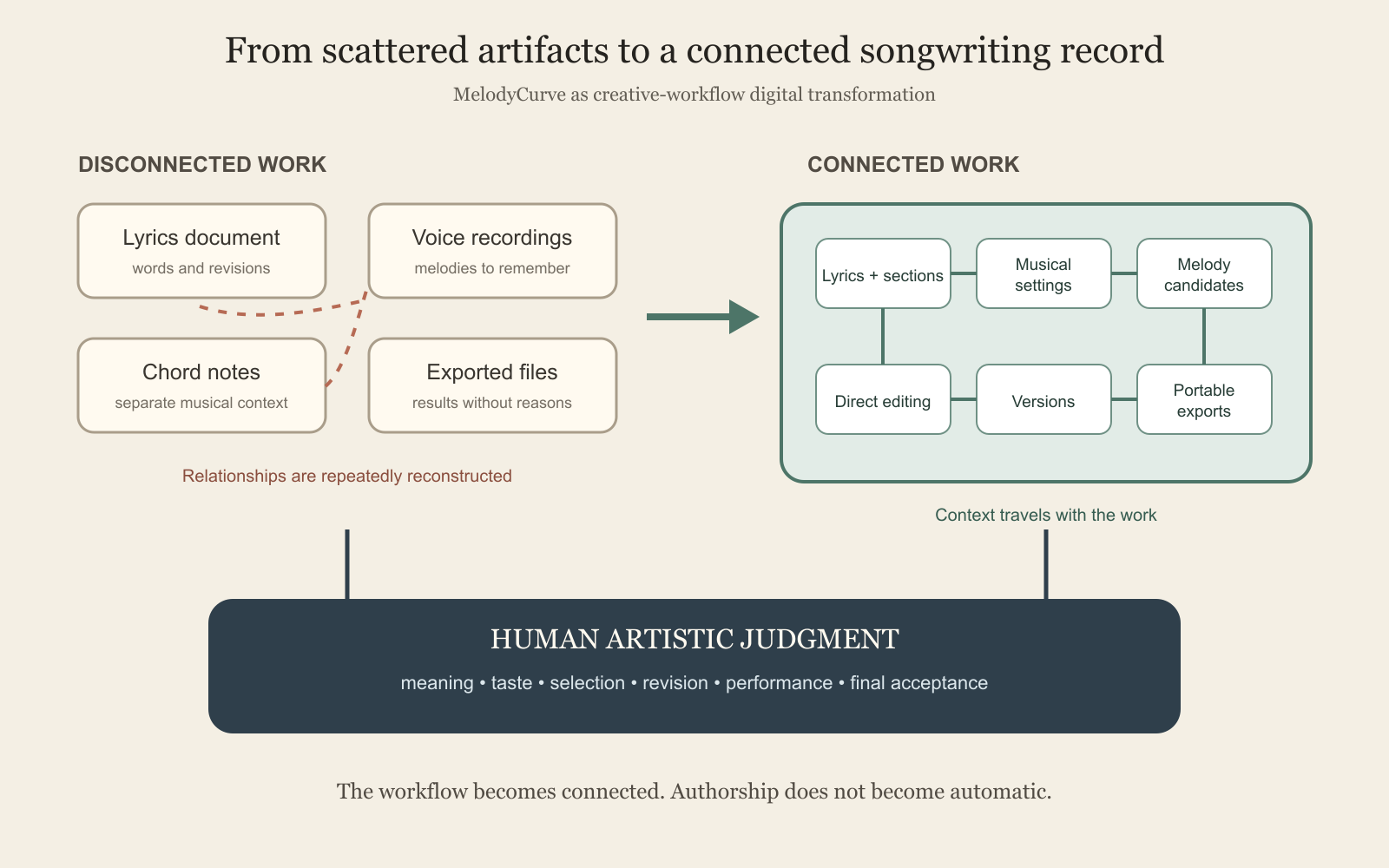
MelodyCurve connects lyrical, musical, editing, and export decisions. Human artistic judgment remains active throughout the workflow.
What the System Does—and What It Does Not Decide
The application can analyze lyrical mood and suggest musical settings. It can apply rule-based musical constraints when generating candidates. It can favor singable movement, relate strong beats to harmony, account for phrasing, and present several possibilities for review.
Those capabilities reduce mechanical work and make alternatives easier to inspect.
They do not answer the final artistic questions:
- Does the melody sound like this song belongs to me?
- Is the emotional movement too obvious?
- Does a surprising note deepen the lyric or merely call attention to itself?
- Does the chorus earn its lift?
- Should a difficult phrase remain difficult?
- Is the result memorable after the application stops playing?
The songwriter still selects, edits, performs, revises, or rejects the work.
This is not the same as entering a short prompt and asking for a finished song. The songwriter remains inside the process. Musical choices stay visible and editable instead of arriving only as a completed audio result.
Why This Can Be Called Digital Transformation
Digital transformation should begin with a real need. In this case, the need is not “use more artificial intelligence.” It is to help a lyrics-first songwriter carry intention through a fragmented musical workflow.
MelodyCurve addresses that need in several connected ways:
- Information becomes structured. Lyrics, sections, syllables, musical
- Decisions become inspectable. The songwriter can see and edit pitch,
- Alternatives become comparable. Candidate melodies can be reviewed
- Work becomes reversible. Undo, redo, and version history make
- Outputs become portable. MIDI, MusicXML, audio, and lyrics exports allow
- Human control remains explicit. Suggestions and generated candidates do
settings, chords, notes, and versions can be treated as related information.
timing, note relationships, and lyrical alignment.
without relying only on memory.
exploration less destructive.
the work to continue in notation and production tools.
not become artistic decisions until the songwriter accepts them.
The result is not simply a faster old process. It is a different way to organize the work.
The Difference Between Assistance and Substitution
Creative software often becomes difficult to discuss because every use of automation is treated as the same thing.
It is not.
A tool can substitute for a finished creative decision. It can also expose more decisions to the person doing the work.
MelodyCurve is designed around the second model. It offers candidates and editing surfaces. It makes relationships visible. It allows the writer to change the notes, timing, musical settings, and structure. Its value depends on the songwriter continuing to judge the result.
That does not make every output good. It makes the path to revision clearer.
A Practical Example
Consider a songwriter who has completed a verse and chorus but cannot find a melody that respects the words.
In a disconnected process, the writer may record several vocal attempts, change chords on an instrument, rewrite a line, and then lose track of which version solved which problem.
In MelodyCurve, the writer can:
- Enter the lyrics with verse and chorus markers.
- Review suggested musical settings rather than accepting them blindly.
- Choose or change the harmonic direction.
- Generate several lyric-aligned melody candidates.
- Listen while following the words and curve.
- adjust individual pitches or timing.
- Compare the result with the earlier candidates.
- Export the selected work for notation, production, or further performance.
The transformation is the continuity between those steps. The writer does not have to surrender authorship to gain that continuity.
Questions to Ask Before Transforming a Creative Workflow
The MelodyCurve example suggests a practical set of questions for other creative systems:
What human need starts the process?
For MelodyCurve, it is the need to turn words into singable melodic ideas without losing the relationship between them.
Which information is repeatedly lost or reconstructed?
The connection among lyrical stress, phrasing, harmony, melody, revisions, and exported files is easily lost when each step uses a separate artifact.
Which decisions should software support?
Repetitive analysis, candidate generation, alignment, playback, comparison, versioning, and format conversion are appropriate forms of support.
Which decisions must remain human?
Meaning, identity, taste, emotional truth, selection, revision, performance, and final acceptance remain with the songwriter.
Can the work leave the system?
A useful transformation should not trap the song. Standard exports allow the writer to continue in other tools.
Can an unfinished result be revised?
If the only useful output is a finished file, the workflow leaves too little room for authorship. Editable intermediate results matter.
What Remains Unfinished
MelodyCurve has a broad set of implemented capabilities, but the larger transformation is still developing.
For example, a documented integration plan proposes comparing an exported reference melody with audio returned from another generation system. That could help a songwriter determine whether the returned performance preserved the intended melodic identity. It is a useful direction, but a plan should not be described as a completed production feature.
The same discipline applies to provenance, validation, collaboration, and professional workflow claims. Each must be tested in real use and described according to its actual state.
The Transformation Is the Preserved Relationship
MelodyCurve is easy to describe as a melody generator. That description is too small.
Its more important idea is that a songwriter’s words, musical choices, revisions, and portable outputs can remain connected through the development of a song.
Technology organizes and supports that relationship. It does not supply the reason the song should exist.
That remains human work.
Continue the Songwriting Workflow
Carry the selected song beyond MelodyCurve with a creative decision record across tools. For the authorship boundary, see why I do not let AI write my songs and why “AI music” needs more precise language.