Creative work rarely develops in the order we use to explain it afterward. A finished body of work can make the path look inevitable: first came the idea, then the method, then the refinement, and finally the result. My own experience is almost the opposite. I make something because it interests me. It exposes a question I did not know I was asking. That question appears again inside another theme, another material, or another technical problem. Only later do I recognize that the works have been teaching one another.
The work is never linear.
This is not a complaint about disorder. It is one of the strengths of an artistic practice. An experiment can remain valuable before I know where it belongs. A theme can be created in a vacuum and still alter everything that follows. The important question is not whether each study advances a predefined plan. It is whether I looked closely enough to carry something meaningful away from it.
An experiment does not have to justify itself in advance
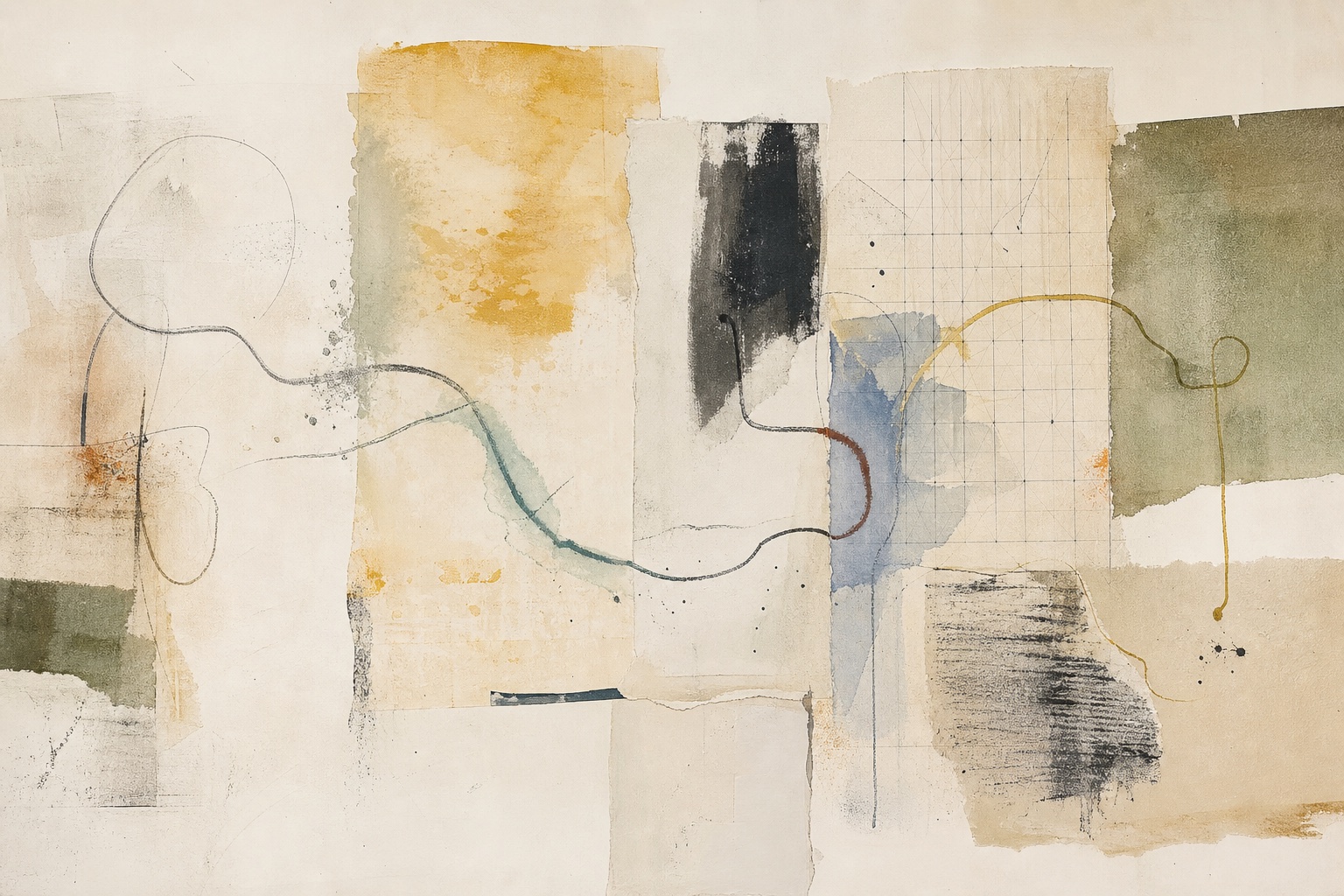
I have created abstract themes without knowing how they would contribute to the larger body of work. They were not illustrations of a strategy. They began with curiosity about shape, rhythm, density, interruption, color, movement, or the behavior of a surface.
I do not see those works as a step down from the goal of creating collector’s fine art. They gave certain questions enough room to become visible. Representation sometimes arrives with obligations: an object must remain identifiable, a narrative must be readable, or a symbol must carry an expected meaning. Abstraction can temporarily release those obligations and let me examine relationships directly.
What does variation feel like when it is not yet development? How little can remain before absence becomes active? Can two regions answer each other without becoming symmetrical? When does repetition produce rhythm, and when does it produce stagnation? These are not merely technical questions. They are distinctions that change what I am able to see.
The study may begin in a vacuum, but the artist does not leave it empty-handed.
What travels between works
The most useful discoveries are often not motifs. I do not need to carry the same leaf, figure, palette, or composition into every theme. What travels is a way of noticing.
One experiment may teach me the difference between movement and displaced repetition. Another may show that an empty area is not unfinished if the surrounding marks make the absence consequential. A third may reveal that a rough edge carries memory more convincingly than a complete form. These discoveries can enter later work without being copied visibly.
This is why nonlinear practice can still accumulate knowledge. The works need not resemble one another for one to deepen the next. Their continuity may exist in judgment rather than appearance.
In The Journey of Looking, I described attention as an active part of making: the work is examined at the level of the line, the section, and the whole. That same principle applies across themes. Looking also happens retrospectively. I can return to an earlier experiment and finally understand what it contributed.
Good abstractions remember what the experiments discovered
There is a parallel process in the code. Surfaces and reusability did not have to be imposed as a master plan before the themes existed. They emerged because recurring artistic needs became visible through practice.
A good code abstraction is not simply a clever way to avoid duplication. At its best, it preserves a distinction. A surface may separate compositional behavior from material treatment. A shared structure may let several themes use the same information while interpreting it differently. An export stage may remain independent of the visual language that produced the artwork.
These separations matter because they allow learning to travel without forcing every theme to look alike. Reusable architecture should protect difference, not erase it.
This is the reversal I want to remember: I did not create the experiments to justify a reusable system. The system became reusable because the experiments taught it something worth remembering.
Reuse is a consequence, not the artistic purpose
Reuse can easily become a false measure of value. A singular hand-drawn decision may never be repeated and may still be the most important act in the studio. A piece of code may be used a hundred times without producing one necessary artwork.
The reusable part does not have to be the final mark. It may be a boundary, a relationship, a passage, a method of review, or a record of why an element was removed. The artwork can remain specific while the learning becomes available elsewhere.
This lets me hold two commitments at once. I can build systems capable of supporting future work, and I can protect the irreducible decisions that give collector’s fine art its presence. Scalability belongs to the infrastructure. It does not have to determine the character or quantity of the finished work.
Lessons learned so far
- A detour can become a foundation. Its value may only become legible after another work needs what it discovered.
- Abstraction is not an escape from the main work. It can isolate relationships that representation makes difficult to see.
- Technical reuse should follow artistic recognition. Abstract what has become meaningfully recurrent, not everything that could theoretically be generalized.
- Shared structure should preserve independent visual languages. Themes can inherit information and still refuse to resemble one another.
- Documentation should record decisions, not only settings. Palette, dimensions, materials, and parameters matter, but so does the reason an element was accepted, revised, or removed.
- A study is successful when it improves judgment. It does not have to become a product or a feature to contribute to the practice.
- The finished work remains the test. Technical completion and architectural elegance do not equal artistic completion.
AI: another collaborator, another possible detour
This raises a newer question: when should AI enter the development workflow?
AI belongs naturally within the subjects I write about, and working with it can increase the range and speed of development. It can help me compare interpretations, inspect implementation, articulate alternatives, preserve decisions, and notice assumptions that have become invisible through familiarity. Used well, it can help move knowledge between artistic and technical forms.
But capability is not the same as direction. AI can generate enough momentum around the tool that the artwork recedes from view. A development conversation can branch indefinitely. Every answer can produce another feature, another abstraction, or another plausible path. The collaboration can feel productive while postponing the moment when I must look at one work and decide what it needs.
I do not need to settle this question in advance. I can give AI a provisional role and evaluate it by its consequences.
Does this collaboration return me to the work with a clearer eye, or has it given me another interesting place to remain?
That question is more useful than deciding whether AI is inherently part of the art or merely a development tool. Its role may change from one phase to another. It can be expansive while possibilities are being named, critical while assumptions are being tested, and quiet when the work requires sustained attention from the hand and eye.
A working agreement with the tool
For now, I can establish a few boundaries. AI may help me ask better questions, identify transferable distinctions, test whether the architecture expresses the artistic intention, and document what changed. It should not decide that a technically valid result is artistically resolved. It should not multiply possibilities when the next necessary act is commitment. And it should not make the practice legible at the cost of making it alive.
The artist remains responsible for selection, refusal, material consequence, and completion.
This is close to the conclusion I reached in Code the Conditions, Paint the Decision. The system can establish a field of possibility, but possibility must eventually encounter judgment. The same applies to collaboration. AI can help design the conditions. It cannot relieve me of choosing the work.
A retrospective that remains open
“Lessons learned” can sound like a report written after the uncertainty has ended. That is not what I mean here. The practice is still moving, and some of these conclusions will be revised by the next experiment.
The retrospective is useful precisely because the path was nonlinear. It lets me recognize which discoveries traveled, which abstractions earned their place, which tools expanded the work, and which forms of productivity became stagnation. It gives me a way to continue without pretending that continuation must be straight.
The work may move from abstract study to code, from code to drawing, from one theme into another, or from a conversation back to the studio. What matters is not the sequence. What matters is whether each movement enlarges my capacity to see and helps something worth collecting come into being.
The work is never linear, but it can still be cumulative.