Love in the Cloud began with my daughter and her husband.
Their relationship inspired me to write about a form of love that feels very contemporary but is built on timeless emotions: two people maintaining a profound connection across physical distance, with technology becoming part of how that connection lives.
The song brought together distance, digital life, and the kind of love that can make those barriers feel smaller. That human story came first. The visual art developed afterward.
You can watch Love in the Cloud (Official Music Video) or visit my IdeaVortex Official Artist channel for more releases.
When I began writing songs, I thought mainly about words and music. Over time, that boundary became less clear. A song created images in my mind, and an image could suggest another way of hearing the song.
Love in the Cloud became one of the first places where those ideas came together.
I did not want to make a single cover image and call the visual work finished. I wanted to ask a larger question: could the structure and meaning of a song become a visual language of its own?
The Sound of the Story
The music combines contemporary pop with the emotional directness of a classic love ballad. It moves at a mid-tempo pace, with piano carrying much of the romantic feeling, acoustic guitar adding warmth, and soft percussion supporting the rhythm without overwhelming it.
The arrangement fits the story. The relationship is shaped by modern technology, but the emotions are not technological. Distance, devotion, memory, and the hope of building a life together are timeless.
The lyrics return to the idea of two people bridging distance and forming something lasting in the cloud. The digital setting is important, but it is never the real subject. The subject is the human connection.
In addition to the official music video, you can hear the mastered song on YouTube or find it on streaming platforms.
The Artist Came Before the Developer
Long before I wrote my first program, there were pens, ink, color, and pencils.
I had an architectural design background, but the creative impulse came even earlier. Architecture gave it discipline and taught me to think about proportion, structure, space, and how separate elements form a whole. It did not create the artist in me. That part was already there.
I have always had what I think of as the wild mind of a left-handed person—visual, restless, and constantly making unexpected connections. I do not mean that left-handedness automatically makes someone creative. It is simply part of how I have always understood my own way of moving through the world.
For much of my professional life, I worked hard to keep the artist in the background. Software development rewarded logic, precision, and systems thinking, and I built a long career around those strengths. But the creative side never disappeared. It came through in doodles, portraits, designs, and ideas that refused to remain contained.
It may have been a quieter side of me professionally, but it was never a smaller one.
Retirement did not turn me into an artist. It gave the artist who was already there more room to come forward.
Programming later gave that imagination another set of materials. Object-oriented design, abstraction, and generative systems did not replace the pen or pencil. They expanded the number of ways I could give an idea form.
A Song Is Already More Than Sound
A song contains several kinds of information at once.
There are the literal words. There is the emotion behind them. There is rhythm, repetition, contrast, tension, release, and the shape of the melody. A listener experiences these things together, even when they are not consciously analyzing them.
As a software developer, I tend to look for systems and relationships. As someone with an educational background in architecture, I also think about structure, space, balance, and movement.
Those instincts made me wonder whether a song could be interpreted visually without simply illustrating its lyrics.
Why Abstraction Felt Like Second Nature
Abstraction was already second nature to me because I had spent more than thirty years as an object-oriented software architect and developer.
In object-oriented design, abstraction means separating an essential idea from one particular implementation. You define what a part of the system is responsible for, then allow different components to carry out that responsibility in their own way.
A well-designed application does not force every part to know every internal detail. One component works through a clear contract with another. The implementation can change without requiring the entire system to be rebuilt. In plain English, one underlying idea can support several valid expressions.
That thinking transferred naturally to Orrery Glyph. I could separate the structure interpreted from a song from the particular visual theme used to express it. A theme could work with the shared abstraction while still producing art with its own materials, geometry, and character.
The abstraction layer does not dictate a single picture. It creates a stable bridge. Different themes can cross that bridge and arrive somewhere visually different.
To me, this does not make art mechanical. It prevents the system from confusing the meaning of a song with one fixed visual style. The separation creates room for variation, experimentation, and human choice.
Illustration Was Not the Goal
If a lyric mentions a cloud, the most obvious response is to draw a cloud. That can work, but it was not what interested me most.
I wanted to move one level deeper.
What relationships exist inside the song? Where does it gather energy? What returns? What feels distant or connected? How might the rhythm, lyrical ideas, or musical structure influence shape and placement?
This is where abstraction became important. An abstract image does not have to describe the song literally. It can create a visual experience that carries some of the same internal relationships.
The viewer does not need to decode every mark. The work should still function as art.
The Love in the Cloud Series
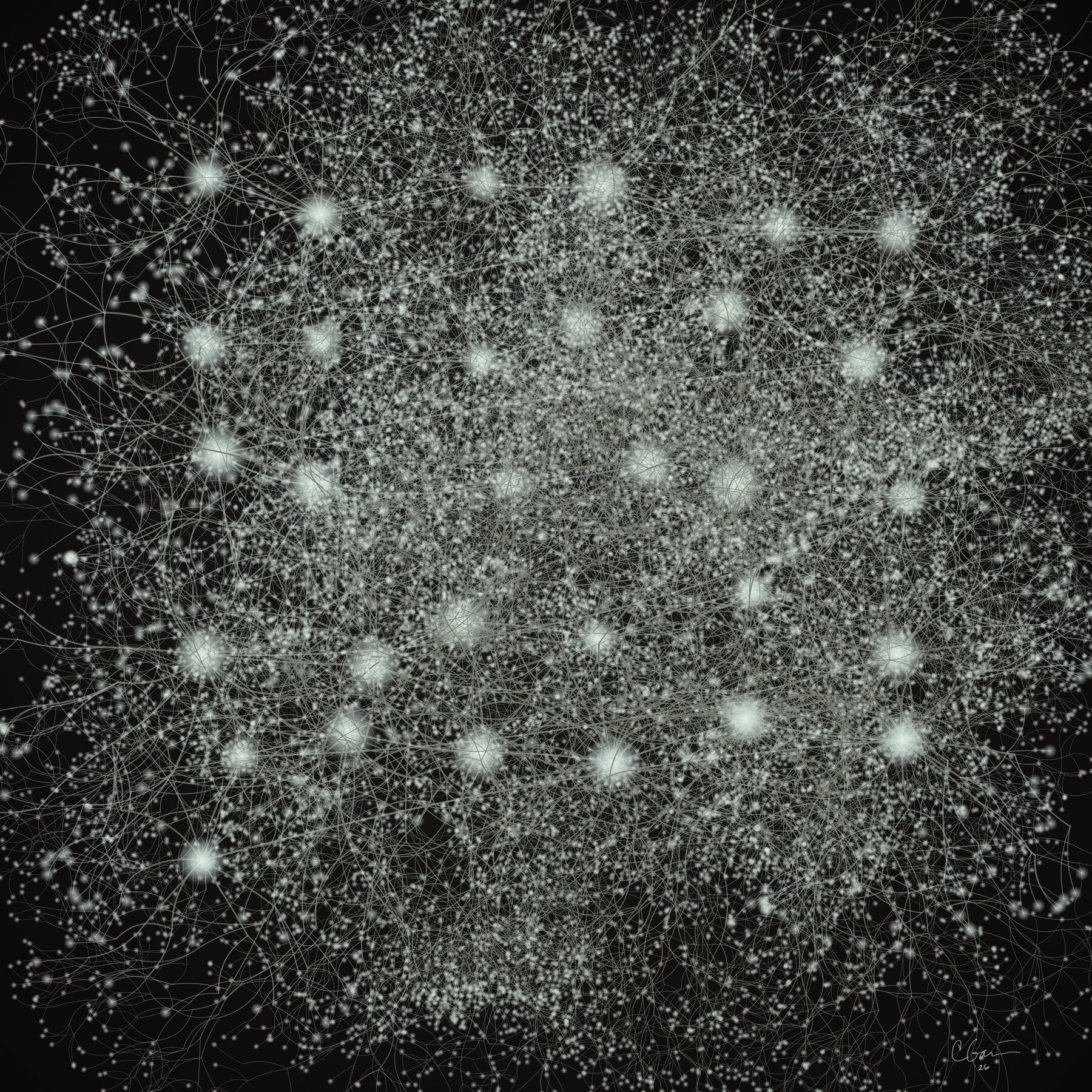
The visual work associated with Love in the Cloud developed into a coherent black-and-white series. The pieces use points, lines, clusters, and open space in ways that can suggest constellations, networks, notation, or memory.
I think of this as one theme within a much larger system—not as the single appearance of all the art I intend to make.
That distinction matters. Orrery Glyph is not a style filter that makes every song look alike. It is a system capable of supporting different visual themes. Each theme can interpret song information through its own materials, geometry, and visual character.
Love in the Cloud became the second of those themes.
Three Ways I Make Art
It is also important to understand that my creative life did not begin with digital systems.
I have always drawn. My doodles give ideas a place to appear without asking permission. I also make portraits dedicated to particular people, where the relationship and intention behind the work matter as much as the image. Physical, handmade art remains the largest and most active part of my practice today.
I see three related but different ways of making art in my work.
Physical, Handmade Art
This includes the doodles, portraits, and other work I make directly with physical materials. My hand, the surface, the tool, and even small imperfections participate in the result.
Digitally Handmade Art
Digital art is not automatically generated art. I can still draw, place, shape, erase, revise, and compose the work myself. The screen and software are the medium, just as paper and physical tools are media. The decisions and marks remain direct.
System-Rendered Art
The third category is work rendered through a system I designed and direct. The usual term is “generated art,” but I use it reluctantly. In today’s AI conversation, “generated” can sound like a slot machine: pull the lever and accept whatever appears.
That description does not fit my process. I design the system and its themes, choose meaningful inputs, set constraints, evaluate variations, reject weak results, refine the controls, and curate what becomes part of a collection. The computer performs part of the rendering, but the creative process surrounds and directs it.
For that reason, I prefer terms such as system-rendered or computationally rendered. They acknowledge what the software does without erasing what the artist designed and decided.
These categories are not competitors, and one is not automatically more valuable than another. They are different relationships between the hand, the tool, the system, and the finished work. My physical practice informs my digital judgment, and my digital experiments sometimes return new ideas to the work I make by hand.
Where the Human Artist Remains
When software participates in visual art, people often assume that the artist typed a prompt and accepted the first image produced.
That is not how I approach this work.
I design the system, choose the inputs, develop the visual theme, evaluate the results, change the controls, reject weak pieces, and decide what is worth presenting. The software can generate possibilities, but it does not decide what the collection means or which work is finished.
My handmade art also influences my judgment. Working physically develops a different sensitivity to line, balance, material, and imperfection. Digital tools do not replace that experience. They give me another medium in which to apply it.
The important part is not whether a computer was involved. The important part is where the meaningful choices were made.
A Repeatable System, Not a Repeated Picture
One quality I value in my songwriting tools is repeatability. I do not want every result to depend on pulling a lever and hoping chance produces something useful.
The same principle matters in the visual work.
A repeatable system lets me return to an idea, vary selected inputs, compare outcomes, and build a related collection. It gives the work continuity without requiring every image to be identical.
That is an important difference:
Repeatability creates authorship and control. Repetition alone creates sameness.
A visual theme should be recognizable, but each piece should still have a reason to exist.
What Makes Song-Based Art Collectible?
I am interested in what a collector receives when music and visual art belong to the same creative process.
The artwork can stand on its own. It should not require the song as an explanation or an apology. But knowing that it emerged from a particular song can add another layer of meaning.
A collector might encounter the art first and discover the music afterward. A listener might begin with the song and want a physical expression of its world. Several pieces could form a visual suite connected with different aspects or moments of the same music.
This relationship creates possibilities beyond conventional album art. The image is no longer packaging. It becomes another authored work connected to the same source.
Connecting the Art Through StepCard
This is also where StepCard becomes relevant.
A physical artwork can serve as an entry point into a larger experience. An image can function as a QR code, connecting the collector or viewer to music, video, writing, and an interactive sequence.
The art does not have to sit silently beside a separate web address. It can participate in the path through the work.
One person might enter through a song. Another might enter through an image. Both can discover the relationships among the music, the visual collection, and the story behind them.
What I Am Protecting
I can explain the premise of Orrery Glyph without publishing its internal methods.
At a high level, it can work with sources such as lyrics and MIDI and render visual art or video through different themes. The important technical layer is how those inputs are interpreted and translated into a form that themes can use.
That abstraction layer is part of the technology I am protecting. I will discuss the creative questions and show finished work, but I will not publish the dictionaries, weighting, parsing, mappings, or generation methods behind it.
This is not meant to make the work mysterious for its own sake. It is a normal boundary between explaining an artistic system and giving away its protected implementation.
One Song, Several Creative Lives
Retirement gave me time to pursue music, but music did not remain in one box.
It led me back into software design. It connected with my interest in visual systems and architecture. It gave my digital art a source of structure and gave my handmade work another context.
Love in the Cloud helped me see that a song can have several creative lives. It can be heard, seen, collected, revisited, and experienced through more than one medium.
That is the larger direction of Orrery Glyph: not turning every song into one kind of picture, but creating a thoughtful bridge between musical structure, human interpretation, and visual art.
Related: Orrery Glyph: From Alien Language to Song-to-Art System