This Peaceful goose painting began when I went to the lake because I was trying to get some pain relief.
A Canada goose with a drooping left wing stayed near me.
I cannot say why the goose remained there. I do not know its diagnosis, its history, or what it made of my presence. What I know is simpler: I was struggling, the goose appeared to be carrying a struggle of its own, and for a while we occupied the same place.
I called my friend Peaceful.
The First Attempt
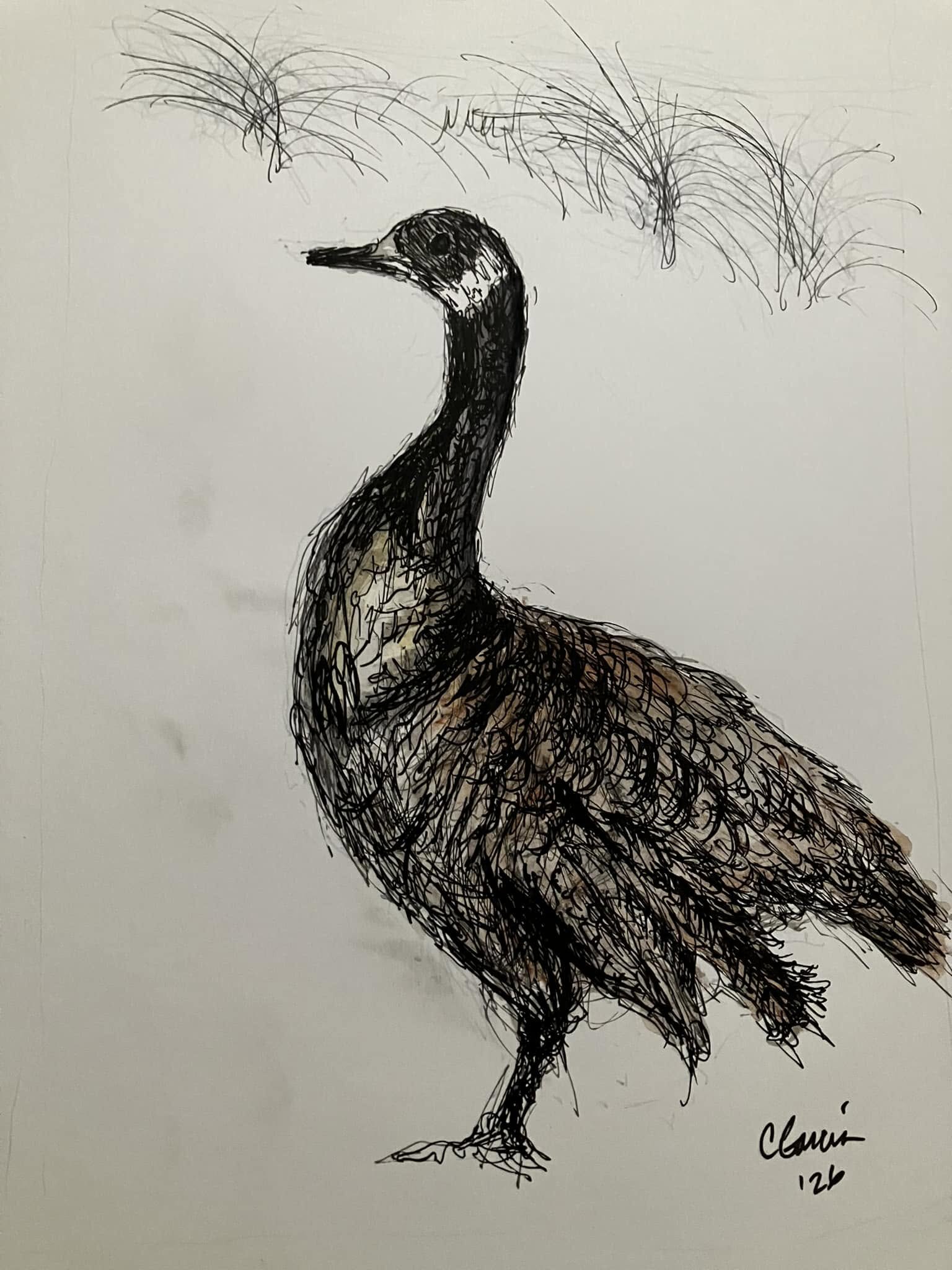
The first attempt established the bird through urgent line, repeated marks, and a restrained field.
I began drawing Peaceful from direct observation at the lake and continued at home using my own photograph. The first study is mostly drawing. I used erasable ink, although I did not really need to erase anything. I draw with the ink itself. Dense black marks build the head, neck, body, wing, and single visible leg. The body accumulates from short, searching strokes. I especially like the line detail along the edges because it keeps the bird organic.
The limited brown washes begin to locate the feather mass, but much of the surface remains open. Loose marks above the goose suggest surrounding movement without describing a finished landscape.
I made mistakes along the way, and I had very little color in the first phase. This version found the bird’s posture and alert presence, but it did not yet give Peaceful the clear day or the environment I remembered.
What Changed
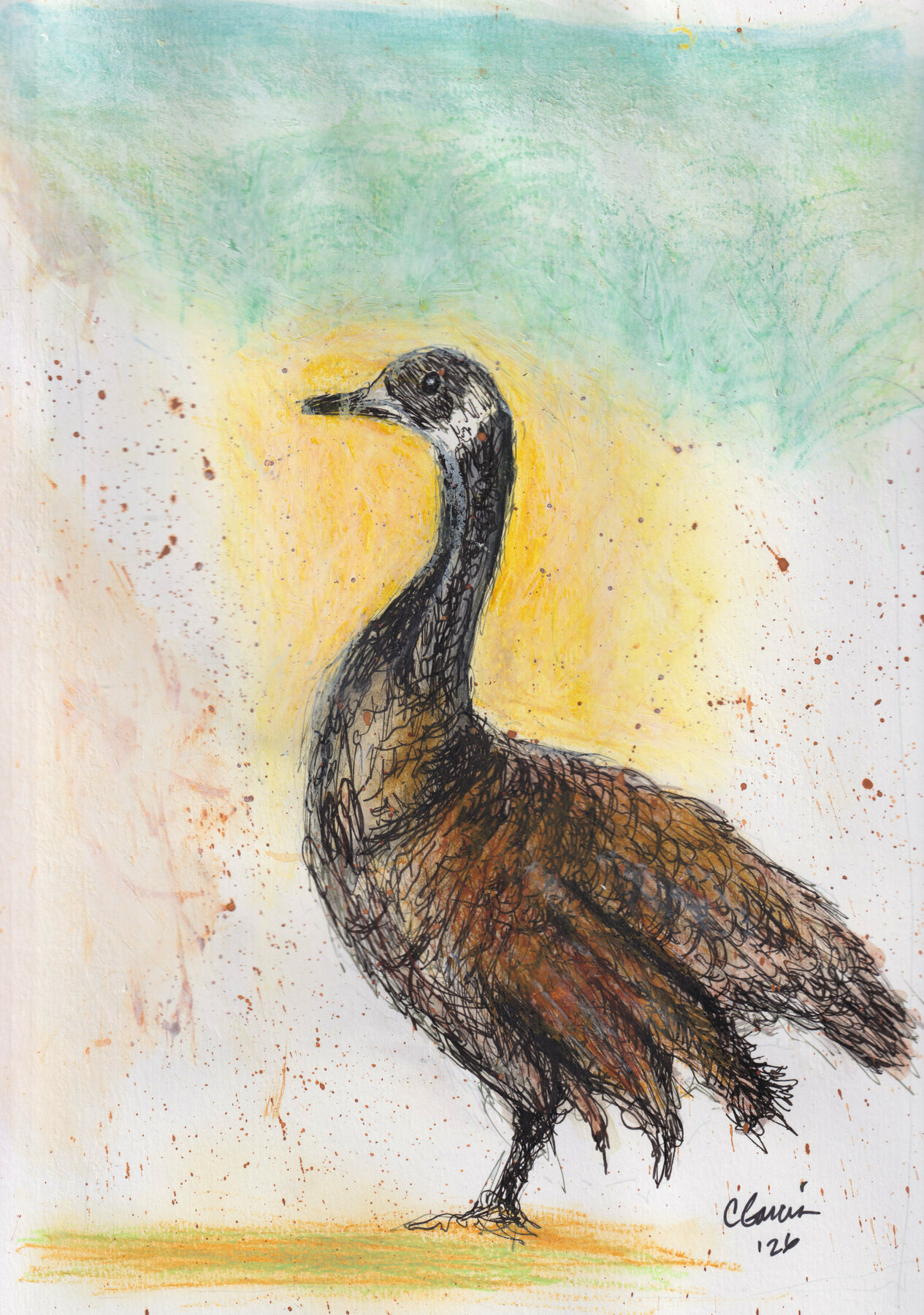
The finalized study retains the original line drawing while adding atmosphere, warmth, color, and ground.
The final version does not replace the first drawing. It carries it forward. The black marks remain visible throughout the neck, body, and wing.
Several changes alter the emotional space:
- A pale turquoise field creates the air and openness of a clear day.
- Warm yellow gathers behind the head and upper body as light.
- Browns and muted orange deepen the feather mass.
- Scattered droplets interrupt the open surface.
- A narrow green-and-gold band gives the bird somewhere to stand.
- Color and open space help balance areas where I had overworked the shrubbery.
The result is still a study of a particular bird. It is also less isolated. The goose occupies a place rather than floating on an unfinished page. Building that clear day around Peaceful also helped me feel closer to the encounter. It carried some of the “feel better” sense that helped me endure the pain.
Why the Painting was named Peaceful
The title does not claim that the goose was free of pain or fear. I could not know that.
Peaceful names what the encounter offered me. And my wife picked that and named her or him.
Pain can narrow the world. It can reduce a day to finding the next position, the next treatment, or the next small amount of relief. At the lake, my attention moved outward. I noticed another living presence. I watched. I remembered.
The goose did not need to perform a rescue. Its presence was enough.
Peaceful Keeps Returning
Peaceful has since become what I affectionately call my “maintained” pet. I do not own or confine him. He remains free in a place that seems well suited to him, with water, shelter, plenty to eat, and perhaps family nearby. He chooses when to visit and when to leave.
What surprises me is that he often comes to see me alone. The other geese are usually together, while Peaceful keeps some distance. I have also seen other geese push him away. I cannot know whether they respond differently because of his drooping wing, but the possibility has crossed my mind.
During one recent visit, Peaceful positioned himself between me and the other geese. Perhaps he was protecting me. Perhaps he was protecting the food I was giving him. I know which interpretation I prefer, but Peaceful is entitled to keep a few secrets.
He also eats a surprising amount.
A Painting for My Doctor
I decided to give the finished painting to my doctor.
I told my doctor the story and warned her that I am no Picasso. She was excited nonetheless.
The disclaimer was probably unnecessary. I drew Peaceful from life at the lake and continued at home from my own photograph. The painting is a genuine record of a specific meeting during a difficult time. Giving it allows that moment to become an expression of gratitude.
The original will leave my possession, but not its history. The two photographs preserve an honest record of the study and its development.
What I Wrote on the Back
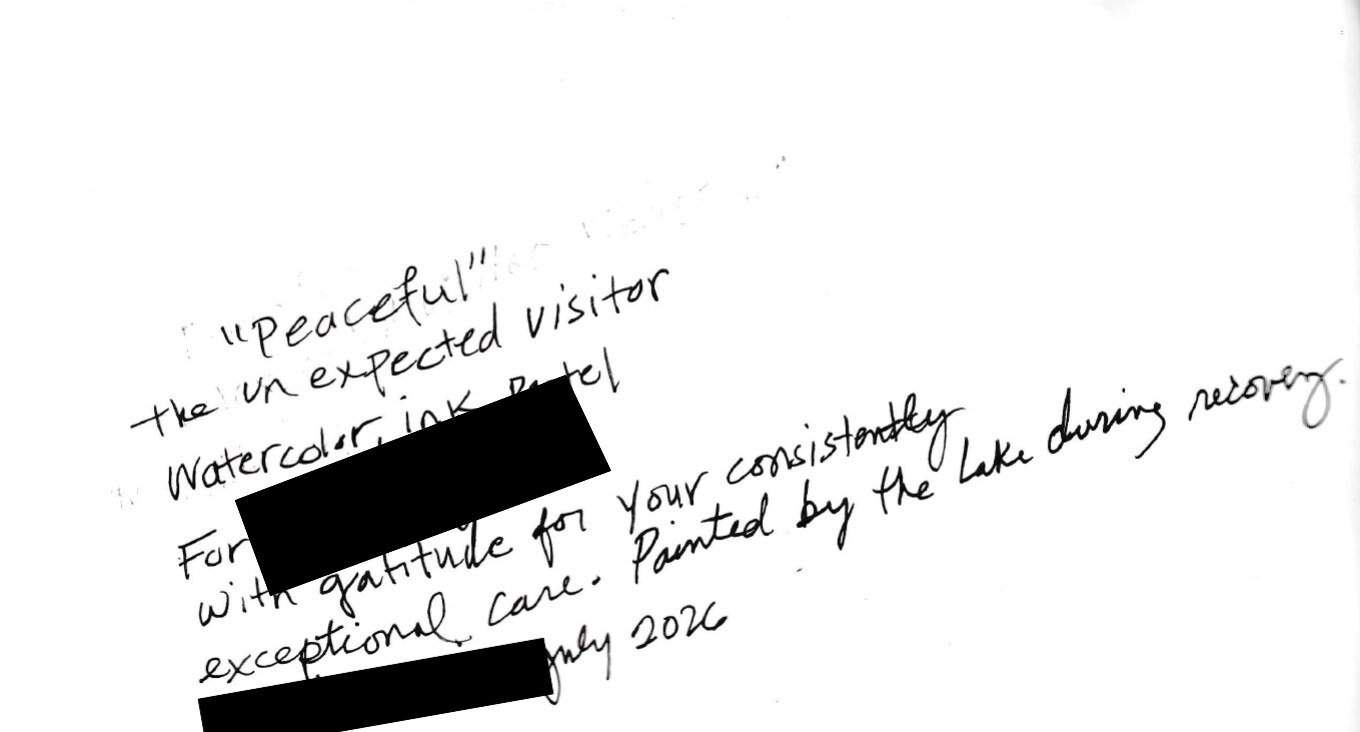
The redacted reverse preserves the original handwritten record without publishing my signature or the recipient’s name.
On the reverse I identified the work as:
“Peaceful,” the unexpected visitor
Watercolor, ink, pastel
For my doctor, with gratitude for consistent, exceptional care
Painted by the lake during recovery
July 2026
That note completes the record. It establishes the materials, recipient, setting, purpose, and date in my own hand. It also says something the front cannot: the painting was made during recovery and was always connected to an act of gratitude.
What the Two Phases Preserve
The first and final images show more than a before-and-after improvement.
The first attempt contains the act of finding: repeated observation, uncertain marks, corrections, pressure, and the search for posture.
The finalized version contains the act of choosing: which lines to keep, where to add warmth, how much atmosphere the bird needs, and when the work can stop.
That distinction matters in a studio record. A finished image can make its construction look inevitable. The earlier study shows that it was not.
The Story I Can Tell Truthfully
I can say that I went to the lake seeking relief from pain.
I can say that a goose with a drooping left wing stayed near me.
I can say that I felt companionship in the encounter and made this painting.
I can say that I named it Peaceful and chose to give it to my doctor.
I cannot say what the goose intended. I do not need to.
The meaning of the meeting lies partly in what happened and partly in the attention I gave it afterward. Painting became a way to keep that attention, then pass it along.
Key Questions and Answers
Is Peaceful a wildlife illustration?
It is a watercolor, ink, and pastel portrait of an observed goose, but it is not intended as a scientific or diagnostic illustration. The gestural line, color field, texture, and personal story are part of the work.
Why show the first attempt?
The first study shows the genuine construction of the painting. It records the limited palette, the mistakes, the ink drawing, and the environment that was still missing. Beside it, the final version shows why I added a clear day, preserved the organic edge lines, and used color and open space to balance the overworked shrubbery. The two phases also preserve something personal: building Peaceful’s environment helped me feel closer to the encounter and to the sense of relief I was seeking.
Why give away the original?
The painting grew from a difficult experience involving pain, attention, and relief. Giving it to my doctor turns the work into a specific expression of gratitude.
Is the goose’s injury known?
No. I observed a drooping left wing, but I do not know its medical condition or history.
Is the work connected to the music-and-art catalog?
Not directly. Peaceful belongs to the physically handmade side of my broader studio practice. Its inclusion helps show that the practice is not defined by one subject, medium, or set of digital tools.