I have written a large catalog of songs in English, Spanish, and other languages. The working files include lyrics, alternate versions, translations, notes, and metadata. One song, Love in the Cloud, has already grown into a related series of visual works.
That raised a useful question:
If I add fine art to a song catalog, am I carrying out a digital transformation?
Not necessarily.
Creating an artwork in response to a song is an act of artistic interpretation. It may produce a new and important body of work, but adding images to songs does not automatically transform the way the creative practice operates.
The transformation begins when the music and art become part of one reliable, repeatable, and sustainable catalog.
Artistic Expansion and Digital Transformation Are Different
A song may inspire a painting, drawing, digital composition, or computationally rendered work. The visual work can interpret the song’s emotional tension without illustrating the lyrics literally.
That is artistic expansion.
Digital transformation addresses a different set of questions:
- Can each song and visual work be identified reliably?
- Can translations and alternate versions be related without confusing them?
- Are authorship, medium, rights, and provenance recorded?
- Can a listener move naturally from a song to its artwork and story?
- Can a collector understand what object or edition is being offered?
- Can the catalog survive a change in website, store, streaming service, or social platform?
- Can the artist add future works without rebuilding the entire system?
The art supplies the creative reason for the catalog. Transformation supplies the operating discipline that allows the catalog to grow.
Begin With the Human Experience
The process should not begin by asking software to turn lyrics into a picture.
A stronger process begins by identifying the human experience beneath the song. That experience may be love, memory, endurance, doubt, belonging, caregiving, reconciliation, grief, renewal, or the quiet courage to continue.
The next question is about tension. A song may hold connection and separation, proof and belief, motion and stillness, ambition and presence, or fragility and endurance at the same time.
That tension can guide an abstract visual language:
- repeated or interrupted gestures;
- open or crowded space;
- grids, paths, orbits, networks, fractures, or thresholds;
- emerging, reflected, or obscured light;
- harmonious or conflicting colors;
- transparent, resistant, eroded, or accumulated materials; and
- a rhythm that pauses, returns, expands, or breaks.
The objective is not to reproduce every image named in the lyrics. It is to create an independent visual work that carries a related human truth.
The Artwork Must Stand on Its Own
For a collector, the song can deepen the experience of the artwork. It should not be required to rescue it.
A person who has never heard the song should still encounter a resolved visual work with its own presence, structure, and meaning. After hearing the song, the collector may understand why a certain tension, rhythm, material, or visual gesture matters.
This creates a conversation between two works:
- the song moves through language, sound, rhythm, and time;
- the artwork occupies space, material, color, gesture, and light.
The artwork is a second voice, not promotional merchandise.
Build One Canonical Creative Record
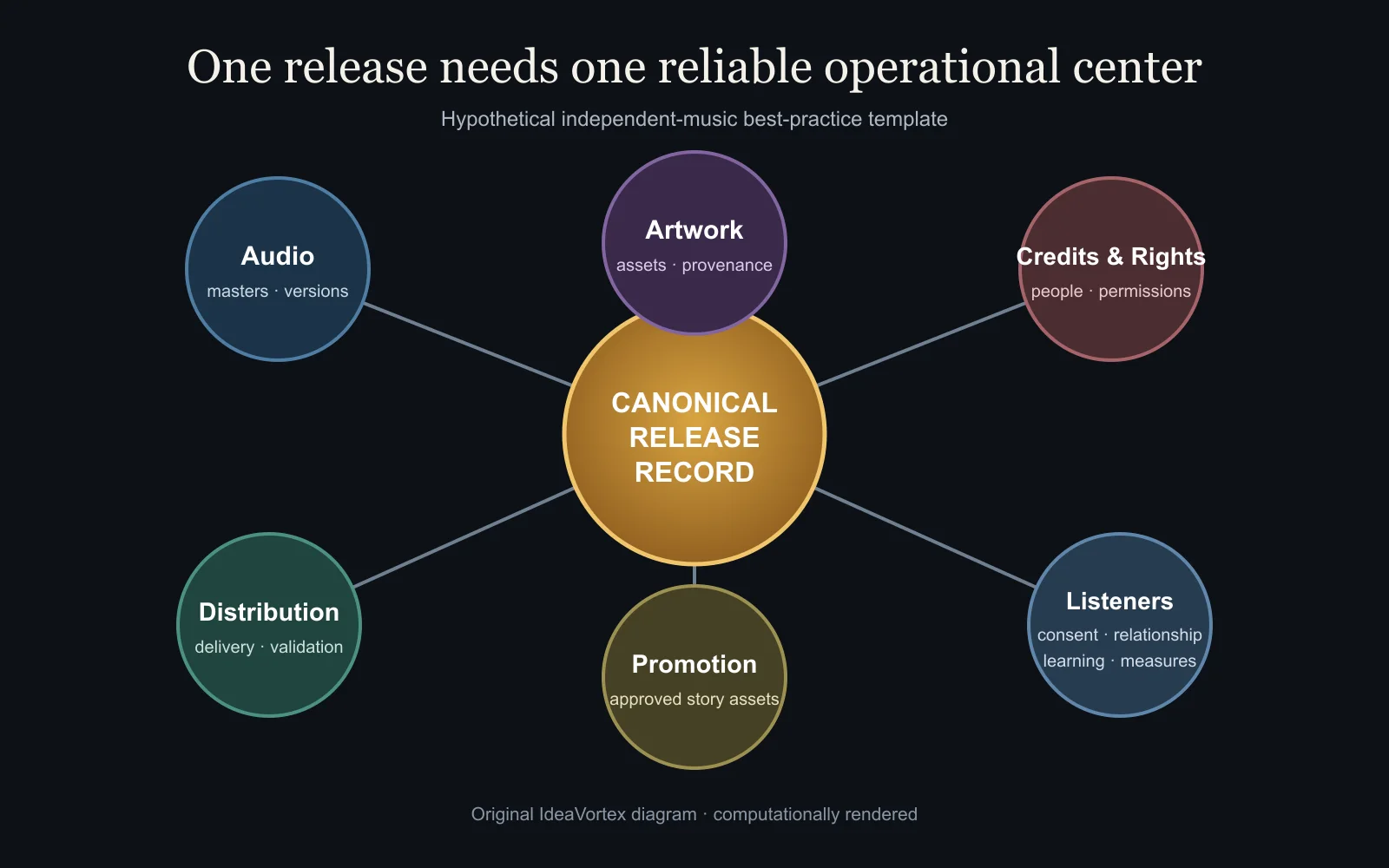
The transformed catalog needs one authoritative record for each composition and each related visual work.
For a song, the record could include:
- proper title;
- stable catalog identifier;
- language;
- composition and lyric versions;
- relationships to translations and alternate arrangements;
- contributor credits;
- rights status;
- recording and release status;
- approved lyrics or excerpts;
- listening links;
- notes and source files; and
- related visual works.
For an artwork, it could include:
- title and stable identifier;
- related song and version;
- artist and contributors;
- date, medium, dimensions, and materials;
- whether it is physical handmade, digitally handmade, hybrid, or computationally or system-rendered;
- master and reference files;
- object or edition status;
- signature and certificate information;
- publication and exhibition history;
- availability;
- care instructions; and
- provenance.
The public page does not need to show every internal field. The internal record should still be complete.
Preserve the Truth About the Medium
A music-and-art catalog should not flatten all creative work into the word “digital.”
Physical handmade art, digitally handmade art, and computationally or system-rendered art describe different relationships among the artist, tools, materials, and finished object.
A physical work may carry texture, gesture, surface, and evidence of direct material contact. A digitally handmade work may be composed and revised directly by the artist through digital tools. A computationally rendered work may use rules, systems, repeated processes, or controlled variation that the artist designs and directs.
Hybrid work may move among these forms.
Collectors should be told what the work is, how it was made, and what object or edition they are acquiring. Accurate language creates more lasting value than fashionable language.
Organize the Catalog Into Song Cycles
A catalog containing many songs can overwhelm a visitor. A collector may find it difficult to understand why the works belong together.
Small song cycles provide a better structure.
A cycle could contain three to seven songs and related artworks joined by a human concern. Possible cycles within my catalog include:
- Fragile Light: caregiving, mortality, endurance, and hope;
- Marks We Leave: memory, scars, drawing, writing, and human trace;
- Miles and Journeys: movement, ambition, migration, and inner arrival;
- Love Across Time: partnership, distance, memory, and return;
- Faith and the Unseen: belief, doubt, grace, and quiet attention;
- Family Forms: parenthood, partnership, and intergenerational identity;
- Small Courage: overlooked effort, perseverance, and dignity; and
- Nature Remembers: fog, wind, stars, birds, leaves, sea, and landscape as carriers of memory.
A cycle is not merely a marketing category. It gives the artist a field in which the works can respond to one another.
Define the Collector Object Before Offering It
The digital image shown on a website is not a complete description of what a collector acquires.
The catalog should identify whether the work is:
- a unique physical artwork;
- a unique digitally handmade master with one physical realization;
- a limited archival-pigment edition;
- an open edition;
- an artist proof;
- a study;
- or a computationally or system-rendered variation from a declared system.
Edition size, substrate, dimensions, signature method, proofs, and the possibility of related future versions should be clear before a work is sold.
Ownership of an artwork also does not automatically transfer copyright, music rights, reproduction rights, or synchronization rights. Those relationships should be stated plainly.
Provenance Is Part of the Transformation
Provenance should not be assembled only after a collector asks for it.
The operating process should record the work from the beginning:
- creative identity and stable identifier;
- source and master files;
- creation date and material notes;
- relationship to the song;
- edition and object details;
- artist and contributor credits;
- high-quality reference image;
- certificate information;
- publication and exhibition history;
- condition and care guidance; and
- ownership history when appropriate.
Private collector information should remain private. The catalog still needs a reliable record showing that the work exists, what it is, and how it moved.
A Repeatable Song-to-Art Workflow
The proposed workflow is:
- select a song because it supports a convincing visual interpretation;
- name its human center and central emotional tension;
- define a restrained visual grammar;
- select a medium because it contributes meaning;
- create a short visual score;
- make and review the work;
- decide whether it is strong enough to enter the catalog;
- define the object or edition;
- complete provenance, rights, photography, and care information;
- publish the song, artwork, context, and availability as one connected catalog entry; and
- preserve the authoritative record outside any single publishing or sales platform.
Not every song needs artwork. Not every artwork needs a series. One resolved work is better than several weak variations created to fill a template.
Love in the Cloud as the First Pilot
Love in the Cloud became a nine-work visual interpretation organized around sections of the song. That project proved that a song could support more than a cover image.
It should be treated as a pilot, not a rule.
The next song may need one major physical work. Another may support a three-piece sequence. A multilingual pair may lead to related but different visual works. A computational system may be appropriate when a song concerns networks, repetition, emergence, or change.
The process should remain consistent while the artistic result remains free.
What Collectors Gain
A well-designed music-and-art catalog gives collectors several ways to enter the work:
- through the visual work itself;
- through a song or human story;
- through a coherent song cycle;
- through the medium and making process;
- through the artist’s developing catalog;
- or through an interest in a particular theme such as memory, faith, family, endurance, or belonging.
The collector can understand how a work stands alone and how it belongs to something larger.
Possible collector materials include a concise artist note, listening page, visual-score excerpt, authentic process material, care guidance, and notice of future works in the same cycle.
The aim is not to add more sales language. It is to give the work enough context to be understood and enough space to remain open to interpretation.
Key Questions and Example Answers
Are we illustrating lyrics?
Example answer: No. We identify a human tension carried by the song and create an independent abstract work in response to it.
What makes this a digital transformation?
Example answer: The transformation is the move from disconnected song and art files to a governed catalog and repeatable operating process connecting identity, versions, media, rights, provenance, publication, commerce, and collector relationships.
Must every song receive artwork?
Example answer: No. A song should enter the visual catalog only when it can support a convincing independent work.
Must every song become a visual series?
Example answer: No. The nine-part Love in the Cloud project is one model, not a production quota. The artistic need determines whether a song receives one work, a small sequence, or a larger series.
What should technology decide?
Example answer: Technology may help maintain records, connect related assets, validate required information, publish consistent entries, and preserve provenance. It should not decide which human experience matters or whether an artwork is finished.
What does a collector acquire?
Example answer: A precisely described object or edition, its provenance and certificate, and its documented relationship to a song. Other rights transfer only when they are stated explicitly.
How should success be measured?
Example answer: Begin with catalog integrity, completed provenance, resolved rights, strong finished works, meaningful catalog exploration, qualified inquiries, acquisitions, and continuing collector relationships. Clicks should not determine what art gets made.
The Actual Transformation
The transformation does not turn the human spirit into data.
It creates a disciplined way to recognize human experience in a song, answer it through visual art, describe the resulting work truthfully, preserve its history, and make its place in a larger catalog understandable.
The creative center remains human.
The system exists so that the work, its meaning, and its history do not become lost among files, platforms, and passing campaigns.
Disclosure
This article describes a proposed IdeaVortex operating model. Except for the existing Love in the Cloud pilot and current song-management foundations, it does not claim that the complete catalog transformation has already been implemented.
Continue the Transformation Workflow
The catalog model becomes more practical when paired with a creative decision record for each song and the independent music-release transformation template. Love in the Cloud is the first full music-and-art example.