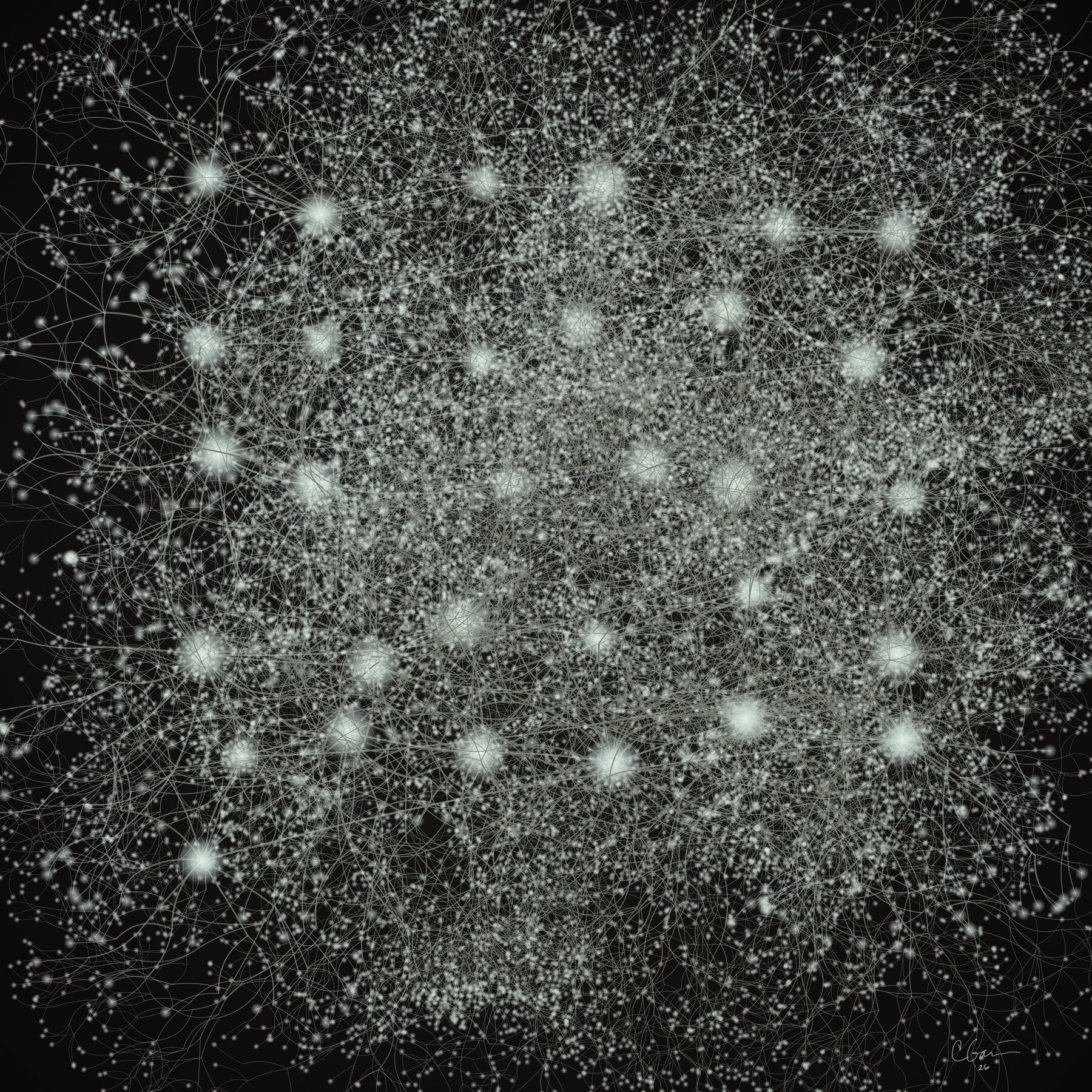
The IdeaVortex music-and-art catalog connects songs with the visual works, studies, process records, and collector information that grow from them.
Featured catalog entry
Love in the Cloud
Love in the Cloud is the first completed music-and-art pilot: one song developed into a nine-work black-and-white visual series. The works are system-rendered through the human-directed Orrery Glyph process. They are abstract responses to the song’s structure and emotional continuity, not literal illustrations of individual lines.
Explore the Love in the Cloud nine-work series, the collector guide, and the provenance and certificate guide.
Listen to Love in the Cloud on Carl Garcia’s official artist channel.
How to read a catalog entry
Each song entry will identify:
- the canonical song title, language, and version;
- the public recording or video, when one is available;
- the lyric record and human subject of the song;
- the artwork relationship: completed, study, proposed, or not yet developed;
- the medium, including handmade, digitally handmade, or computationally/system-rendered work;
- related process notes, studies, and revisions;
- provenance and edition information when the work is offered to collectors; and
- unresolved questions that remain part of the studio record.
Current development entries
A Little Leaf of Fall is an active study rather than completed catalog artwork. Its Seasonal Drift work is being revised through a vertical botanical direction and the Metamorphic Continuity surface. The Seasonal Drift studio record explains what has been accepted, rejected, and left unresolved.
Metamorphic Continuity: An unbroken process of transformation where underlying forms, materials, or philosophical states constantly shift while maintaining a persistent, connected existence. In Orrery Glyph, the artwork can change across lyric scenes without losing its identity, relationships, or memory.
The Journey of Looking essay documents how attention, omission, and revision shape a work after the first rules are established.
What this catalog is for
This is not a promise that every song will become a nine-piece series. *Love in the Cloud* is a reference implementation. Each song should receive only the visual form its own idea can support: one painting, a study, a sequence, a moving work, or no artwork yet.
The catalog will grow slowly enough to preserve the relationship among song, image, process, and record. A collector should be able to encounter the artwork without the song, hear the song without the artwork, and understand why they belong together when experienced as one body of work.
**Next catalog entry:** reconcile the canonical record and public description for *It Circles Back to Me*, then determine whether its existing abstract video is a finished artwork, a study, or a separate media work.
Catalog principles
The catalog separates what is known from what is still being developed. A public recording does not automatically mean that a finished artwork exists, and a visual experiment does not automatically become a collector edition. Each entry will say which stage it has reached.
It also preserves the difference between the physical handmade work I make with ink, paint, or other materials; digitally handmade work assembled with deliberate editing; and computationally or system-rendered work produced by a defined visual system. These are different media decisions, not a ranking.
For collectors, the record matters as much as the image. A complete entry should make the title, source song, version, medium, dimensions, edition language, availability, and provenance easy to understand. When a detail is not yet known, the catalog will leave it open rather than manufacture certainty.
For listeners, the catalog offers another way into the songs. The visual work can stand without explanation, while the lyric, recording, and process notes remain available for anyone who wants to follow the relationship more closely.
The catalog is therefore both an archive and a working studio map. Its completed entries show what has been resolved. Its studies show where decisions are still being tested. Its proposed entries show where a song may go next.
As the catalog grows, each new song will be assessed on its own terms. The goal is a coherent body of work without forcing every song into the same format.