One of the first projects I worked on after I began semi-retiring had nothing to do with artificial intelligence. It involved a magnetic whiteboard, magnets, stretchable string, architectural perspective, and a pen.
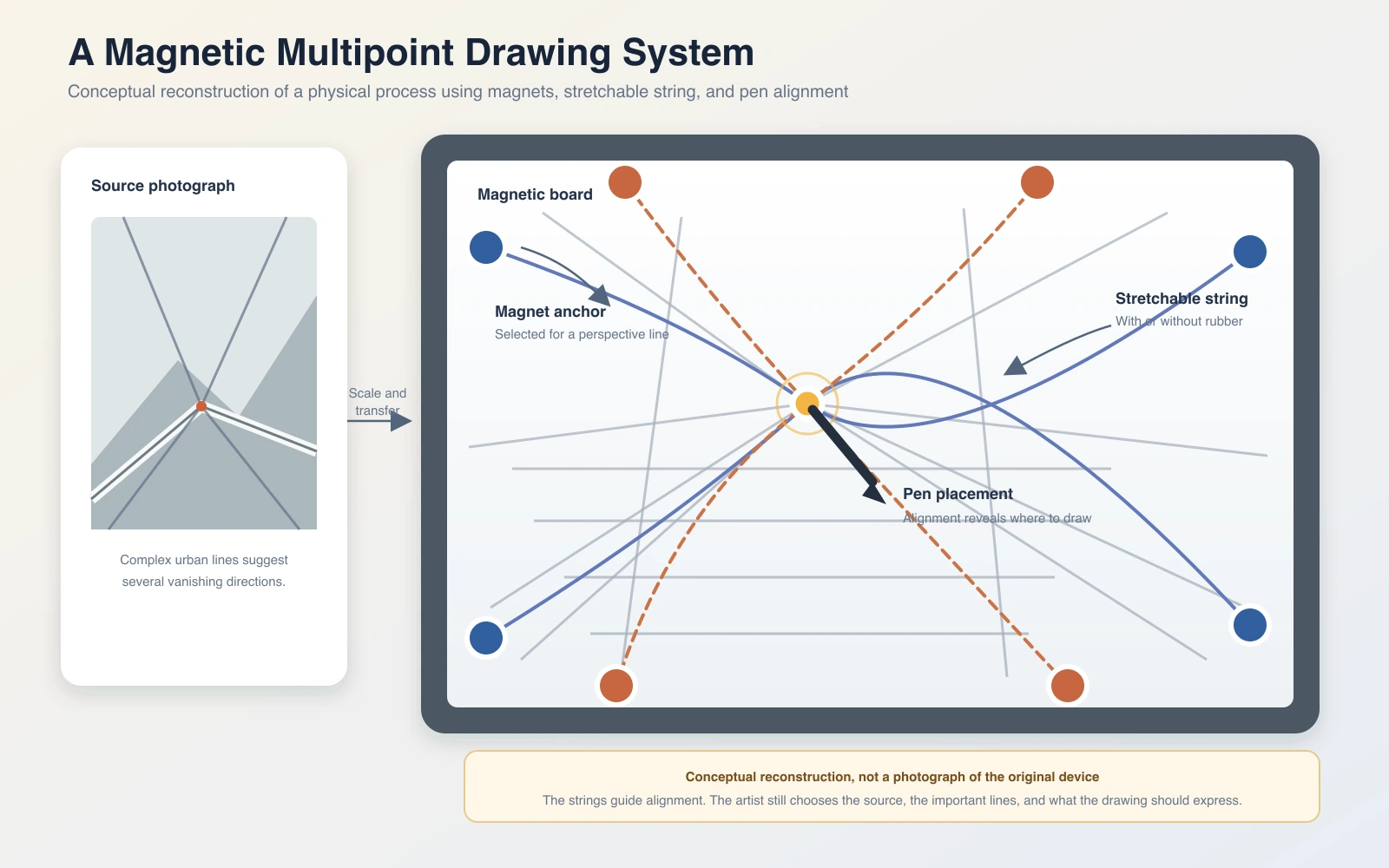
I was working with architectural design and just beginning to discover urban painting. I wanted a faster way to scale a new drawing, typically from a photograph. That can be difficult with more conventional approaches, especially when the scene contains many lines moving toward different vanishing points.
So I designed a physical device and process of my own.
Magnets, String, and Perspective
I anchored magnets at selected points on a magnetic whiteboard. From those anchors, I stretched strings across the working area. I experimented with strings that had rubber and strings that did not. The different materials gave me different kinds of tension and control.
By aligning points and watching where the strings crossed, I could determine where my pen should draw. The system helped me transfer and scale the perspective from a photograph very quickly while keeping the geometry accurate.
It was more of an exercise than a finished product, but it worked. It could handle very sophisticated multipoint perspective, not only the familiar one-, two-, or three-point constructions.
The Artist and the Architect Were Both Present
My interest in this system came from two sides of my life. I had studied architecture for two years, so I was accustomed to thinking carefully about space, construction, and perspective. But I was also returning more fully to the artist I had been before becoming a software developer.
I wanted to draw. I also wanted to understand the structure behind what I was drawing. Even as a software engineer, I was the one working with UML and structure. In a way, I was still drawing.
Later, I learned that many artists do not concern themselves very much with perspective beyond three points, if they construct formal vanishing points at all. Many work more intuitively, and that is not a failure. An artist does not need to behave like an architect to make convincing art.
My experiment simply reflected the way my own mind works. When I encounter a difficult creative process, I often want to see whether I can make the underlying structure more visible and controllable. In a sense, I was trying to introduce order into chaos, something very familiar from my work designing, architecting, and developing software.
I Was Not Trying to Remove the Artist
The magnetic drawing system did not draw for me. It did not decide what photograph to use, what part of the scene mattered, what lines to emphasize, or what kind of image I wanted to make. It helped me place my pen accurately.
That distinction has become even more important now that creative tools can produce complete-looking results with very little human involvement.
I am not interested in tools because they offer the easiest path. I am interested in tools that make a creative process more capable, accurate, expressive, or responsive to human intention.
I do not build tools to remove myself from the creative process. I build them to improve what I can do inside it.
That was true with magnets and string. It remains true in the work I do today.
A Pattern I Can See More Clearly Now
At the time, I saw the device mainly as an experiment. Looking back, I can see a larger pattern.
I often move between art, architecture, and software thinking. I encounter a creative limitation, study the structure of the problem, and design a system that gives me more intentional control. The result may be physical, digital, or computationally rendered, but the purpose is similar.
That pattern appears in my current projects too. Orrery Glyph translates information from a song into themed visual art while protecting the creative system behind it. Love in the Cloud combines a personal song, my visual imagination, and a system I designed to create a black-and-white art series.
The technologies are different, but the instinct is familiar: do not settle for the first available process when a more expressive one can be designed.
Creative Tools Should Preserve Creative Responsibility
The magnetic system also reminds me that a tool can increase precision without taking responsibility away from the artist.
The strings could guide alignment. They could not decide whether a line belonged in the drawing. The magnets could hold a geometric relationship. They could not determine what the finished image should express.
I still had to look, choose, draw, adjust, and sometimes start again.
That is the kind of relationship I want with newer tools as well. Assistance is valuable. Greater capability is exciting. But I want the creative intent and responsibility to remain human.
Long before today’s arguments about AI, a magnetic whiteboard taught me that lesson with magnets, stretchable string, and the point of my pen.