
An independent music release can look simple from the outside. Finish the song, upload it, announce it, and wait for people to listen.
Behind the release is a small information system.
There may be multiple audio masters, cover-art versions, contributor credits, ownership splits, identifiers, lyrics, distributor fields, release dates, promotional assets, social posts, press information, and fan communications. Each platform may ask for a different portion of that information in a slightly different form.
When those pieces live in disconnected documents, drives, inboxes, and platform portals, the problem is not a lack of creativity.
The problem is that the release has no reliable operational center.
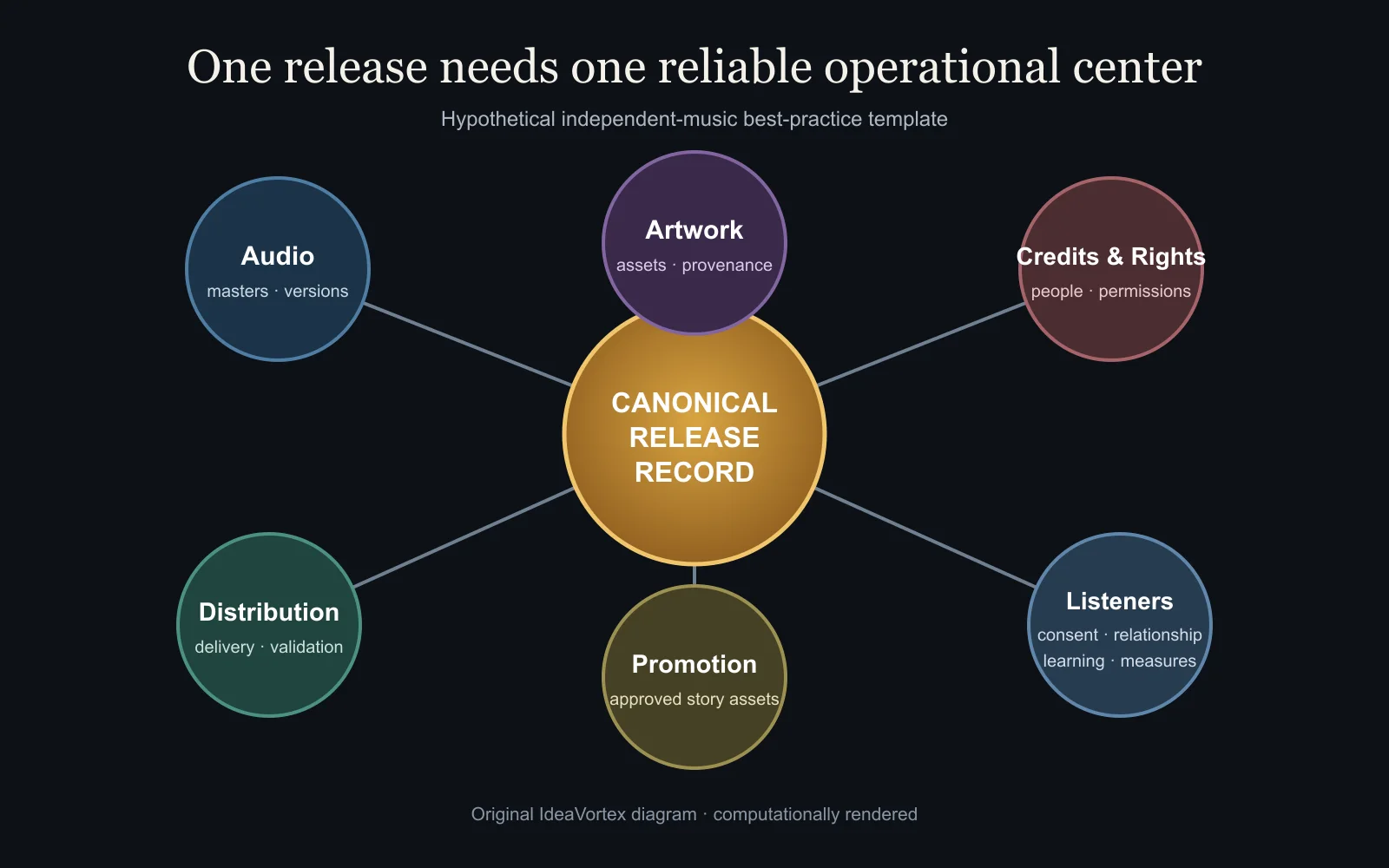
This article presents a hypothetical digital transformation template for an independent artist or small music team. It is derived from established best-practice principles, but it does not disclose any underlying proprietary methodology, templates, calculations, or sources. The example was not implemented, and it reports no observed results.
Begin With the Business Need
The business need is not “use AI in music” or “automate the release.”
A more useful statement is:
Create a repeatable release process that reduces preventable errors, protects creative and ownership information, supports timely distribution, and helps the artist build a direct, consent-based relationship with listeners.
That statement creates a test for every proposed technology.
If a tool does not improve accuracy, coordination, ownership, timing, learning, or the artist-listener relationship, it may not belong in the first phase.
Define a Canonical Release Record
The proposed foundation is one authoritative release record.
It would not replace every platform. It would hold the information that the other systems need:
- release title and version
- artist and contributor names
- songwriting, performance, production, and artwork credits
- ownership and royalty-split information
- track and release identifiers when assigned
- approved lyrics and descriptive copy
- explicit-content and language information
- release dates, territories, and distribution status
- links to approved audio, artwork, video, and promotional files
- approval status and responsible person
- and a record of material changes.
The canonical record should distinguish a missing value from an unapproved value. “We do not know yet” is different from “someone entered a guess.”
This is an important control when a release involves several collaborators.
Treat Media as Governed Assets
The audio master, cover art, promotional images, videos, and supporting documents should be treated as governed assets rather than loose attachments.
Each approved asset would have:
- a stable descriptive filename
- a version or revision identifier
- an owner or responsible person
- an approval status
- the intended channels and formats
- accessibility information where appropriate
- and provenance describing how it was made.
That provenance should preserve meaningful creative distinctions. Physical handmade art, digitally handmade art, and computationally or system-rendered art are not interchangeable descriptions.
The same principle applies to music. A human-written and performed work should not be described as machine-generated merely because software supported part of the production or distribution workflow.
Resolve Rights Before Distribution
Distribution is not the moment to discover that contributor names, ownership shares, or permissions are unresolved.
The proposed workflow would include a rights-and-credits checkpoint before a release can move into final delivery. It would confirm:
- who wrote, performed, produced, mixed, and mastered the work
- who created or licensed the visual assets
- whether ownership splits have been reviewed
- whether samples or third-party materials require permission
- whether names and roles are represented consistently
- and which questions remain unresolved.
Automation can check whether required fields are present. It should not invent a split, infer permission, or make a legal judgment.
Human approval remains the control.
Automate Handoffs, Not Creative Decisions
Once the canonical record and approval rules are reliable, selected workflow steps could be automated.
Examples include:
- creating a release checklist from the approved release date
- notifying a contributor when a required field is missing
- generating channel-specific task lists
- checking image dimensions and audio-file requirements
- copying approved descriptive information into promotional drafts
- recording delivery confirmation from a distributor
- and creating a post-release measurement schedule.
The system should not decide which master sounds best, which artwork represents the song, or how the artist should speak to listeners.
Those are creative and relational decisions.
Integrate Carefully With Distribution Platforms
APIs or structured exports could reduce repetitive entry when a distributor, store, website, mailing platform, or analytics service supports them.
But integration should follow data discipline.
If the source record is incomplete, automation can distribute the error faster. If platform fields use different definitions, a direct field-to-field copy can create misleading metadata. If a service changes its interface, the workflow may fail without warning.
Each integration would therefore need:
- a documented mapping from the canonical record
- validation before transmission
- a record of what was sent and when
- failure alerts and a manual fallback
- and periodic review of platform requirements.
The goal is not to make the artist dependent on more platforms. It is to make the release process understandable even when platforms change.
Build a Direct, Consent-Based Listener Relationship
Streaming and social platforms provide reach, but they mediate the relationship between artist and listener.
A small music business could also develop an owned, permission-based channel such as an email list or membership community. The release workflow could offer listeners a clear reason to join:
- release notes
- early access
- artwork or process material
- event announcements
- downloadable resources
- or a continuing story around the work.
Consent should be explicit. The artist should explain what the listener will receive, how often, and how to leave.
The purpose is not to collect the largest possible quantity of personal data. It is to create a respectful channel that remains useful when platform algorithms change.
Test the Template With One Release
The realistic first step is a pilot involving one song or one small release.
The pilot would test questions such as:
- Can every approved asset be found from the canonical record?
- Are credits and ownership questions visible before delivery?
- Can a collaborator understand what is waiting for them?
- Does the process preserve a reliable revision history?
- Do automated checks catch errors without blocking legitimate exceptions?
- Can the team recover when an integration fails?
- Does the listener invitation produce meaningful, consent-based engagement?
The pilot should include a short review after release. The team would record what caused confusion, what required manual correction, which controls were useful, and which steps added work without adding value.
Measure Operational Health, Not Just Streams
Stream counts matter, but they do not explain whether the release operation is becoming more reliable.
Proposed operational measures could include:
- percentage of required metadata approved by the internal deadline
- number of post-delivery metadata corrections
- unresolved credit or ownership questions at delivery time
- approval lead time for audio and artwork
- percentage of planned assets delivered on schedule
- failed or manually corrected integrations
- time spent locating the current approved asset
- direct listener opt-ins with valid consent
- and completion of the post-release review.
These are proposed measures, not reported results. Their purpose is to help the team learn where the process is fragile.
Risks the Template Must Not Hide
A music-release system can become harmful when it creates an illusion of certainty.
Important risks include:
- incorrect credits or ownership information
- exposure of private contributor or fan data
- platform dependency and vendor lock-in
- inconsistent definitions across services
- automation running before approval
- loss of original creative files or provenance
- unclear labeling of computationally rendered media
- and a process so heavy that it slows the artist rather than supporting the
work.
The controls should be proportional to the release. A single independent artist does not need the bureaucracy of a major label. The artist does need enough structure to protect the work and avoid repeating preventable mistakes.
Key Questions and Example Answers
These questions give an artist or small music team a practical place to start. They reflect the discipline of established transformation practice without revealing any proprietary methodology.
What business outcome are we trying to improve?
Example answer: We want a repeatable release process that reduces preventable metadata, asset, credit, and delivery errors while protecting the artist’s creative control.
What is the smallest useful scope?
Example answer: Pilot the process with one song, its cover art, required credits, one distributor, a small promotional plan, and one direct listener-signup opportunity.
What information must have one authoritative source?
Example answer: The approved title, artist and contributor names, credits, ownership status, release date, identifiers, lyrics, asset links, approval status, and distribution status should come from one canonical release record.
Which decisions must remain human?
Example answer: People must approve the master, artwork, credits, ownership information, permissions, release timing, public story, and any exceptional case. Automation may validate and route information, but it may not invent or approve it.
What evidence would justify automation?
Example answer: A step is a good automation candidate when it is repeated, rule-based, based on approved information, and costly enough in time or errors to justify maintaining the automation.
What should we deliberately postpone?
Example answer: Postpone integrations, predictive features, and complex fan segmentation until the canonical record, approvals, consent, and basic release workflow are reliable.
How would we test the proposal safely?
Example answer: Run a one-release pilot with manual fallbacks. Record missing information, corrections, failed handoffs, approval delays, and exceptions without putting the release at unnecessary risk.
How would we know the process is improving?
Example answer: Compare metadata completeness, post-delivery corrections, unresolved rights questions, approval lead time, on-time asset delivery, time spent locating files, and valid listener opt-ins. These would be proposed measures, not assumed benefits.
What is the most important risk?
Example answer: The greatest risk is allowing an incomplete or incorrect record to appear authoritative and then using automation to distribute it widely.
Who owns the process after the pilot?
Example answer: One named person should own the canonical release record and workflow, while creative, rights, distribution, and communication decisions remain with the appropriate people.
A Reusable Best-Practice Pattern
The public-facing pattern can be summarized without disclosing any proprietary method:
- Define the business need and the creative boundaries.
- Establish one authoritative release record.
- Govern audio, artwork, credits, rights, and approvals.
- Automate reliable handoffs and validation checks.
- Integrate with platforms through documented mappings and fallbacks.
- Build a direct listener relationship based on clear consent.
- Pilot the process with one release.
- Measure operational health and revise the workflow.
This is digital transformation at the scale of an independent music business.
It does not require turning the artist into a technology company. It requires making the operational system reliable enough that technology supports the music instead of distracting from it.
Continue the Release Transformation
Connect release operations to the work itself with the creative decision record, the music-and-art catalog transformation, and the MelodyCurve songwriting workflow.