How do I decide which visual language fits a song? I am still answering that question for A Little Leaf of Fall.
That sentence matters because it sets the order of the work. The song came first. The visual idea must answer it. A convenient tool, an available theme, or a technically successful rendering does not get to make that decision for me.
One candidate is Seasonal Drift, a visual approach built around falling leaves, changing seasons, patient movement, and the approach and retreat of a hummingbird. On paper, it fits the song remarkably well.
It is not yet a finished artwork.
This is a record of how I reached that point and what still has to be decided.
The Horse Before the Carriage
The human experience is the horse. The medium and tools are the carriage.
I begin by asking what the song is carrying. Only then do I ask whether the answer should be physically handmade, digitally handmade, computationally or system-rendered, animated, or some combination of those methods.
The order protects the work from a common temptation: making something because the means of making it are close at hand.
Convenience is useful. It can remove repetitive labor, preserve versions, test an idea, or make a difficult presentation possible. But convenience does not establish beauty. It does not resolve a composition. It does not decide whether an image deserves to remain.
A slow physical process is not automatically more sincere. A fast computational process is not automatically more suitable. Each method has to earn its place through what it contributes to the artwork.
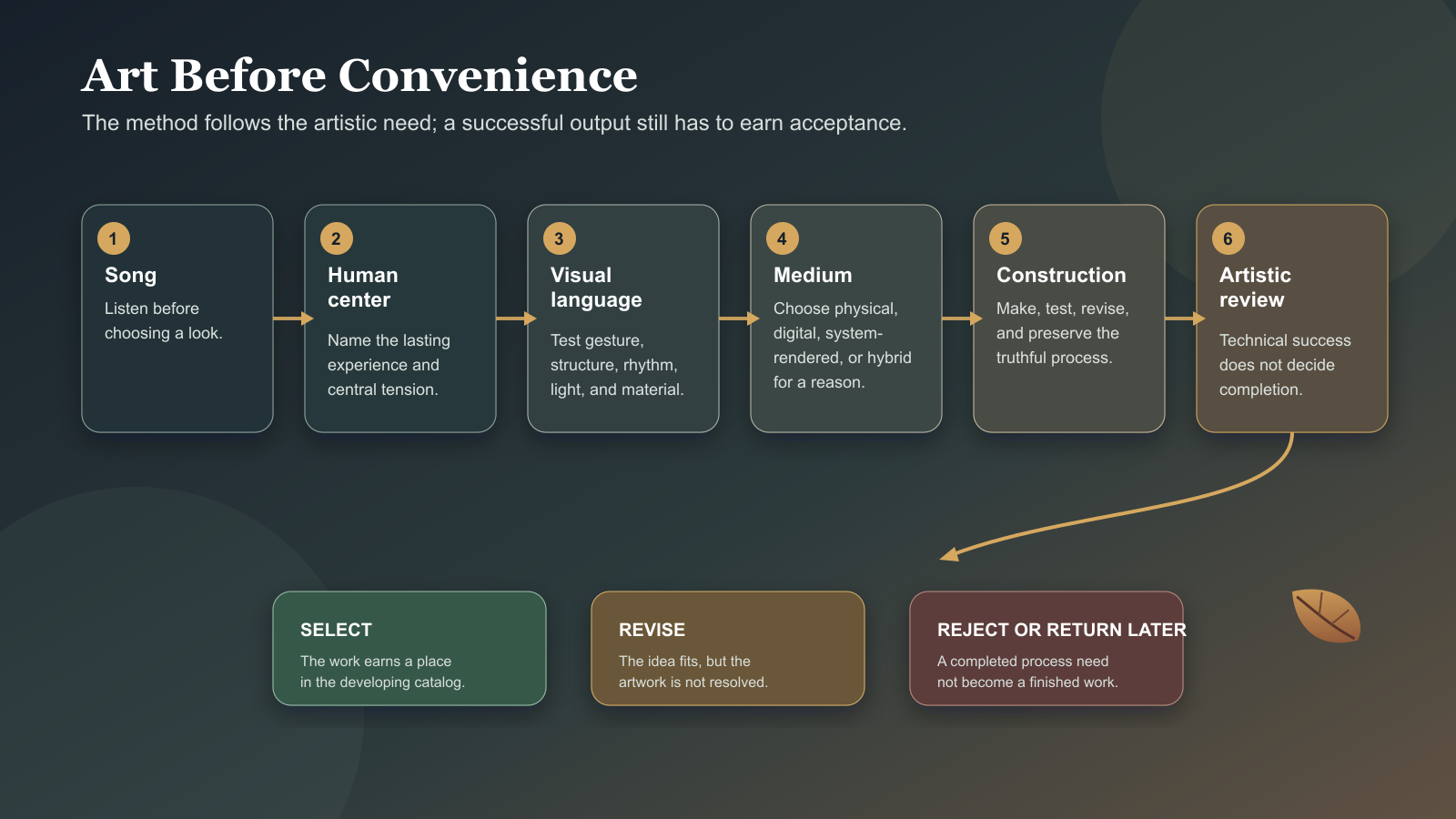
The method comes after the artistic need. Technical completion is followed by artistic review, not automatic acceptance.
What the Song Is Carrying
A Little Leaf of Fall is built from small gestures that become lasting memories.
Its images include seasons, a leaf by the front door, a hummingbird drawing near and measuring the distance, rain, light, and patient affection. Those images are concrete, but the human center is not botany.
For me, the song holds the tenderness of approaching another person carefully. It remembers the small things people do when larger gestures would be too much or arrive too late. Its central tension is closeness and distance.
That distinction matters. If I begin with the noun “leaf,” I may produce a competent autumn picture. If I begin with affection that approaches, pauses, and remains, I have a better chance of finding the work.
Why Seasonal Drift Became a Candidate
Seasonal Drift was not selected simply because the title mentions fall. Several parts of its visual grammar correspond to the song:
- A downward path can give the leaf a sense of time rather than using it as a decorative object.
- Seasonal changes can carry memory across fall, spring, summer, and winter.
- A hummingbird can embody approach and retreat.
- Pauses in the music can become suspension rather than empty space.
- Changes in musical phrasing can affect fall paths, wing movement, density, and pace.
- A restrained botanical palette can hold tenderness without becoming sentimental.
The candidate also offers several possible forms. It could become one botanical plate, a small seasonal sequence, or a short loop in which the movement remains quiet enough to watch.
An early theme assessment gave Seasonal Drift a very strong conceptual match for the song. That result was useful. It brought a promising direction to my attention.
It did not finish the artwork.
The Difficult Balance of Abstraction
This study also exposed a problem I did not want to avoid: abstraction does not require recognizable objects.
Orrery Glyph began as an alien communication language built from a small, basic abstract vocabulary. With a pure-text source, it can express forces, relationships, distance, direction, repetition, and change without turning every noun into a picture.
A song makes that discipline harder. Lyrics may name leaves, seasons, rain, flowers, or a hummingbird, but those objects are not necessarily the meaning of the song. If I render them too directly, the result can become an illustration of the words. If I remove them completely, I may lose the particular memories and gestures that give the song its identity.
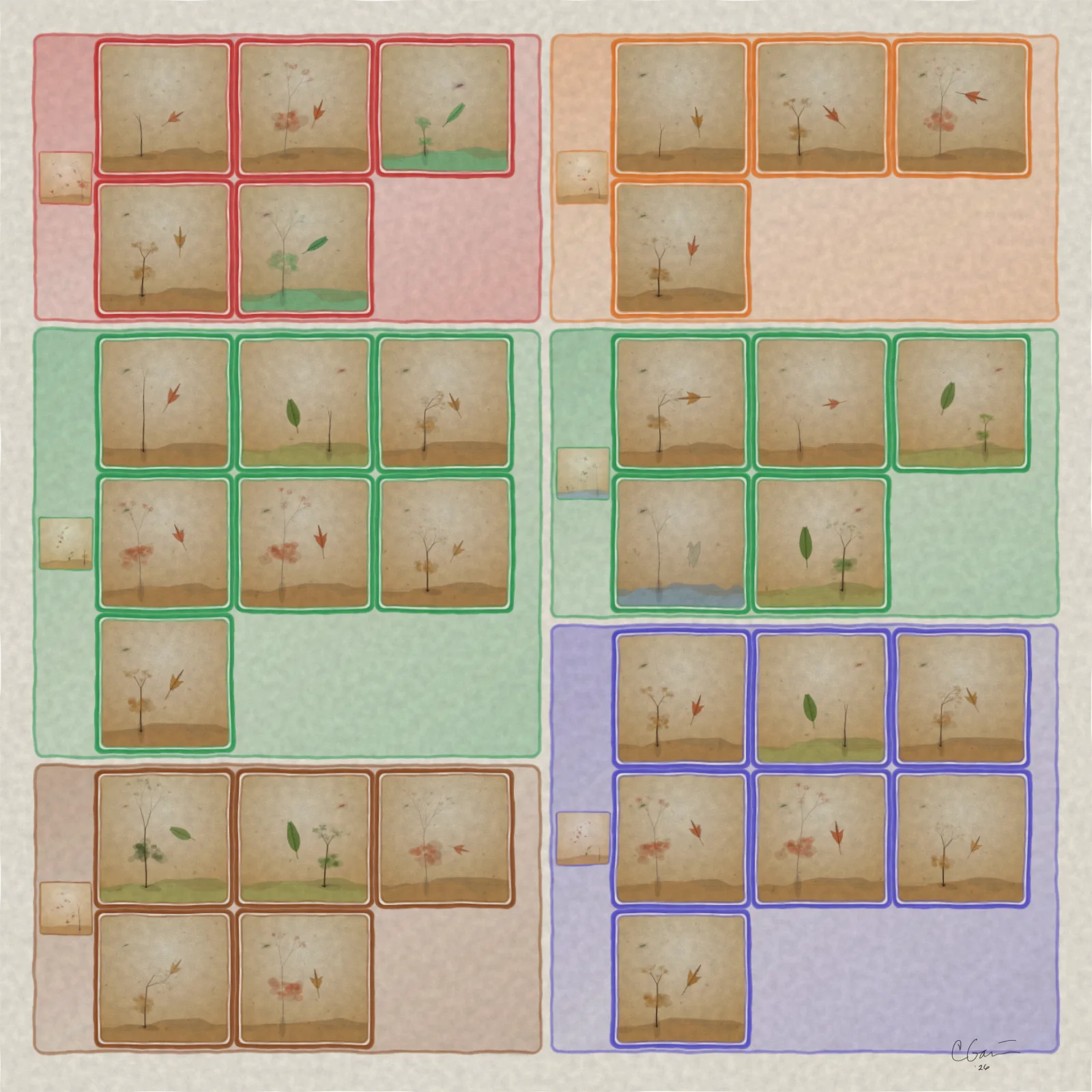
The more specific tension in this study came from adapting the Seasonal Drift theme to the song at several scales. A by-line view may respond convincingly to one phrase. A by-section view may give a verse, chorus, or bridge its own coherent character. Neither result guarantees that the WHOLE view of the song will be artistically strong.
That WHOLE view matters because it has to hold together as one work, at least according to the artistic criteria I set for it. The line and section studies can supply useful evidence, but they cannot make the final decision by accumulation. Their objects, movement, spacing, color, pressure, repetition, and absences must resolve into a composition with its own visual necessity.
That is the balancing act in Seasonal Drift: preserving meaningful responses to the song’s smaller parts while refusing to let the complete work become a gallery of individually successful fragments. The purpose is not to prove that the system can draw a leaf or a bird. It is to discover whether the adapted theme can hold the entire song without merely describing it.
These details also make the human work visible. I am not submitting a non-deterministic prompt and accepting whichever image appears. I define the theme and its vocabulary, decide how the song changes it, compare the by-line, by-section, and WHOLE views, establish the artistic standard, and revise or reject the result. Deterministic rendering makes those decisions repeatable; it does not make them for me.
A New Surface: Metamorphic Continuity
The first gallery also forced a structural decision. Seasonal Drift could respond to individual lyric lines, but a sequence of good individual responses did not necessarily tell a story across the song.
The idea for another approach came from two paintings by my daughter. She is not a professional artist, but the paintings made a memorable narrative move. In the first, a female silhouette blows toward a flower with visible pollen. Small people begin to descend in parachutes. In the next painting, those figures continue their journey and become easier to see. Neither painting merely repeats the other. An element crosses the boundary between them, changes in clarity, and allows the pair to tell one story.
I did not copy her imagery. I adapted the underlying decision: an object or actor can persist from one visual field into the next.
That required a new Orrery Glyph Surface, which I named Metamorphic Continuity. Here, a Surface is not simply a texture or simulated art material. It is a visual behavior layered onto the parent theme. Metamorphic Continuity inherits Seasonal Drift’s botanical forms, atmosphere, and composition rules, then adds its own continuity rules.
Metamorphic Continuity: An unbroken process of transformation where underlying forms, materials, or philosophical states constantly shift while maintaining a persistent, connected existence. In Orrery Glyph, the artwork can change across lyric scenes without losing its identity, relationships, or memory.
For this surface, Orrery Glyph deterministically derives a target and subtarget from the lyric structure. The target can remain present across related line or section works. Subtargets can enter, recede, transform, or continue into the next field. The purpose is to make the narrative more granular than a sequence that follows abstract semantics alone.
The art is being written and rendered algorithmically overall. I define and program the deterministic visual system, inspect what it produces, and decide what to retain, revise, or reject. Implementing Metamorphic Continuity was one part of that larger programming and studio practice.
The interface view shown here records the named surface and several resulting line works. It does not disclose the algorithm that derives or carries the targets and subtargets. That implementation is proprietary. The useful public studio record is the observable rule, the reason I needed it, and the visual evidence I used to judge its results.
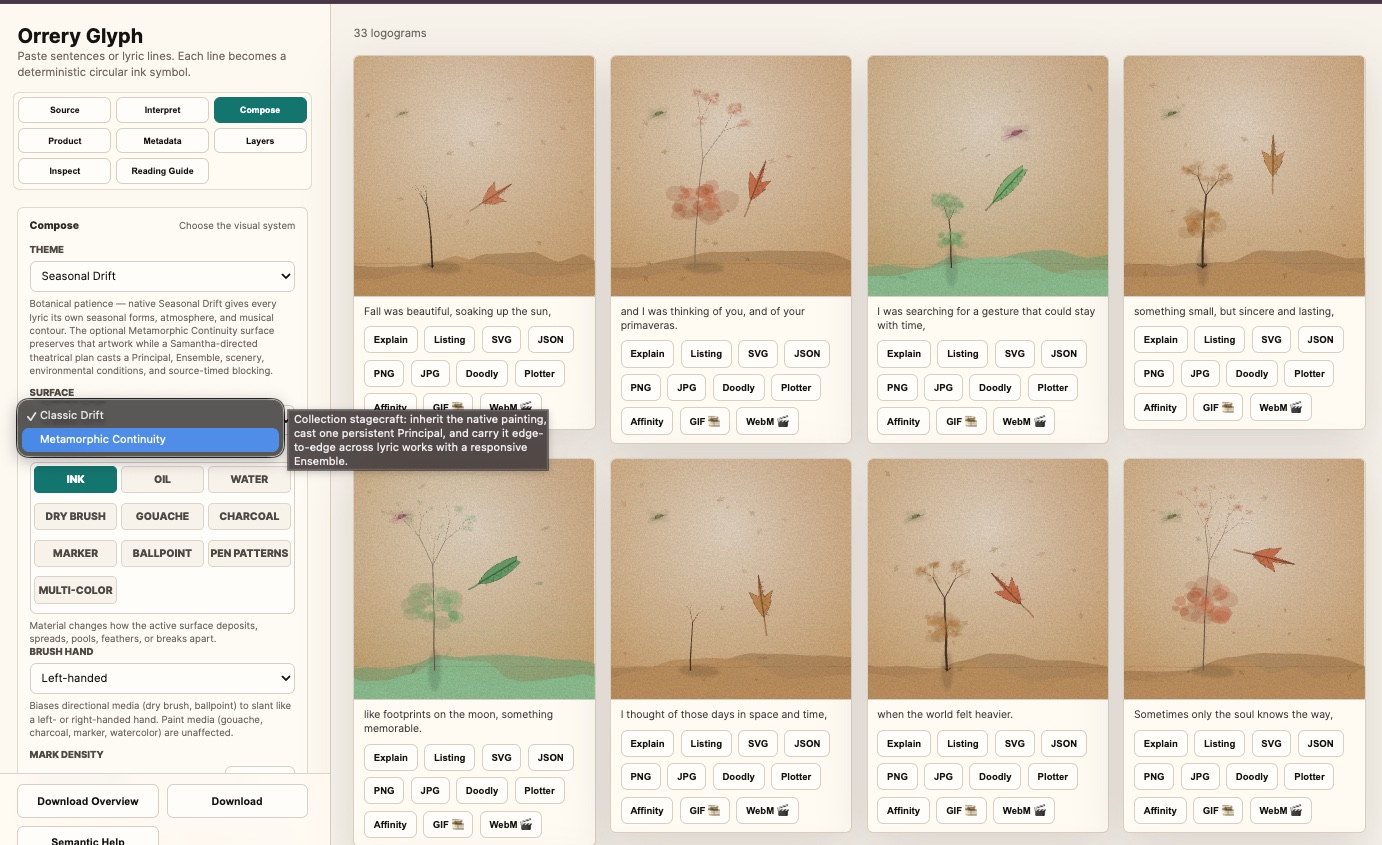
This does not ask the software to invent the story. I still decide whether the selected target deserves to persist, whether the subtargets strengthen the song, and whether their movement produces one artwork rather than a row of connected illustrations. The deterministic selection makes the decision inspectable and repeatable. The artistic judgment remains mine.
Which Subject Leads?
For A Little Leaf of Fall, the two recognizable subjects are the leaf and the hummingbird. I needed a deterministic way to establish which should lead, so I used recurrence in the lyric. The leaf appears most often and became the primary subject. The hummingbird became the secondary subject.
That choice improved the storytelling. The parent Seasonal Drift theme could preserve the abstract semantic relationships, while Metamorphic Continuity added a more explicit subject hierarchy.
The approach is not yet a universal rule. The next song will have different subjects. If the subject logic changes, I will also need to preserve the rule version so this song continues to produce the same deterministic result. I do not yet know what the more general design should be. That is an honest open question for the next study.
I am satisfied with what Orrery Glyph can generate now. Here, generative means a programmed system producing repeatable visual results from its rules and source. It does not mean an AI service produced a finished image from a prompt. I discuss that distinction further in Rethinking AI Music.
This is also an example of why I keep a creative decision record for a song: the result alone cannot explain why this new visual behavior exists.
The companion article When the Parts Work but the Whole Does Not follows this real workflow from lyric-line studies through section studies to the separate judgment of the complete artwork.
Where the Current Direction Falls Short
The present Seasonal Drift work needs more botanical depth. The leaves need more convincing structure, veins, translucency, decay, variation, and overlapping shadow. The surface needs enough texture to hold attention as a print rather than functioning only as an animation frame.
The hummingbird presents another problem. It can be a precise image of tenderness on pause, but it can also become a cute mascot. If it explains the song too quickly, it weakens the abstraction. It may need to remain small, partial, distant, or absent.
Composition is still open. A downward spiral may preserve reading order, but a systematic path can become predictable. Four seasons can create structure, but they can also divide the work too neatly. A beautiful palette can still become conventional if every emotional state receives an expected seasonal color.
These are not software defects. They are artistic questions expressed through the construction of the work.
Conceptual Fit Is Not Artistic Readiness
This is the most useful lesson from the experiment so far:
A visual language can fit a song intellectually and still fail as art.
The concept may be clear. The musical timing may work. The renderer may produce a valid file. The animation may play without error. None of those facts proves that the image is resolved.
Technical completion answers, “Did the process run?”
Artistic review asks different questions:
- Does the work carry the song’s tension without explaining the lyrics?
- Is the image too literal?
- Is it decorative where the song is emotionally difficult?
- Does the visual rhythm reward sustained attention?
- Does the chosen medium contribute meaning?
- Can the work stand without the song playing beside it?
- Does hearing the song deepen the image rather than rescue it?
- Is it strong enough to enter the catalog?
Until those answers are convincing, Seasonal Drift remains a candidate and a study.
Why Bioluminescence Moved Forward First
The shortened Orrery Glyph film for A Little Leaf of Fall took a different path. Its Bioluminescence treatment does not illustrate a literal leaf. It presents one stable, organism-like form whose breath, filament flare, satellite movement, and particle drift respond to the music.
That interpretation moved farther from the nouns in the lyric and closer to a living presence shaped by tenderness, vulnerability, and motion. The image remained recognizable while the music changed its behavior.
For the short film, that direction became visually convincing before Seasonal Drift did.
This does not make Bioluminescence the permanent or only interpretation of the song. It means one work reached an acceptable form while another promising direction remained unresolved.
The Artist’s Technical Decisions
When a visual system is part of the studio, some technical decisions are also creative decisions.
For Seasonal Drift, those decisions include:
- whether each lyric, phrase, or song section should receive a visual form;
- how musical timing should influence fall, pause, approach, and retreat;
- how much variation a leaf can carry while remaining part of one work;
- whether seasonal palettes should follow emotional analysis or be deliberately contradicted;
- how to keep a moving work from becoming visually restless;
- how to preserve repeatability when a fixed film or edition requires it;
- how much texture and irregularity are needed to avoid a generic digital surface; and
- when a technically workable behavior should be removed because it weakens the composition.
These decisions are not the subject of the artwork, but they help make the artwork possible. They are comparable to choosing a surface, mixing a color, changing brushes, controlling drying time, or painting over a passage that works technically but not visually.
What I Am Not Promising
Writing about Seasonal Drift does not promise that it will become a finished piece.
It may improve and enter the catalog. It may become a physical study before it returns to motion. It may divide into several related works. The hummingbird may disappear. The theme may prove too literal and be set aside.
Any of those outcomes would be legitimate.
The blog can record the construction of the catalog without turning every experiment into inventory. Showing a real decision in progress is different from manufacturing a story after the outcome is known.
Expectations for the Developing Catalog
This process sets several expectations:
- Not every song will become visual art.
- Not every strong idea will survive development.
- A close thematic match does not guarantee a finished work.
- A study is not automatically a catalog piece.
- A system can propose; I must decide.
- Work may be physical, digitally handmade, hybrid, or system-rendered, depending on what the artwork requires.
- Some works will take longer because the right visual language has not yet been found.
- The catalog will grow through selection rather than automatic production.
A song enters the visual catalog only when the resulting artwork earns its place there.
Questions I Will Carry Into the Next Study
What must remain from the song?
The sense of patient affection, closeness and distance, and a small gesture that remains in memory.
What can be removed?
Any literal object that explains the lyric without strengthening the artwork, including the leaf or hummingbird if necessary.
What does Seasonal Drift offer that another visual language does not?
It can make time, season, descent, pause, and return part of the composition.
What would make it more than an autumn illustration?
A resolved structure that carries emotional tension across the whole work, with botanical detail and material presence strong enough to stand without the lyric.
When will it be finished?
Not when the rendering succeeds. It will be finished when further changes no longer strengthen the visual and emotional whole.
Construction Captured in the Making
This article is not a postmortem. Seasonal Drift is still under consideration.
That is why it belongs here.
The finished catalog will show selected works. The blog can also preserve the questions, competing directions, revisions, and rejections that formed them. Readers do not need to see every technical detail, but they should be able to see that the work was chosen rather than merely produced.
The process can propose.
The artist must decide.
Continue the journey of looking
The next studio entry, The Journey of Looking, follows how attention, omission, and revision continue after the first visual direction is chosen.